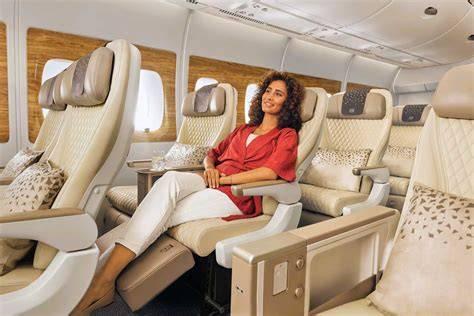
Premium economy has quietly become one of the most important cabins in long-haul aviation. For travelers who want something substantially better than economy but cannot justify the cost of business class, it offers a compelling middle ground. In 2026, airlines are investing heavily in this space, adding wider seats, greater legroom, better dining, improved entertainment, and more attentive service. Yet one carrier continues to stand out when it comes to the overall comfort of its premium economy product: Emirates.
According to the SKYTRAX World Airline Awards 2025, Emirates has the world’s most comfortable premium economy seat. That recognition is particularly notable because Emirates only introduced the cabin in 2021. In just a few years, its premium economy product has gone from a new experiment to one of the most highly regarded offerings in long-haul aviation.
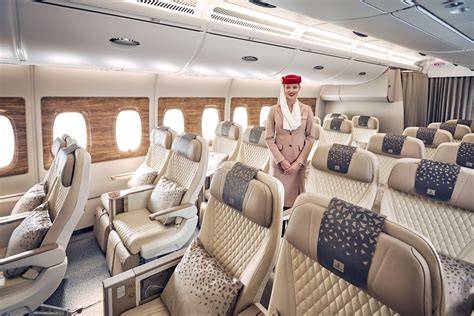
Based at Dubai International Airport, Emirates has built its reputation around premium service, ambitious aircraft, and an extensive global network. Its premium economy cabin follows the same philosophy, combining generous personal space with polished design and an onboard experience that feels considerably more sophisticated than standard economy.
Why Emirates Has the World’s Most Comfortable Premium Economy Seat
The secret behind Emirates’ success is not simply one unusually spacious seat. Instead, the airline has created an entire cabin experience around the idea that passengers should receive meaningful improvements in comfort without paying business-class prices. That distinction is important because premium economy has become increasingly competitive, and travelers now expect more than a few additional inches of legroom.
Emirates officially launched its premium economy cabin in January 2021, initially introducing the product aboard its Airbus A380. The timing was significant. While the aviation industry was still dealing with extraordinary disruption, Emirates was making a long-term investment in a cabin designed for the post-pandemic era of travel.
The seat itself immediately established a strong foundation. Emirates offers up to 40 inches of seat pitch, a width of approximately 19.5 inches, and up to eight inches of recline. Those dimensions give passengers substantially more room than the airline’s regular economy seats, particularly around the legs and shoulders.
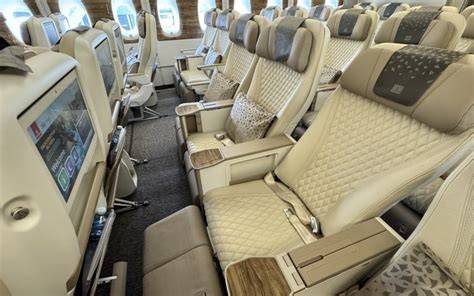
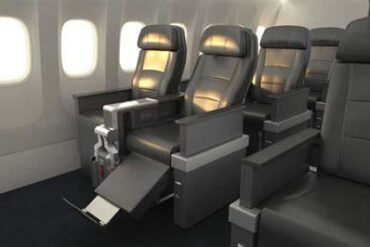
The design also pays close attention to the details that become increasingly important during a long flight. The cream-colored leather seat has an adjustable headrest, leg rest, and footrest, allowing passengers to create a more comfortable position for sleeping, reading, or watching entertainment. A six-way adjustable headrest provides additional support, while the combination of seat width and pitch creates a noticeably more open environment.
This is where Emirates’ premium economy product differs from a simple economy upgrade. The airline has attempted to create a distinctive cabin rather than merely a larger economy seat. Passengers receive more physical space, but they also experience different materials, presentation, dining, and service standards.
A Premium Economy Seat Designed for Long-Haul Comfort
Seat dimensions are among the easiest specifications to compare, but they do not tell the whole story. A seat can have generous pitch and still feel uncomfortable if its padding, recline mechanism, storage, or head support are poorly designed. Emirates’ product attempts to address several of these factors simultaneously.
The eight-inch recline is particularly useful on overnight and ultra-long-haul flights, when passengers may spend many hours in the same position. The integrated leg rest and footrest also make it easier to settle into a more relaxed posture. Rather than relying solely on seatback recline, the passenger can adjust several points of contact around the body.
The large 13.3-inch HD entertainment screen adds another important dimension. Emirates pairs the seat with its Ice inflight entertainment system, giving premium economy passengers access to a huge selection of movies, television programs, music, and other entertainment. For travelers spending eight, 10, or even more hours aboard a widebody aircraft, entertainment becomes part of the comfort equation.
Charging options are also conveniently positioned, allowing passengers to keep phones, tablets, and laptops powered during the flight. A broad dining table provides a more practical surface for meals, drinks, and personal devices, while the overall seat environment is designed to feel more refined than the conventional economy cabin.
The Experience Goes Beyond the Seat
One reason Emirates ranks so highly is that the airline does not treat premium economy as a seat-only product. The experience begins with the welcome onboard, where passengers receive a drink served in fine glassware. That small detail immediately establishes a different atmosphere from the standard economy cabin.
Dining is another major part of the proposition. Meals are served on real china with stainless steel cutlery, rather than the simplified presentation commonly associated with economy class. The food is designed around regional and seasonal influences, reflecting the international character of Emirates’ network.
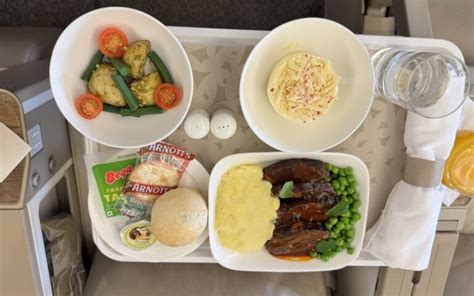
The beverage selection also contributes to the upgraded experience, with passengers offered a range that can include wines, beers, and spirits. The objective is not necessarily to reproduce business class, but to provide enough additional refinement that travelers can clearly feel the difference between the two cabins.
There is also a psychological advantage to the premium economy environment. A smaller, dedicated cabin can feel more peaceful than a large economy section, while dedicated cabin crew provide a more focused level of service. For travelers on long-haul flights, reduced noise and a greater feeling of personal space can be almost as valuable as additional seat pitch.
Japan Airlines Is a Serious Challenger
Emirates may hold the top position, but the competition is remarkably strong. Japan Airlines ranked second in the 2025 SKYTRAX assessment of the world’s most comfortable premium economy seats, and its product demonstrates why seat dimensions alone cannot determine the winner.
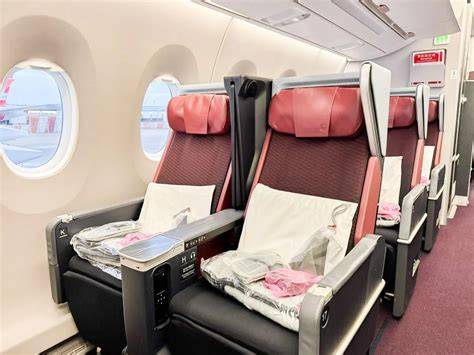
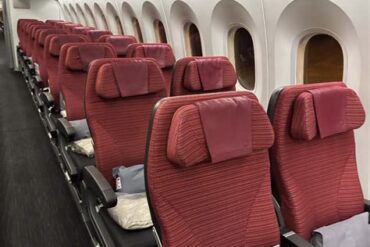
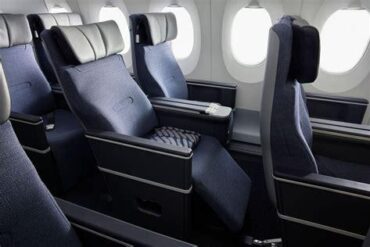
Japan Airlines offers approximately 42 inches of seat pitch, actually giving passengers more legroom than Emirates. Its premium economy seats are around 19 inches wide and provide approximately seven to eight inches of recline. The cabin can be found on many of the airline’s long-haul aircraft, including the Boeing 787 and Airbus A350.
One of the standout features is the shell-style seat design. Instead of simply reclining backward into the passenger’s personal space, the seat moves forward as it reclines. This helps preserve the usable space behind the passenger and makes reclining less intrusive.
That design illustrates the complexity of premium economy comfort. Emirates wins the overall recognition, but Japan Airlines demonstrates that a larger seat pitch and clever recline mechanism can deliver a different interpretation of long-haul comfort.
Virgin Atlantic and the Other Leading Premium Economy Cabins
Virgin Atlantic ranked third, reinforcing its reputation for stylish and passenger-focused long-haul cabins. Depending on the aircraft, its premium economy seats provide approximately 38 inches of pitch and between 18.5 and 21 inches of width, with seven to eight inches of recline.
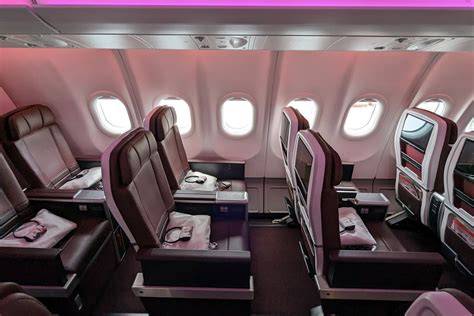
The airline combines generous dimensions with leather upholstery, adjustable headrests, footrests, personal power outlets, and USB connections. Large tables and useful storage areas also contribute to the cabin’s practicality, while softer lighting and a quieter environment help create a more relaxed atmosphere.
The remainder of the SKYTRAX top 10 illustrates just how competitive the category has become. Singapore Airlines ranked fourth, followed by Delta Air Lines, Cathay Pacific, Air New Zealand, Qantas, Lufthansa, and British Airways. The rankings include airlines from all three major global alliances, alongside Emirates and Virgin Atlantic.
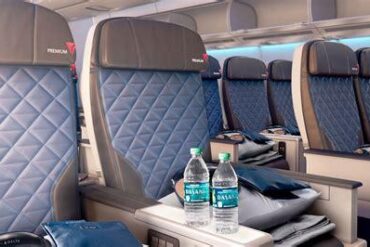
Delta was the only North American airline to make the top 10. Its premium economy product, marketed as Premium Select, varies by aircraft, with Airbus A350-900 aircraft using a 2-4-2 arrangement and Boeing 767-400ER aircraft using a 2-2-2 layout. The latter configuration can provide passengers with more convenient aisle access.
Why Premium Economy Is Growing So Quickly
The rise of premium economy reflects a broader change in how passengers think about long-haul travel. Business class remains extremely attractive, but its fares can be difficult to justify for leisure travelers. At the same time, conventional economy cabins have become increasingly dense, making the difference between the two experiences more noticeable.
Premium economy occupies the increasingly valuable space between those extremes. Travelers can pay more for extra legroom, wider seats, better meals, improved service, and additional amenities without moving all the way to business class pricing.
That proposition is especially attractive on overnight flights. An additional few inches of space might not seem transformative on a two-hour journey, but on a 10-hour flight, the ability to stretch the legs, recline more comfortably, and adjust the head and foot support can make a substantial difference.
Airlines have recognized the opportunity. Carriers including Cathay Pacific, British Airways, and American Airlines have expanded or refreshed their premium economy offerings, while others have increased the number of seats available in existing cabins. The trend suggests that premium economy is no longer a niche product designed for a small group of passengers.
Emirates’ Global Network Gives Its Premium Economy an Advantage
Another reason Emirates’ premium economy stands out is the scale of the airline itself. Emirates operates an enormous long-haul network from Dubai International Airport, connecting destinations across six continents. That means travelers have many opportunities to experience the premium economy cabin on lengthy international journeys where its advantages matter most.
The airline’s fleet strategy is also important. Emirates has historically centered its operation around widebody aircraft, particularly the Airbus A380 and Boeing 777, while the Airbus A350 has become an increasingly important part of its future fleet. The A380, in particular, provides Emirates with a distinctive platform for premium cabins and long-distance travel.
Emirates has continued retrofitting aircraft with its premium economy product, expanding availability beyond the initial routes. Early destinations included major markets such as London Heathrow, Paris Charles de Gaulle, and Sydney, all of which are associated with long-distance international travel.
That expansion matters because a great seat is only truly valuable when passengers can find it on the routes they actually want to fly.
Is Emirates Premium Economy Better Than Business Class?
Calling Emirates’ premium economy seat the world’s most comfortable does not mean it replaces business class. Business class still provides a significantly more private environment, more extensive personal space, and, on many aircraft, a fully flat bed. For passengers who need to arrive rested after an overnight journey, those benefits can justify the higher fare.
But premium economy does not need to beat business class to be successful. Its real strength is delivering a substantial improvement over economy at a much lower price than business class.
That makes Emirates’ product particularly appealing to travelers who value comfort but remain price-conscious. The seat’s generous dimensions, adjustable support, large entertainment display, upgraded dining, dedicated service, and quieter cabin collectively create an experience that feels like a meaningful step upward rather than a minor upgrade.
The Verdict: Emirates Sets the Premium Economy Benchmark
In 2026, premium economy has evolved into a serious long-haul cabin rather than an afterthought between economy and business class. Airlines are competing through seat design, personal space, food, service, technology, and cabin atmosphere, giving passengers more choices than ever.
Emirates currently sets the benchmark, according to the SKYTRAX World Airline Awards 2025. Its premium economy seat combines up to 40 inches of pitch, 19.5 inches of width, eight inches of recline, adjustable leg and foot support, a large HD entertainment screen, and thoughtful charging and dining facilities. More importantly, those features are supported by upgraded meals, quality tableware, attentive service, and a dedicated cabin environment.
Japan Airlines may offer even more seat pitch, while Virgin Atlantic brings its own distinctive combination of space and style. Yet Emirates succeeds because it treats premium economy as a complete experience. For travelers looking for a comfortable long-haul journey without stepping into business-class pricing, Emirates premium economy remains one of the strongest choices in the sky in 2026.