
San Diego, Xiamen, Lisbon, Stansted, and Gatwick have something unusual in common: millions of passengers depend on airports where one runway effectively carries the entire operation. At first glance, that may seem like a minor infrastructure detail. In reality, it creates a major operational vulnerability. When the only usable runway closes because of maintenance, weather, an aircraft incident, or a safety inspection, the airport can lose its ability to accept or dispatch commercial flights almost instantly.
Modern airports are designed around redundancy wherever possible. Major hubs such as Dallas/Fort Worth International Airport and Hartsfield-Jackson Atlanta International Airport can close one runway and continue operating on several others. That flexibility allows controllers to redistribute traffic, airlines to protect schedules, and airport operators to absorb temporary disruptions. A single-runway airport has no comparable safety valve. Its terminals may have dozens of gates, its airlines may serve hundreds of destinations, and its passenger numbers may rival those of much larger multi-runway facilities, but the entire system ultimately depends on one strip of pavement.
The consequences become especially significant when the airport is embedded in a large metropolitan area with limited alternatives. A runway closure at one of these airports is not simply an airport problem; it can become a regional transportation problem. Nearby airports may have their own capacity constraints, incompatible route networks, or insufficient terminal space to absorb thousands of displaced passengers. The following five airports demonstrate just how exposed a major aviation market can become when runway redundancy is limited.
San Diego International Airport: America’s Busiest Single-Runway Airport
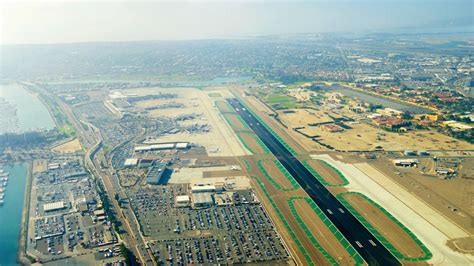
San Diego International Airport (SAN) is the clearest example of how geography can turn a single runway into a regional bottleneck. The airport handled a record 25.24 million passengers in 2024, making it the busiest commercial airport in the United States that operates with only one runway. Runway 09/27 stretches 9,401 feet (2,865 meters), and every commercial arrival and departure must ultimately depend on it.
The airport’s location makes the situation extremely difficult to solve. SAN sits only about three miles northwest of downtown San Diego, with San Diego Bay to the south, Interstate 5 to the east, the Marine Corps Recruit Depot to the north, and densely developed neighborhoods surrounding its approach corridors. There is simply no obvious piece of land on which another full-length commercial runway could be constructed. Proposals for a second runway have surfaced repeatedly since the 1960s, but the physical constraints have consistently prevented them from becoming a practical solution.
That limitation is particularly striking because SAN is not a small regional airport. Southwest Airlines accounts for nearly one-third of the airport’s passenger traffic, while Alaska Airlines operates a hub-like network and United, Delta, American, JetBlue, and numerous other carriers connect San Diego with more than 70 nonstop destinations. The airport’s international reach includes cities such as London, Tokyo, and Frankfurt, along with numerous destinations in Mexico and Canada.
The airport has been investing heavily in terminal infrastructure. The first phase of the new Terminal 1 opened in late 2025 with 19 additional gates, while the second phase is expected to demolish the remaining original 1967 terminal and add another 11 gates by 2028. Those projects will improve passenger processing and gate capacity, but they cannot solve the fundamental constraint. More gates do not help much if aircraft cannot reach them.
A prolonged closure of Runway 09/27 would therefore affect the entire San Diego metropolitan area, home to roughly 3.3 million people. Tijuana International Airport is just across the Mexican border, while John Wayne Airport in Orange County is approximately 80 miles north. Both can provide alternatives for some travelers, but neither has the spare capacity or network structure required to absorb SAN’s normal traffic. A single runway closure could consequently push disruption well beyond the airport perimeter.
Xiamen Gaoqi International Airport: One Runway Serving a Major Coastal Economy
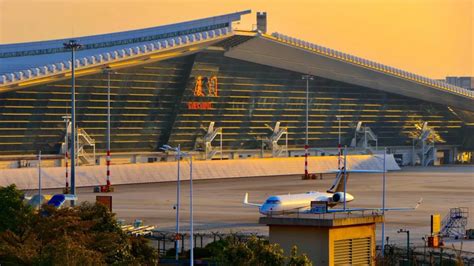
On China’s southeastern coast, Xiamen Gaoqi International Airport (XMN) demonstrates an even larger concentration of traffic. The airport handled approximately 29.19 million passengers and 198,582 aircraft movements in 2025, all on a single 11,155-foot (3,400-meter) runway. That makes Xiamen the busiest single-runway airport in China.
XMN occupies a constrained position on the northeastern tip of Xiamen Island, roughly 7.5 miles from central Xiamen. The airport serves as the main hub for XiamenAir and a major focus city for China Eastern Airlines, Shandong Airlines, and Spring Airlines. Its two terminals support a network extending across China, Southeast Asia, and Europe, making the airport an important component of the region’s economic infrastructure rather than simply a local passenger facility.
The island location is the key reason redundancy has been so difficult to achieve. Water, existing urban development, terminal infrastructure, and surrounding land uses leave little practical room for another runway. Unlike an airport sitting on an expansive tract of undeveloped land, XMN cannot simply acquire additional territory and construct another parallel strip.
That makes the runway unusually important. A maintenance closure, serious weather event, runway inspection, or aircraft incident can interrupt virtually the entire commercial operation. The problem is not limited to passengers waiting inside the terminal. Airlines must also deal with aircraft stranded at other airports, crews reaching duty-time limits, missed connections, cargo disruptions, and aircraft rotations that can remain out of position for hours.
There is, however, an important difference between Xiamen and the other airports on this list. Xiamen Gaoqi is approaching the end of its single-runway era. Xiamen Xiang’an International Airport, being developed on Dadeng Island, is expected to open in late 2026. Its first phase is planned around two parallel runways and capacity for approximately 45 million passengers annually, with longer-term plans calling for four runways and capacity reaching 75 million passengers.
Once the transition is completed, Gaoqi will cease civilian operations after roughly 43 years of service on Xiamen Island. In other words, XMN’s extreme runway dependency is not necessarily permanent. The replacement airport is effectively the infrastructure solution that Gaoqi’s geography could never provide.
Lisbon Humberto Delgado Airport: Portugal’s International Gateway on One Runway
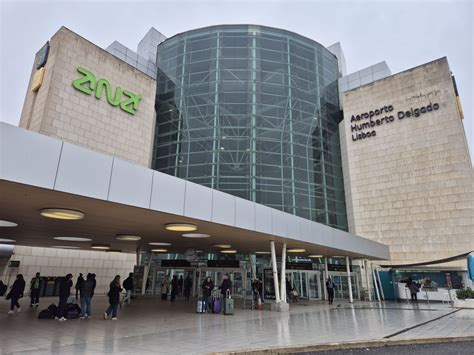
Lisbon Humberto Delgado Airport (LIS) presents perhaps the most consequential single-runway problem in mainland Europe. Portugal’s primary international gateway handled 35.1 million passengers in 2024, exceeding its designed capacity of roughly 34 million passengers. All of that traffic was processed through Runway 03/21, a 12,484-foot (3,805-meter) runway located remarkably close to the center of Lisbon.
LIS is the principal hub of TAP Air Portugal and an important base for Ryanair and easyJet. Its location gives airlines a convenient gateway into Portugal, but the same urban environment makes expansion extremely difficult. Residential communities surround the airport, and aircraft noise affects large numbers of people in Lisbon and nearby Loures.
The runway dependency becomes especially serious because Lisbon does not have a second major commercial airport capable of immediately taking over the operation. Porto’s Francisco Sá Carneiro Airport is about 190 miles north, while Faro Airport is roughly 165 miles south. Both are important airports in their own right, but neither can simply substitute for Lisbon’s role as Portugal’s principal international hub.
For TAP in particular, a runway shutdown can have consequences far beyond individual point-to-point flights. Hub operations depend on carefully synchronized waves of arrivals and departures. A closure during a peak period can therefore disrupt connecting passengers, aircraft rotations, crew schedules, and onward international services simultaneously. The longer the runway remains unavailable, the more difficult it becomes for airlines to recover the schedule.
Portugal has recognized the problem for decades and is now pursuing a replacement airport project. The proposed Luís de Camões Airport would be constructed at the Alcochete military firing range on the south bank of the Tagus River. The estimated cost is approximately €7.9 billion to €8.9 billion, with construction targeted for 2029 and an opening window between 2035 and 2037.
Until then, Lisbon must continue squeezing additional capacity from its existing infrastructure. ANA is investing roughly €400 million in interim improvements intended to raise throughput to around 45 flights per hour. That may create more breathing room during normal operations, but it does not change the fundamental equation: one runway remains responsible for Portugal’s most important international air gateway.
London Stansted Airport: A Single Runway Behind a Massive Low-Cost Network
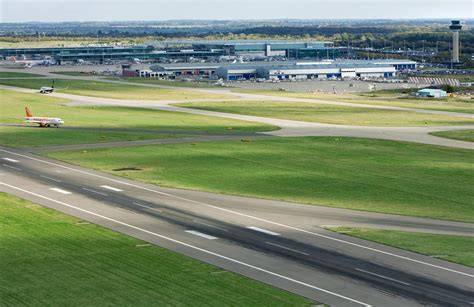
London Stansted Airport (STN) proves that a single runway does not prevent an airport from becoming enormous. Stansted handled a record 30 million passengers in 2025, despite having only one operational runway, 04/22, measuring approximately 10,000 feet (3,049 meters).
The airport’s importance is heavily tied to its role as Ryanair’s largest base anywhere in the world. The airline connects Stansted with more than 150 destinations, while Jet2 and TUI also maintain bases there. Turkish Airlines added another dimension to the network with Istanbul service launched in March 2026.
The concentration of low-cost operations makes a runway closure particularly disruptive. Ryanair operates more flights from Stansted than from any other airport in its network, and many destinations are served specifically from Stansted rather than from another London airport. A passenger whose flight is canceled cannot necessarily expect an easy transfer to Heathrow, Gatwick, or Luton.
The airport is expanding in other areas. Its Foster + Partners-designed terminal, which opened in 1991, is undergoing a £1.1 billion expansion, including a £600 million terminal extension. In December 2025, Uttlesford District Council also approved an increase in Stansted’s annual passenger cap from 43 million to 51 million over the next 20 years.
Yet the striking part is how this additional growth is expected to occur without another runway. Manchester Airports Group has indicated that the higher passenger volume can be achieved through larger aircraft and more efficient use of the existing operation. A second-runway proposal submitted in 2008 was withdrawn in 2010 following political opposition and a Competition Commission review.
That leaves Stansted in an unusual position. An airport moving toward 51 million annual passengers will continue relying on one runway. During normal operations, sophisticated scheduling and aircraft utilization can make that arrangement work. During an unexpected closure, however, the same efficiency leaves little spare capacity to absorb the shock.
London Gatwick Airport: Europe’s Single-Runway Giant
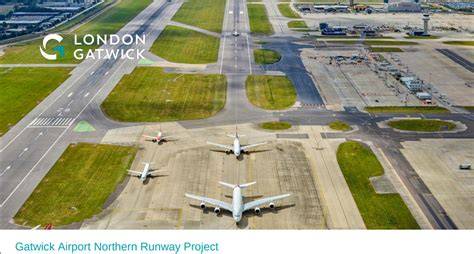
If Stansted demonstrates how large a single-runway airport can become, London Gatwick Airport (LGW) pushes the concept even further. Gatwick handles approximately 45 million passengers and 280,000 flights each year, making it Europe’s busiest airport by passenger volume when measured on a practical single-runway basis.
Technically, Gatwick has two runways. The northern runway, 08L/26R, exists and can be used when the main runway is unavailable. The problem is that the two strips are too close together for normal simultaneous operations. As a result, the northern runway functions primarily as a standby facility rather than as a second independent runway.
When the main runway closes, switching to the northern runway takes approximately 15 minutes during which aircraft cannot land or depart. That might sound brief, but at an airport operating at extremely high utilization, even a short interruption can create a substantial queue.
Gatwick is home to major operations from easyJet, British Airways, Norse Atlantic, and Wizz Air and serves more than 200 destinations. Its network is particularly important for long-haul leisure traffic, linking London with destinations across the Caribbean, Southeast Asia, Africa, and other regions.
The airport’s operational model leaves little room for disruptions. A burst tire, runway inspection, aircraft incident, or sudden weather-related closure can rapidly turn into a system-wide schedule problem. Aircraft arriving late affect later departures; departing aircraft miss their slots; crews can reach duty limitations; and passengers accumulate throughout the terminal.
The situation is now changing. In August 2026, the UK government approved Gatwick’s plan to bring the northern runway into regular use by moving it 12 meters farther north. The project, estimated at £2.2 billion, is expected to enable simultaneous runway operations and add roughly 100,000 flights annually. Capacity could eventually reach 75 million to 80 million passengers by the late 2030s, with the northern runway expected to become operational around 2030.
Until that happens, however, Gatwick remains fundamentally dependent on its main runway. Its enormous passenger volume makes that dependence particularly remarkable. An airport handling more than 45 million passengers can still be brought to an operational standstill by one strip of pavement.
Why Single-Runway Airports Remain So Vulnerable
These five airports show that runway redundancy is not simply about how many runways appear on an airport map. What matters is whether those runways can operate independently and whether surrounding infrastructure can support them. Gatwick technically has two runways, yet its current configuration behaves much like a single-runway airport. Xiamen has one runway because its island setting prevents practical expansion. San Diego faces similar geographic constraints, while Lisbon and Stansted are attempting to extract more capacity from existing infrastructure while longer-term solutions remain years away.
The vulnerability becomes more serious as passenger numbers grow. Every additional flight scheduled on a single runway increases the potential size of the disruption when that runway becomes unavailable. A small regional airport may cancel a handful of services and recover quickly. A 30-million- or 45-million-passenger airport can generate thousands of displaced passengers, hundreds of delayed aircraft movements, and network effects stretching across multiple countries.
There is also a difference between planned and unplanned closures. Planned maintenance can be scheduled during periods of lower demand, allowing airlines and air traffic controllers to prepare. An unexpected runway closure offers no such advantage. When an aircraft becomes disabled on the runway or an inspection is suddenly required, flights already approaching may have to divert while departures are held at their gates.
That is why redundancy is one of the most valuable forms of resilience an airport can possess. Multiple independent runways do not eliminate delays, but they provide operators with options. They allow traffic to continue, even at reduced capacity, while maintenance or emergency teams address the original problem.
The five airports examined here also demonstrate that infrastructure solutions take time. New runways require enormous investments, environmental assessments, land acquisition, political approval, construction, and years of planning. In Xiamen, the answer is a replacement airport. In Lisbon, the proposed solution is an entirely new gateway. Gatwick is taking the more unusual approach of converting an existing standby runway into a fully operational second runway.
Until those projects deliver additional capacity, millions of passengers remain dependent on infrastructure that offers remarkably little redundancy. The lesson is straightforward: an airport can have a huge terminal, hundreds of gates, and an international route network, but if only one runway can handle normal commercial operations, the entire system still has a single point of failure. For San Diego, Xiamen, Lisbon, Stansted, and Gatwick, that single point remains one of the most important pieces of infrastructure in the region.