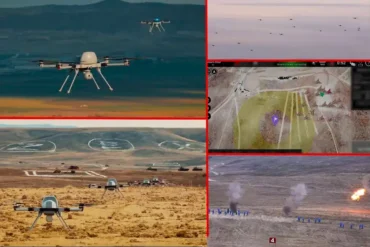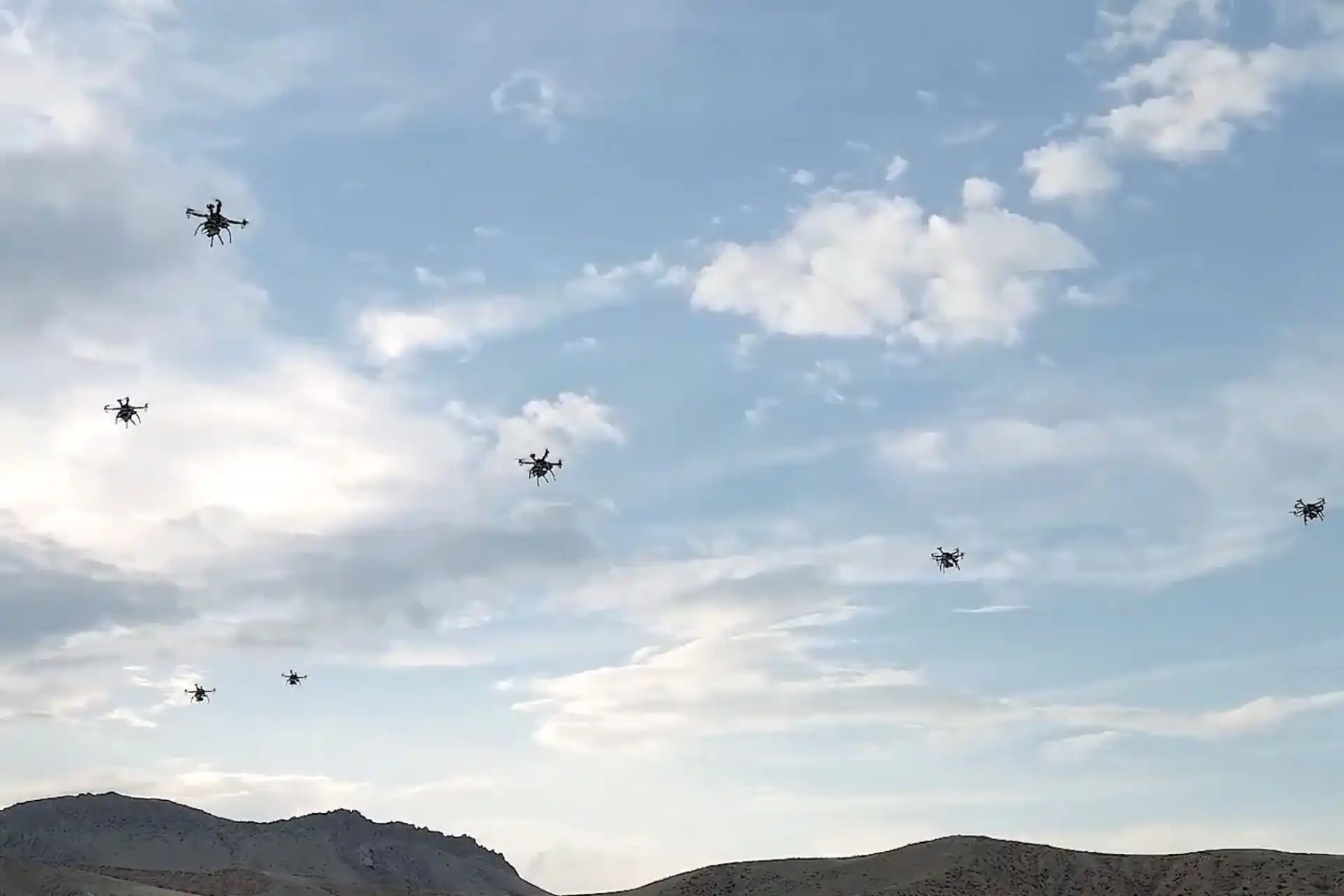
Türkiye has taken a decisive step in modern autonomous warfare with a live field demonstration that moves drone swarm concepts from controlled testing environments into an operationally realistic setting. This week, defense software and systems company HAVELSAN publicly showcased its Digital Troops concept by deploying a coordinated swarm of POYRAZ quadcopter drones, executing autonomous missions that included synchronized kamikaze-style attacks and simultaneous multi-target engagement. The event, conducted in front of senior civilian and military officials, underlined Ankara’s intent to transform swarm-enabled unmanned systems into a credible, deployable combat capability rather than a purely experimental technology.
A Live Demonstration Signals Operational Maturity
Unlike laboratory trials or scripted test ranges, the HAVELSAN demonstration was designed to mirror battlefield complexity. The POYRAZ swarm was tasked with identifying, assigning, and striking multiple targets without continuous human control, relying instead on embedded autonomy and distributed decision-making. HAVELSAN emphasized that the scenario deliberately introduced communications stress and network disruptions, conditions that would cripple centrally controlled systems. The swarm continued to function throughout the exercise, reinforcing claims that its architecture is resilient enough for real combat environments where electronic warfare and signal degradation are expected norms rather than exceptions.
The presence of high-level observers was not incidental. Türkiye’s defense sector increasingly uses such demonstrations to signal readiness to both domestic decision-makers and international partners. In this case, the message was clear: autonomous swarming is no longer theoretical within the Turkish defense ecosystem, but an emerging operational tool aligned with future force concepts.
Distributed Swarm Intelligence Without a Central Brain
At the core of the Digital Troops concept lies a distributed swarm control architecture. Instead of relying on a single command node that could become a critical vulnerability, each POYRAZ drone operates as an intelligent participant within the network. Mission logic, coordination, and task allocation are shared across the swarm, allowing operations to continue even if individual drones fail or communications are partially denied.
This approach addresses one of the central weaknesses of early swarm concepts. In contested electromagnetic environments, centralized control links are prime targets for jamming or cyber interference. HAVELSAN’s design ensures that the loss of a node degrades performance gradually rather than catastrophically. During the demonstration, simulated link losses forced the swarm to reconfigure in real time, redistributing tasks among remaining drones while maintaining mission momentum.
Autonomous Kamikaze Attacks and Multi-Target Engagement
The operational scenario focused on a complex multi-target problem set. Once launched, the POYRAZ drones autonomously divided into sub-swarms, each assigned to a specific objective. Rather than following a rigid preprogrammed sequence, the drones dynamically adjusted formations and attack vectors based on mission logic and real-time inputs.
In the terminal phase, the swarm executed synchronized dive maneuvers, striking designated targets nearly simultaneously. This capability is particularly significant in modern combat, where saturating defenses and compressing reaction time can overwhelm point-defense systems. HAVELSAN highlighted that malfunctioning or damaged drones automatically disengaged from the mission without operator intervention, while the rest of the swarm preserved coordinated attack behavior. This level of fault tolerance is essential for any system intended for real-world combat, where attrition is inevitable.
Integrating Sensors, Platforms, and Kill Chains
While POYRAZ quadcopters formed the striking element of the demonstration, HAVELSAN placed equal emphasis on multi-platform integration. The swarm did not operate in isolation. Instead, target data was supplied by other unmanned systems and sensors, demonstrating a modular kill-chain architecture where detection, decision, and engagement functions are distributed.
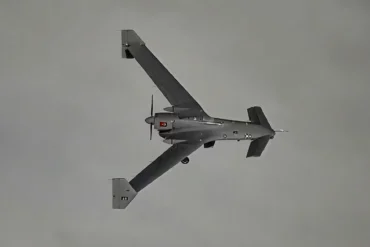
A key supporting platform was BULUT, an autonomous vertical take-off and landing UAV used to provide persistent surveillance. Equipped with the GIMBAL 275 electro-optical system, BULUT delivered stabilized real-time imagery that fed directly into the swarm’s mission logic. This configuration reflects a broader shift in modern warfare toward decoupling sensors from shooters. High-value sensor platforms can remain at safer distances, while lower-cost, expendable drones conduct high-risk terminal attacks.
Software as the Strategic Enabler
Beyond airframes and sensors, the real differentiator in HAVELSAN’s demonstration was software. The Digital Troops concept is explicitly software-defined, enabling rapid adaptation to different platforms, mission profiles, and operational doctrines. HAVELSAN framed the exercise as an end-to-end validation, covering the entire chain from sensor input and data fusion to engagement decisions and post-mission reporting.
The swarm’s ability to operate under degraded communications highlights the maturity of its onboard autonomy. When external inputs were limited, drones relied on preloaded mission rules and local situational awareness to complete objectives. Importantly, while navigation and attack profiles were autonomous, munition activation remained constrained by predefined safety and authorization parameters, reflecting ongoing efforts to balance autonomy with command oversight.
Tactical Advantages and Real-World Constraints
The demonstrated capabilities point to several clear tactical advantages. A swarm capable of dividing into coordinated sub-elements can overwhelm defenses through simultaneous multi-axis attacks, forcing defenders to make rapid, high-stakes decisions. The expendable nature of quadcopter-based effectors allows commanders to trade relatively low-cost assets for high-value targets or defensive saturation effects.
At the same time, constraints remain. Quadcopter drones are inherently limited in range, endurance, and performance under adverse weather conditions. High winds, heavy rain, or extreme temperatures can reduce effectiveness. HAVELSAN’s concept mitigates some of these limitations through rapid deployment, local launch capability, and integration with other platforms, but such systems are best suited to short-range tactical environments rather than deep-strike roles.
Strategic Implications for Türkiye and Beyond
HAVELSAN’s live swarm demonstration fits neatly into Türkiye’s broader defense strategy of pairing domestically produced platforms with advanced mission software to create exportable operational concepts. Rather than selling hardware alone, Ankara increasingly markets integrated systems that combine UAVs, autonomy, and command-and-control logic.
For regional security dynamics, the normalization of autonomous strike swarms increases pressure on air-defense modernization and counter-UAS capabilities. States facing dense drone threats must now consider layered defenses, electronic warfare investment, and their own autonomous responses. On a global level, demonstrations like this accelerate the international race toward integrating sensors, unmanned platforms, and digital command systems across both NATO and non-NATO defense ecosystems.
As autonomous swarms move from concept to capability, the lines between experimentation and deployment continue to blur. HAVELSAN’s Digital Troops exercise suggests that Türkiye intends to be among the countries shaping that transition, not merely observing it.