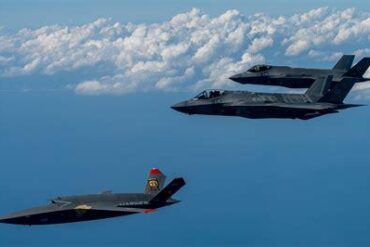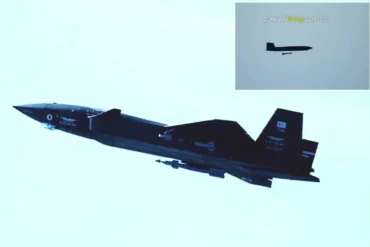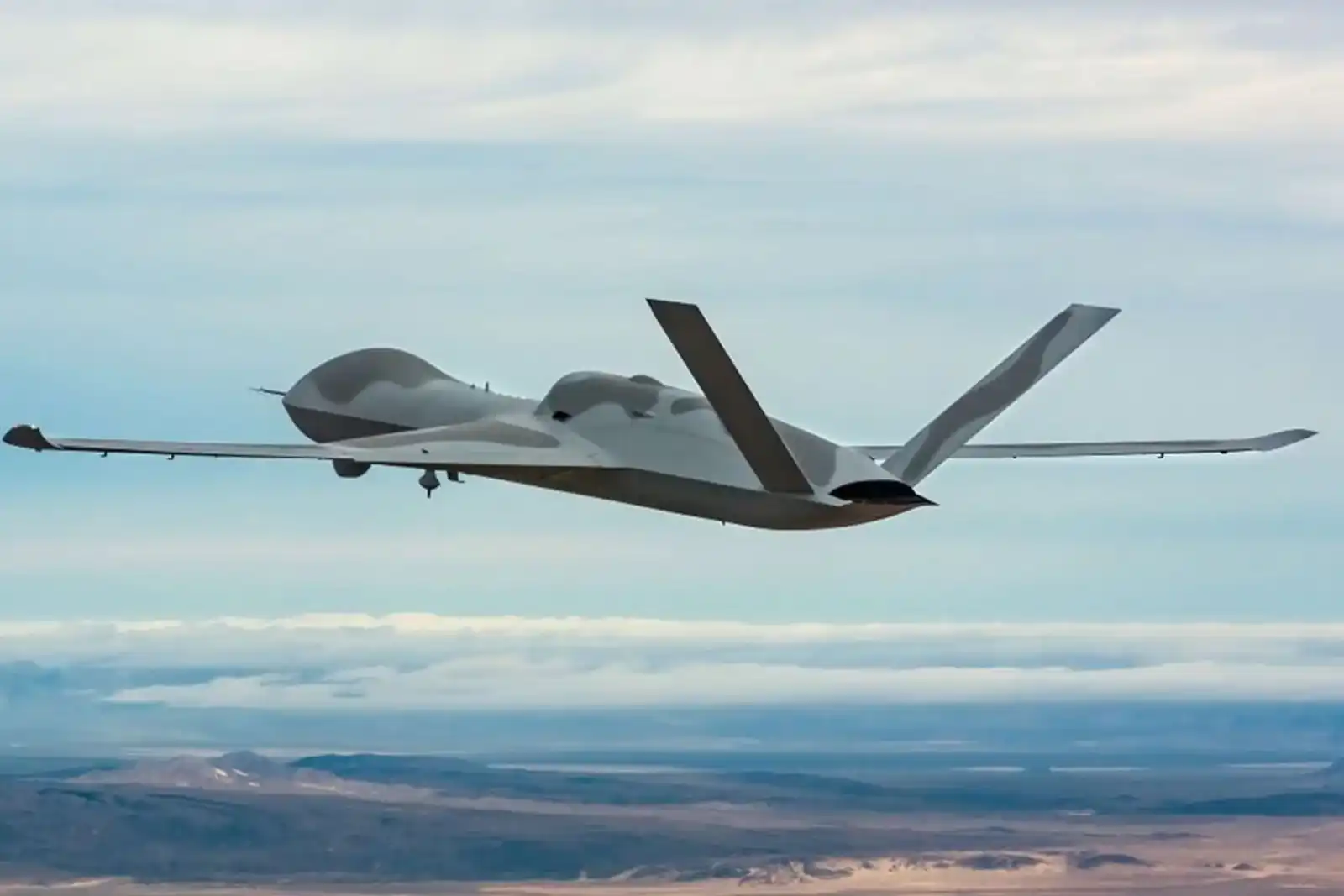
The U.S. Air Force has taken a decisive step toward operationalizing manned-unmanned teaming by flying an F-22 Raptor as a command aircraft directing an MQ-20 Avenger unmanned jet during a live autonomy exercise at Edwards Air Force Base. Conducted in partnership with General Atomics, the drill showcased how a fifth-generation stealth fighter can control a jet-powered drone in real time, validating the tactical and technical foundations of the Air Force’s emerging Collaborative Combat Aircraft (CCA) concept.
Rather than a scripted laboratory demonstration, the event unfolded as a realistic combat scenario. The F-22 issued mission commands that were translated into autonomous behaviors onboard the MQ-20. Using a tactical data link and government reference autonomy software, the Raptor directed the unmanned aircraft through coordinated maneuvers, waypoint navigation, Combat Air Patrol (CAP) operations, and an airborne threat engagement sequence. The sortie illustrated how pilot intent can be transformed into machine-executable actions without requiring joystick-style remote control.
The demonstration signals a doctrinal shift. The F-22 was not merely flying alongside a drone; it functioned as a mission commander, delegating specific tasks to an autonomous partner while retaining decision authority. In contested airspace—where advanced air defenses, electronic warfare, and long-range missiles compress reaction times—this distributed model reduces pilot workload and risk while expanding combat reach.
From Cockpit Command to Autonomous Execution
At the heart of the exercise was the Autonodyne Bashi Pilot Vehicle Interface, a cockpit-to-drone pathway enabling the F-22 pilot to transmit high-level commands that the MQ-20 interpreted autonomously. Instead of micromanaging flight controls, the pilot issued tactically meaningful instructions—directing patrol patterns, engagement postures, and mission priorities.
This distinction matters. Remote piloting introduces latency, bandwidth vulnerability, and cognitive overload. By contrast, autonomy-driven teaming allows the human to remain focused on decision-making, threat assessment, and rules of engagement while the unmanned system handles execution details such as station-keeping, geometry optimization, and maneuver timing.
The Air Force’s approach centers on a government-owned Autonomy Reference Architecture, designed to prevent vendor lock-in and accelerate software updates. Multiple autonomy providers integrate their systems against this standardized backbone. The result is a modular, software-first ecosystem where autonomy can be swapped, updated, and certified more rapidly than traditional flight program timelines would allow. This architecture transforms autonomy from a bespoke experiment into an adaptable combat capability.
F-22 Modernization Enables Networked Command
The Raptor’s evolving data link capabilities are critical to this milestone. Historically optimized for stealthy intra-flight communication among F-22s, the aircraft’s networking suite has been steadily modernized. Recent Raptor Agile Capability Release upgrades introduced enhanced Link 16 transmit functionality, allowing the F-22 to exchange J-series messages within the broader joint tactical network.
Integration of MIDS-JTRS (Multifunctional Information Distribution System – Joint Tactical Radio System) strengthens two-way communication, positioning the Raptor not only as a sensor-shooter platform but as a network node capable of commanding unmanned assets. In practical terms, this makes the F-22 a quarterback in a distributed formation, orchestrating manned and unmanned aircraft through a resilient data architecture.
Such connectivity is not cosmetic. In high-end conflict, control of the information domain determines survivability. The ability to push commands securely to an unmanned forward element—and receive sensor data in return—creates a feedback loop that enhances situational awareness while keeping the stealth fighter at optimal stand-off distance.
The MQ-20 Avenger as a Surrogate Collaborative Combat Aircraft
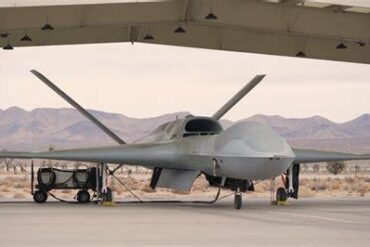
The MQ-20 Avenger, developed by General Atomics, served as a surrogate CCA platform in the exercise. Unlike slower propeller-driven unmanned aircraft, the jet-powered Avenger offers speed, altitude, and payload capacity that align more closely with fifth-generation operations. Its internal payload bay supports approximately 3,500 pounds, with total payload capacity around 6,500 pounds.
The MQ-20 can carry a wide range of munitions, including AGM-114 Hellfire missiles, GBU-12 and GBU-49 laser-guided bombs, GBU-31 and GBU-32 JDAM variants, GBU-38 JDAM, and the GBU-39 Small Diameter Bomb. Beyond kinetic payloads, the aircraft can host electro-optical/infrared sensors, multi-mode radar, signals intelligence (SIGINT) packages, electronic support measures, and communications relay systems.
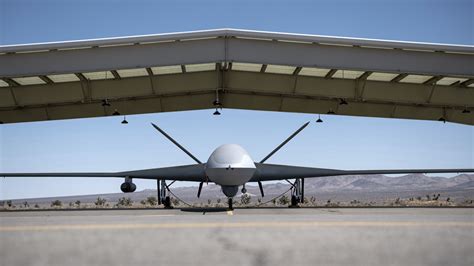
This versatility enables three primary operational roles. As a forward shooter, the MQ-20 can engage targets at extended range. As a sensor node, it can operate in high-threat zones to gather radar or signals intelligence. As a communications relay, it can bridge distributed formations or pass targeting data back to stealth command platforms. Each role supports the broader objective of distributed, survivable combat mass.
Distributed Counter-Air and Engagement Geometry
During the drill, the air-to-air threat engagement sequence illustrated how unmanned aircraft can widen a defended footprint. A forward-deployed MQ-20 on Combat Air Patrol creates additional engagement vectors that complicate adversary targeting. Enemy fire-control systems must now account for multiple aircraft, potentially separated by significant distance, each capable of contributing to the kill chain.
Even if the MQ-20 is not the primary trigger-puller, its presence reshapes engagement geometry. It can hold a sensor posture, force adversary radar activation, or create targeting dilemmas that enable the F-22 to exploit gaps. Autonomy ensures the unmanned jet maintains position, spacing, and timing without continuous human input.
This distributed model aligns with the Air Force’s broader doctrine of resilient kill chains. By separating sensing, decision-making, and shooting functions across multiple platforms, the force becomes less vulnerable to single-point failure. If one node is jammed or destroyed, others continue operating.
Beyond Bombs: Air-Launched Effects and Modular Payloads
The MQ-20’s internal bay has previously supported testing of an Advanced Air-Launched Effects (ALE) vehicle, reflecting a growing emphasis on modular airborne effectors. These low-cost, expendable systems can serve as decoys, sensors, or electronic warfare tools. Combined with cockpit-issued autonomy commands, they allow mixed payload configurations that extend operational flexibility.
In a high-threat environment, an unmanned jet might deploy decoys to saturate defenses, electronic payloads to disrupt radar, and precision munitions to strike hardened targets—all coordinated through high-level instructions from a stealth fighter. This layered approach magnifies the effectiveness of manned aircraft while preserving their survivability.
The concept is particularly relevant in the Indo-Pacific theater, where vast distances and advanced anti-access systems demand scalable, attritable mass. Collaborative Combat Aircraft provide a way to expand force presence without proportionally increasing pilot exposure.
Strategic Implications for Next-Generation Air Dominance
The Edwards demonstration represents more than a successful sortie. It validates the control interface between human judgment and machine execution under realistic conditions. By proving that autonomy software can operate within a government reference architecture—and be commanded from a fifth-generation fighter—the Air Force advances its vision of Next-Generation Air Dominance (NGAD) as a system-of-systems rather than a single aircraft.
The emphasis on open architecture and software-defined capability suggests a future where upgrades arrive as code rather than hardware retrofits. New autonomy behaviors, improved sensor fusion, and expanded mission sets can be integrated with greater speed, shortening the innovation cycle in a domain where technological stagnation invites vulnerability.
In this model, the F-22 evolves from a solitary stealth fighter into a force-multiplying command node. The MQ-20 and future CCAs become extensions of its sensing and striking capacity. Together, they form a distributed formation capable of penetrating contested airspace, complicating enemy defenses, and sustaining operational tempo.
The live manned-unmanned combat drill demonstrates that autonomy is no longer a peripheral experiment. It is becoming a core enabler of American airpower, transforming how missions are planned, executed, and sustained. As the Air Force refines its autonomy architecture and expands CCA integration, the balance between human judgment and machine execution will define the next era of aerial warfare.