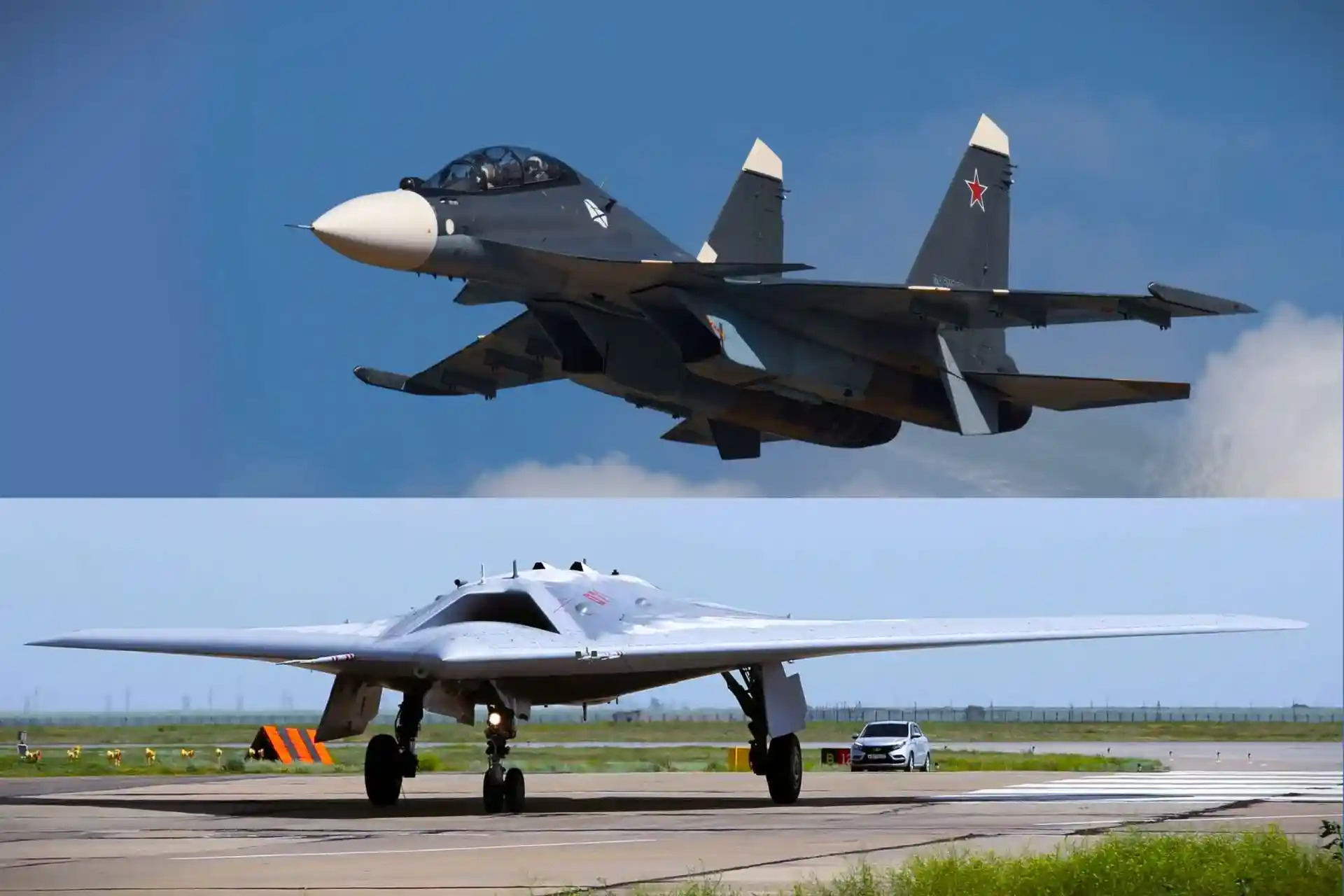
Russia is actively examining a manned–unmanned teaming architecture that would tightly integrate the Su-30SM multirole fighter with the S-70 Okhotnik heavy unmanned combat aerial vehicle (UCAV), signaling a deliberate evolution in its air combat doctrine rather than a wholesale replacement of pilots with machines. The concept, outlined in remarks by Major General Vladimir Popov to Russian media, frames this integration as a structural transformation in how air missions are commanded, executed, and sustained in contested environments.
At the core of the proposal is a philosophical shift: manned aircraft are no longer envisioned solely as independent shooters but as airborne coordinators within a distributed combat network. The Su-30SM, already a central component of the Russian Aerospace Forces, would function as a command node, fusing sensor data, managing tactical decisions, and delegating high-risk tasks to unmanned partners such as the Okhotnik. Rather than reducing the role of pilots, this approach elevates them into mission directors operating at the center of a layered strike ecosystem.
This direction aligns with broader global trends in airpower modernization, where survivability under dense air-defense systems and attrition tolerance increasingly define operational planning. Russian leadership appears intent on preserving the relevance of manned aviation for decades while leveraging unmanned systems to absorb risk and expand tactical reach.
Su-30SM as the Command Hub of a Distributed Strike Network
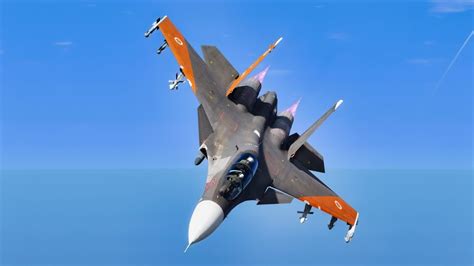
The Su-30SM has long been recognized as a versatile twin-seat multirole fighter capable of air superiority, strike, and maritime attack missions. Its two-crew configuration—pilot and weapons systems officer—naturally lends itself to expanded coordination roles. In a manned–unmanned teaming construct, that second crew member becomes critical, enabling simultaneous aircraft control and off-board asset management.
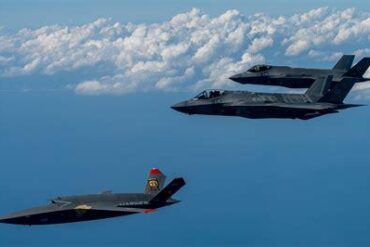
Under the emerging concept, the Su-30SM would orchestrate a formation that includes one or more S-70 Okhotnik drones. Through secure datalinks and sensor integration, the fighter crew could assign reconnaissance tasks, designate strike targets, and monitor threat emitters in real time. This transforms the aircraft from a standalone combatant into a tactical quarterback directing a semi-autonomous formation.
Such an architecture implies the presence of advanced data fusion systems, allowing information from onboard radar, electronic warfare suites, and unmanned sensors to be synthesized into a coherent battlespace picture. While technical specifics remain undisclosed, the operational logic mirrors modern network-centric warfare principles, in which decision speed and distributed sensing outweigh sheer platform numbers.
S-70 Okhotnik: Extending Reach and Absorbing Risk
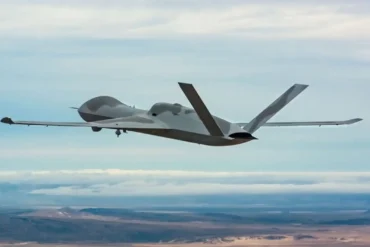
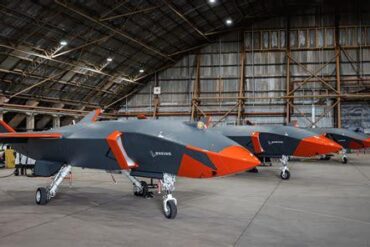
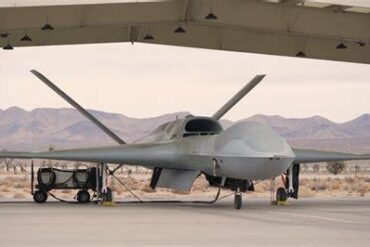
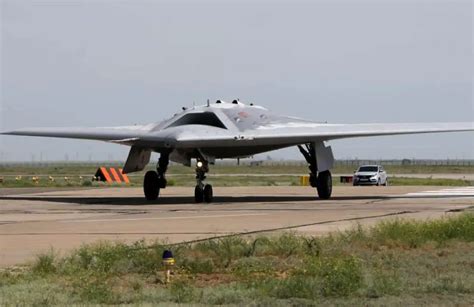
The S-70 Okhotnik, often described as a heavy stealth unmanned combat aerial vehicle, represents Russia’s most ambitious foray into loyal wingman-style operations. Designed with low observable characteristics and substantial payload capacity, it is well suited for penetrating defended airspace, conducting suppression of enemy air defenses (SEAD), or performing deep reconnaissance.
In a teamed configuration, the Okhotnik’s value lies not merely in its weapons load but in its expendability relative to a crewed fighter. High-threat zones saturated with surface-to-air missile systems pose escalating risks to pilots. Assigning those missions to unmanned platforms increases operational persistence while reducing potential personnel losses. The calculus is strategic as much as tactical: preserving trained aircrew remains a priority even as combat environments grow more lethal.
This model also enables standoff tactics. A Su-30SM operating at safer distances could maintain command oversight while the Okhotnik advances closer to threat emitters. The drone effectively extends the sensor and weapons envelope of the fighter without exposing its crew to equivalent danger.
Redefining Air Combat Doctrine
Major General Popov’s description of this integration as a “new philosophy” reflects more than technological experimentation. It suggests doctrinal recalibration. Instead of viewing unmanned systems as auxiliary reconnaissance tools, the Russian Aerospace Forces appear to be considering them as core participants in coordinated strike packages.
In such a framework, missions would be structured around networked clusters rather than isolated sorties. A Su-30SM-led formation could dynamically allocate targets between manned and unmanned elements, adapting to evolving threats mid-mission. Electronic warfare tasks, reconnaissance sweeps, and precision strikes could be distributed across the formation, increasing resilience if one element is degraded.
This distributed model complicates adversary targeting. An opponent must contend not with a single aircraft but with a cooperative formation where sensors and shooters are separated. Destroying one node does not collapse the entire mission architecture, enhancing survivability through redundancy.
Long-Term Commitment to Manned Aviation
Despite the growing emphasis on unmanned integration, Russian military leadership underscores that manned aviation will remain a priority for decades. This stance reflects institutional realities as well as operational logic. Pilot training pipelines, maintenance infrastructure, and established tactical doctrines form the backbone of the Aerospace Forces.
The projection of a fifty-year horizon for manned aircraft underscores a gradualist approach. Rather than pivoting abruptly toward fully autonomous air combat, Russia appears to envision an incremental layering of unmanned capabilities onto existing force structures. Fighters such as the Su-30SM and Su-35S remain foundational, with drones enhancing rather than displacing them.
This balance preserves human judgment in rules-of-engagement decisions, a factor that retains strategic importance. Automation may handle navigation, targeting suggestions, and even weapons release under defined parameters, but final authority is expected to reside with trained officers in the cockpit.
Tactical Implications for Contested Airspace
Modern air defense networks, characterized by integrated radar systems and long-range surface-to-air missiles, increasingly challenge traditional strike operations. In this environment, survivability hinges on dispersal, stealth, and electronic warfare coordination. Manned–unmanned teaming directly addresses these pressures.
A Su-30SM operating as a command platform could coordinate simultaneous strikes from multiple vectors. The Okhotnik might conduct initial suppression of enemy radar sites, clearing corridors for follow-on operations. Alternatively, it could serve as a forward sensor, transmitting targeting data back to the fighter for stand-off missile launches.
This synergy enhances sortie efficiency. Instead of multiple manned aircraft conducting sequential missions, a mixed formation achieves layered objectives in a single coordinated push. The result is greater operational tempo with potentially lower exposure to attrition.
Force Structure and Strategic Signaling
Beyond immediate battlefield considerations, the integration of Su-30SM fighters with S-70 Okhotnik drones carries broader strategic implications. Demonstrating credible manned–unmanned teaming capability signals technological sophistication and adaptability. In geopolitical terms, it communicates resilience against high-end air defense systems fielded by peer competitors.
The evolution of this concept also shapes procurement and industrial priorities. Investment in secure communications networks, artificial intelligence-assisted mission management, and advanced sensor packages becomes central. The aerospace sector must deliver not only airframes but interoperable digital ecosystems capable of real-time coordination under combat stress.
If operationalized at scale, such formations could alter deterrence dynamics. Adversaries must calculate against a force structure that distributes risk across human and machine assets, complicating targeting strategies and raising the threshold for successful counterair operations.
An Evolutionary Path Forward
The exploration of Su-30SM and S-70 Okhotnik integration illustrates a broader pattern in contemporary airpower development: evolution rather than revolution. Pilots remain central, but their roles expand. Unmanned systems grow more capable, yet operate within human-directed frameworks.
Russia’s trajectory suggests confidence in the enduring relevance of manned fighters, even as robotics and autonomy accelerate. The Su-30SM is not being sidelined; it is being repositioned as the cognitive core of a hybrid formation. The Okhotnik, in turn, becomes a force multiplier that extends reach, absorbs risk, and enhances mission flexibility.
The coming years will determine the scale and maturity of this concept. Technical hurdles—secure datalinks, robust autonomy, seamless sensor fusion—must be overcome to translate theory into routine operations. Yet the strategic intent is clear: combine the adaptability of human pilots with the endurance and risk tolerance of unmanned systems to reshape how air campaigns are conceived and executed in the decades ahead.