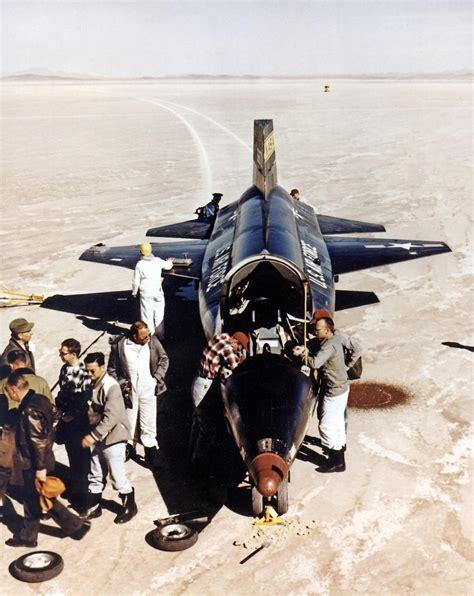
The North American X-15 was not just an aircraft; it was an experimental missile-shaped rocket plane that pushed the boundaries of aviation and aerospace technology. Built during a time when humankind was still grasping the edges of outer space, the X-15’s mission was simple in ambition yet monumental in execution: fly faster, fly higher, and return with vital data that would shape the future of spaceflight. But among its many marvels, its landing technique remains one of the most distinct and daring elements in aviation history.
The Birth of a Hypersonic Vision
In the late 1950s, the U.S. Air Force and NASA, in collaboration with North American Aviation, sought a testbed aircraft that could exceed Mach 5 and operate at the edge of the atmosphere. What emerged was the X-15, a jet-black aircraft with stubby wings, a long fuselage, and a rocket engine so powerful that it generated over 500,000 horsepower, thanks to its XLR99 engine fueled by ammonia and liquid oxygen.
The X-15 wasn’t just fast — it was the fastest manned aircraft ever flown, reaching speeds of 4,520 mph (Mach 6.7), a record set by pilot Pete Knight in 1967 that still stands unbroken. It also soared to an altitude of 354,200 feet, essentially touching space. But what made this all possible — and survivable — was a cocktail of high-temperature metal alloys, cutting-edge engineering, and nerve from the pilots strapping themselves into the cockpit.
The Problem Beneath the Belly: A Fin That Had to Fall Away
While launching from a modified B-52 Stratofortress, the X-15 would be dropped mid-air, igniting its rocket engine to begin an intense 10-minute flight of either ultra-high altitude or top-speed testing. But coming back down was just as extreme as going up. The X-15’s unique underbelly featured a ventral stabilizer fin — an enormous aerodynamic aid that kept the aircraft stable during high-speed flight. However, this very component posed a massive obstacle to landing safely.
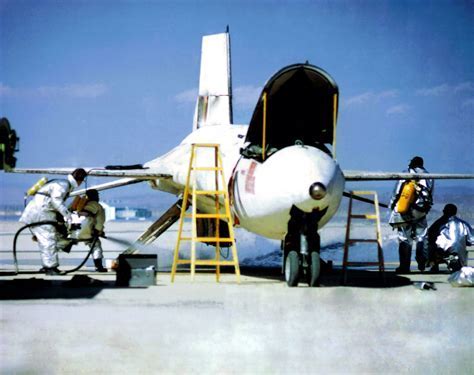
This fin extended further down than the aircraft’s actual landing gear. As a result, it had to be jettisoned before landing, parachuting to the ground separately. Only then could the two rear skids and one small forward wheel do their job. This approach created a visual and mechanical landing process that was closer to skiing across a lakebed than conventional runway landings.
A Skid, Not a Wheel: Landing on the Edge
Unlike commercial or military jets, the X-15 didn’t use traditional wheels under its wings. The rear of the aircraft was outfitted with steel skids — simple, durable, and effective for sliding along the dry lakebeds of Rogers Dry Lake in California, the preferred site for its landings. The nose wheel, meanwhile, was unsteerable, which meant precise directional control was impossible once the aircraft touched down. The choice of skids over wheels was dictated by physics: wheels would likely have collapsed or exploded under the stress of such a landing at the speeds and angles involved.
Landing the X-15 was as much about surviving the descent as it was about the touchdown. Descending from altitudes exceeding 200,000 feet, pilots would begin their glide path from as high as 20,000 feet while still flying at supersonic speeds — often above 1,500 mph. With no engine power during landing (the engine only burned for a brief phase), the glide had to be calculated with surgical precision. There were no second chances.
Supersonic Glide to Controlled Chaos
The X-15 was not powered during landing, making it a true glider — albeit one returning from the edge of space. Pilots had to execute carefully calculated descent trajectories using only the aircraft’s momentum, relying on both aerodynamic control surfaces and, in high altitudes, reaction control thrusters fueled by hydrogen peroxide. These thrusters allowed pilots to make orientation adjustments where the air was too thin for traditional aerodynamic control.
Once within the denser atmosphere, control surfaces took over, but by then, temperatures on the skin could exceed 1,200 degrees Fahrenheit, and the pilot had only seconds to make course corrections. The X-15 would descend steeply, then flare out close to the ground and skim across the lakebed at high speed until the skids dug in and friction brought the aircraft to a halt.
A Dangerous Game: Human Cost and Triumph
Only three X-15 aircraft were ever built, and across 199 total flights between 1958 and 1968, the program produced both unprecedented data and unimaginable peril. The pilots who climbed into the cockpit were the elite — among them Neil Armstrong, who flew the X-15 seven times before becoming the first man on the Moon. Others, like John McKay and Michael Adams, paid dearly for their bravery.
In 1962, McKay was seriously injured during a rough landing. In 1967, Adams lost his life when a control malfunction caused the X-15 to enter a deadly spin at extreme altitude. The crash revealed critical weaknesses in the aircraft’s guidance system and led to an even deeper understanding of aerodynamic control in thin-atmosphere environments.
Despite these risks, the X-15 program was a massive success in terms of scientific return. The data collected informed not only later aircraft but directly influenced the design of the Space Shuttle, including its own unpowered glide landings on dry lakebeds.
Engineering for Hypersonic Punishment
The X-15’s outer structure was made from Inconel X, a nickel-chromium alloy capable of withstanding extreme thermal stress. This allowed the aircraft to survive the friction-induced heat of hypersonic flight without disintegrating. For pilot safety, the cockpit was reinforced with aluminum, and custom-built pressure suits were used — complete with life support systems capable of managing pressure, temperature, and oxygen delivery at altitudes where human survival would otherwise be impossible.
These suits were the precursor to those later worn by astronauts. In fact, X-15 pilots earned astronaut wings if they exceeded 264,000 feet, the edge of space by Air Force definition.
Legacy of the X-15’s Landing Innovation
The North American X-15’s landing technique wasn’t a workaround — it was a necessity born from the extremes of its mission. By removing the ventral fin mid-air and switching to skid-based landings, engineers created a low-weight, low-failure landing system suitable for dry lakebeds — and nowhere else. But the choice allowed the X-15 to focus on performance where it mattered: speed, altitude, and data acquisition.
NASA and the Air Force gleaned insights from the program that changed the trajectory of space exploration and aerospace engineering. Everything from thermal shielding, trajectory computation, control in near-space conditions, and pressure suit development took significant strides forward thanks to this aircraft.
Though rudimentary by today’s fly-by-wire standards, the X-15’s pure reliance on pilot skill and minimal onboard automation placed it in a class of its own. Every successful flight and landing was a triumph of human ingenuity — not just in building the machine, but in flying it back to Earth.
Final Descent: A Skid Into Aviation History
The X-15’s landing approach — beginning at hypersonic speed, shedding a crucial part mid-air, and skidding silently to a halt on a desert floor — stands today as a symbol of engineering ingenuity and piloting bravery. No modern aircraft lands the way the X-15 did, and none have had to.
It was a relic of a unique era, one where space wasn’t yet conquered, but where the first real attempts to touch it were made by men in black rocket planes, descending silently from the edge of space.