The market narrative around Boeing in 2025 looked, at first glance, almost paradoxical. Headlines were dominated by program delays, regulatory scrutiny, and lingering questions about quality control. Yet beneath that noise, equity markets steadily recalibrated expectations, rewarding operational progress over perfection. Investors did not ignore Boeing’s problems; they repriced them. The result was a stock that outperformed the broader market even as the company absorbed multibillion-dollar charges and pushed marquee programs further into the future.
This outcome reflects a deeper truth about cyclical industrial turnarounds. Markets move not on absolute conditions but on directional change, credibility, and forward cash-flow inflection points. Boeing’s 2025 performance was less a vote of confidence in flawless execution and more a bet that the worst had passed, that production discipline was returning, and that deliveries would once again translate into sustainable cash generation.
By the end of the year, Boeing had been transformed in the eyes of investors—from a company priced for survival into one priced for recovery. Understanding why requires looking past the delays and into the mechanics of production rates, backlog monetization, and investor psychology.
A Year Defined by Delays, Yet Not by Defeat
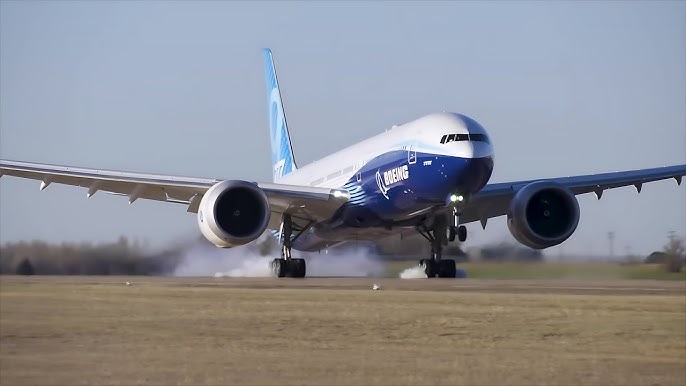
Operationally, 2025 was not kind to Boeing’s reputation. The most visible setback came from the 777X program, where first deliveries were again pushed back, this time to 2027. The delay triggered a roughly $5 billion program charge, reinforcing perceptions that Boeing’s widebody portfolio remained trapped in development purgatory.
At the same time, the company continued to operate under tight FAA oversight, with production caps and quality audits shaping every manufacturing decision. These constraints slowed output and complicated supply chain coordination, especially across the narrowbody and widebody lines. In a traditional industrial cycle, such conditions would almost certainly translate into prolonged share price underperformance.
But markets are rarely linear. Investors began to view 2025 as a bridge year, not a terminal one. Rather than focusing solely on what was delayed, they increasingly emphasized what was stabilizing. The shift in narrative mattered because Boeing’s valuation had already priced in catastrophe. Any credible evidence of progress—however incremental—had outsized impact.
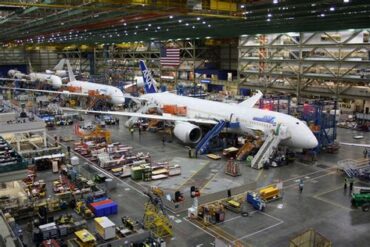
By midyear, production metrics started to tell a different story. Boeing’s 737 MAX line, long the focal point of regulatory scrutiny, reached a sustained output of 38 aircraft per month. More importantly, the FAA later cleared the company to raise production to 42 per month, a signal that oversight was evolving from crisis management toward conditional trust.
This was not a declaration of victory, but it was a tangible step forward. For investors, it marked the transition from planning to execution.
Why the Market Rewrote Boeing’s Valuation Story
Boeing entered 2025 trading at what many analysts described as a survival discount. The stock reflected balance sheet stress, reputational damage, and fears that regulatory headwinds could permanently impair profitability. As those fears began to soften, the market recalibrated.
From January to year-end, Boeing shares climbed from roughly $171 to above $218, delivering gains of more than 22%. Over the same period, the S&P 500 returned around 18%, making Boeing a modest but meaningful market outperformer. The timing of those gains is telling. Much of the outperformance arrived late in the year, when confidence in forward cash flow solidified.
This was not driven by headline news alone. In fact, some of Boeing’s worst announcements—including the 777X delay—landed midyear and weighed on shares temporarily. What ultimately mattered was the accumulation of operational datapoints that supported a recovery thesis: production-rate approvals, improving delivery cadence, and credible management guidance.
The market did not reward Boeing for solving every problem. It rewarded the company for demonstrating control over the problems that mattered most to cash flow.

Production Rates as the Market’s Primary Signal
For a highly levered manufacturer like Boeing, production rates are not abstract metrics. They are the direct drivers of revenue recognition, working capital normalization, and debt service capacity. Every incremental aircraft delivered converts inventory into cash and reduces balance sheet pressure.
The FAA’s approval to lift 737 MAX production to 42 aircraft per month was therefore a critical inflection point. It signaled that Boeing’s quality systems were sufficiently robust to support higher throughput under regulatory supervision. For investors, this reduced the probability of prolonged stagnation.
Simultaneously, 787 Dreamliner deliveries continued to rebuild. While widebody demand is more cyclical, the 787 remains a cornerstone of Boeing’s long-term profitability. Each resumed delivery helped validate the thesis that Boeing’s backlog—valued at more than $600 billion—was not theoretical demand but deferred revenue waiting to be unlocked.
This reframed the equity story. Instead of asking whether demand existed, investors began asking whether Boeing could execute. That shift alone justified a higher valuation multiple, even in the absence of near-term earnings strength.
December’s Breakout: Cash Flow Took Center Stage
The most decisive moment in Boeing’s 2025 stock performance arrived in December. During a conference hosted by UBS, Boeing CFO Jay Malave stated that the company expected free cash flow to inflect positively in 2026, reaching the low single-digit billions.
This comment landed with force because it directly addressed the market’s biggest concern: cash. Boeing’s recent history has been defined by cash burn, debt accumulation, and refinancing risk. A credible path back to positive free cash flow changed the conversation overnight.
Investors began to anchor valuations on future cash generation rather than past missteps. Production approvals, delivery trajectories, and backlog conversion became the dominant analytical framework. As these datapoints aligned, December saw a nearly 16% surge in Boeing shares, dramatically outpacing both the broader market and the Aerospace & Defense sector.
Momentum amplified the move. Year-end liquidity conditions, risk-on sentiment, and momentum-driven funds chasing breakouts created a self-reinforcing cycle. What began as a fundamental re-rating quickly took on technical characteristics.

Defense Contracts Added a Layer of Stability
While commercial aviation dominates headlines, Boeing’s defense business played a subtle but important role in supporting the stock. Late in the year, the company benefited from a $2 billion Pentagon engine-replacement order tied to the B-52 modernization program.
Defense revenues offer something commercial programs cannot: predictability. In an environment marked by geopolitical tension and rising defense budgets, Boeing’s exposure to long-cycle military contracts provided diversification and downside protection. This helped reassure investors that Boeing’s earnings profile was not solely dependent on flawless commercial execution.
The market rewarded this diversification, particularly as defense peers across the sector delivered strong returns in 2025. Boeing did not lead the sector, but it no longer lagged it either—a meaningful shift after years of underperformance.
The Risks Embedded in Boeing’s Rising Valuation
Despite its market-beating performance, Boeing’s valuation remains fragile. The stock is now pricing in a multi-year execution rebound while the company is still rebuilding production stability, supplier health, and internal quality culture.
Analysts projecting a return to positive free cash flow in 2026 are implicitly assuming continued progress across several fronts: sustained 737 production increases, improving 787 deliveries, and no major regulatory setbacks. Any slippage in these assumptions could trigger rapid re-ratings.
The balance sheet adds another layer of risk. Boeing carries roughly $54 billion in total debt, with more than $40 billion in net debt. Significant maturities loom in 2026 and 2027. If cash flow disappoints, refinancing could become more expensive, increasing interest expense and eroding equity value.
The 777X program remains a persistent wildcard. With more than $4.5 billion in charges already absorbed, further delays would strain both investor patience and financial flexibility. The program’s importance to Boeing’s widebody strategy means it cannot be quietly sidelined.
Certification Delays: The Risk Investors May Be Underestimating
One of the most debated aspects of Boeing’s rerating is whether the market is adequately pricing certification risk. The 737 MAX 7 and MAX 10 variants remain uncertified, with unresolved design issues such as engine anti-ice systems and cockpit alerting architecture.
As of late 2025, the FAA continued to lead the certification process, signaling that timelines remain uncertain. These variants are not niche products. They are central to airlines’ fleet strategies, offering lower unit costs and higher seating density without additional crews.
Delays have real commercial consequences. Airlines may extend older fleets, adjust growth plans, or deepen commitments to Airbus alternatives. Over time, this can translate into compensation claims, pricing pressure, and competitive erosion—risks that are difficult to quantify but material to long-term value.
The market’s willingness to look past these uncertainties suggests confidence in Boeing’s eventual resolution. Whether that confidence is justified remains an open question.
Sector Context: Boeing’s Performance in Perspective
In 2025, the broader Aerospace & Defense sector was a standout performer. The S&P Aerospace & Defense Select Industry Index climbed roughly 39%, far exceeding the broader market’s return. Against that backdrop, Boeing’s 22% gain appears more measured than exuberant.
This context matters. Boeing did not outperform because it was the best-positioned aerospace name. It outperformed because it moved from deeply discounted to cautiously optimistic territory. Investors rewarded improvement, not dominance.
On the commercial side, demand remained robust across the industry, but supply chain constraints limited delivery growth. This dynamic benefited aftermarket and MRO providers, as airlines kept aircraft in service longer. Boeing’s exposure to these dynamics was indirect but supportive, reinforcing the view that demand destruction was not the issue.
Looking Ahead: Why 2026 Matters More Than 2025
Boeing’s stock performance in 2025 was not a verdict on its past; it was a wager on its future. The market is now focused squarely on 2026 as the year when operational recovery must translate into tangible financial results.
If production ramps continue, certifications progress, and free cash flow turns positive as guided, Boeing’s rerating could prove durable. The company would then be positioned to gradually de-lever, restore balance sheet strength, and reassert itself as a reliable industrial compounder.
If, however, execution falters or regulatory setbacks resurface, the current valuation leaves little margin for error. The same leverage that amplified gains could magnify losses.
In that sense, Boeing’s market outperformance despite a year of delays reflects a simple but powerful truth: markets reward momentum and credibility, not perfection. In 2025, Boeing delivered just enough of both to change the narrative—and that was enough to beat the market.