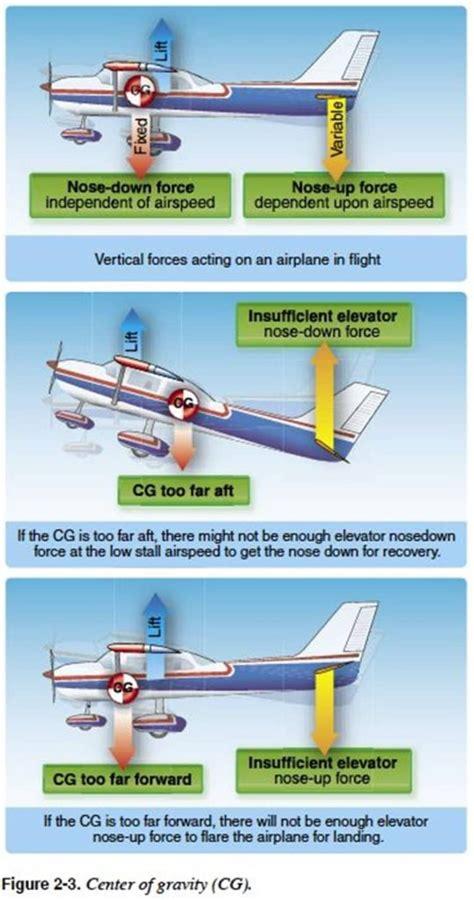
Centre of Gravity (CG)
The Centre of Gravity (CG) of an aircraft is the point where the entire weight is thought to be concentrated. This theoretical point is crucial for balance. In simple terms, if you could hang the airplane from this point, it would remain perfectly balanced.
The CG’s location plays a significant role in the aircraft’s stability. It must stay within specific limits set by the manufacturer to ensure safe operations. While both lateral and longitudinal balance matter, the main focus is on longitudinal balance. This refers to where the CG sits along the length of the aircraft.
To determine the empty weight and the empty weight centre of gravity (EWCG), we use weighing scales along with a reference datum defined by the manufacturer. The total empty weight is the sum of the weights at different points. The EWCG is calculated using moments from these weighing points, the total empty weight, and the formulas found in the Aircraft Flight Manual (AFM).
For smaller aircraft and helicopters, the CG is measured in inches from the datum. In larger planes, the CG is often referenced concerning the wing’s width. Here, the EWCG can be expressed as a percentage of Mean Aerodynamic Chord (MAC), commonly called the “basic index.”
If any equipment is added or removed post-weighing, we can adjust the empty weight and EWCG mathematically. This involves calculating the moment from the changes and updating the basic index. In everyday operations, the basic index serves as a starting point for CG calculations. Weight and arm data for the entire aircraft load—like crew, passengers, cargo, fuel, and catering—are used to find moments. This total moment helps adjust the basic index to find the takeoff centre of gravity. Operators can perform CG calculations either mathematically or graphically, depending on their preference.