The evolution of modern warfare rarely follows a straight line. Instead, it loops—sometimes quite literally. In a striking convergence of past ambition and present necessity, Russia’s newly revealed ring-wing FPV drone has revived a long-abandoned American aerospace concept, bringing Lockheed’s experimental 1980s “ring wing” design back into the spotlight. What was once dismissed as impractical for commercial aviation is now being reimagined for the battlefield, where constraints, priorities, and success metrics look radically different.
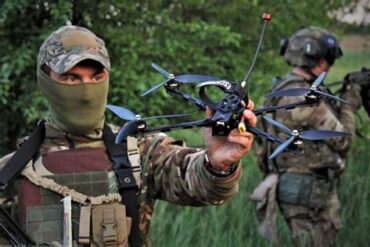
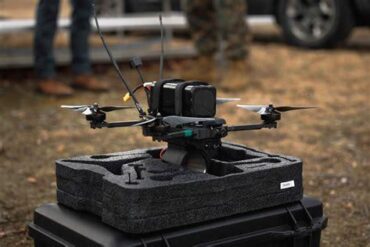
The timing is no coincidence. The Russia-Ukraine war has transformed drone warfare into a relentless cycle of innovation and countermeasure. FPV drones—cheap, adaptable, and devastatingly effective—have become the defining weapon of the conflict, reportedly responsible for over 80% of battlefield casualties. In such an environment, even the most unconventional aerodynamic ideas are being revisited with fresh urgency.
Against this backdrop, Ukraine’s recent downing of an unusual Russian drone revealed something unexpected: a quadcopter encased within a circular, ring-shaped wing. Days later, Russia confirmed the design with the unveiling of its KVS fiber-optic FPV drone, signaling not just a technological update—but a conceptual revival decades in the making.
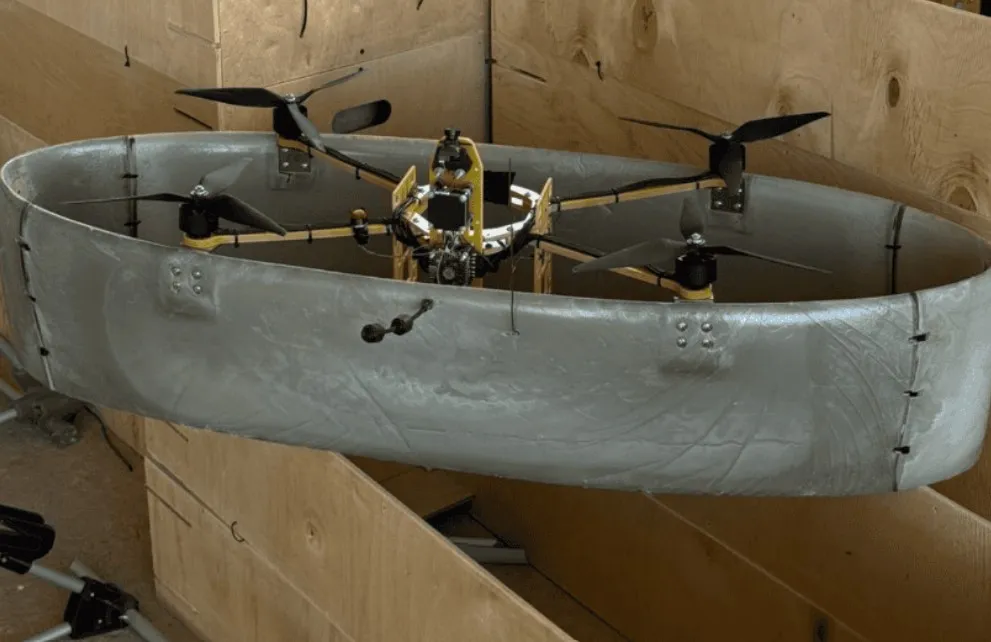
The KVS Ring-Wing FPV Drone: A Tactical Leap in Design
At first glance, the KVS FPV drone appears almost futuristic, blending the familiar geometry of quadcopters with a closed-loop aerodynamic structure. Built on a 10-inch frame, the drone is reportedly optimized for medium-range strike missions, with an estimated operational range of up to 50 kilometers—a significant reach for an FPV platform.
Its payload capacity is equally notable. Comparable to Russia’s Knyaz Vandal Novgorodsky drone, the KVS can reportedly carry warheads up to 3 kilograms, placing it firmly in the category of high-impact tactical drones. Yet what truly sets it apart is not its payload or range, but its ring-shaped wing, a design choice that directly challenges conventional drone engineering.
Experts suggest that the closed-wing structure enhances lift, reduces turbulence at the wingtips, and improves overall aerodynamic efficiency. In theory, this translates into longer flight times, greater payload capacity, and improved stability—all critical advantages in contested airspace.
But the KVS drone is not just about aerodynamics. Its fiber-optic control system makes it highly resistant to electronic warfare, effectively bypassing one of the most significant vulnerabilities of modern drones: signal jamming. This combination of aerodynamic innovation and electronic resilience positions the KVS as a formidable evolution in FPV drone design.
Lockheed’s Ring-Wing Vision: A Concept Ahead of Its Time
To understand the significance of Russia’s design, it’s necessary to revisit the 1980s, when Lockheed engineers explored the same radical idea—not for war, but for commercial aviation.
The Lockheed ring-wing aircraft was an ambitious attempt to rethink the fundamentals of flight. Instead of traditional wings extending outward, the aircraft featured a single continuous circular wing, forming a closed loop around the fuselage. The concept promised increased lift, reduced fuel consumption, and enhanced stability, particularly in crosswinds.
The proposed aircraft was anything but modest. With a wingspan of 170 feet and a circular structure rising 75 feet tall, it was designed to carry up to 120 passengers on short-haul routes. Its 27-degree arched wing seamlessly connected to the tail, creating a structure that looked more like science fiction than commercial aviation.
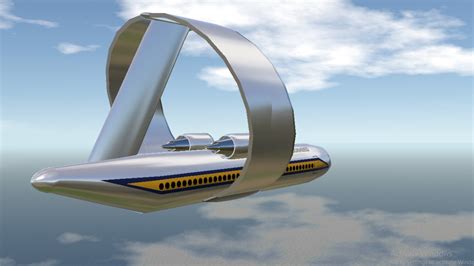
One of its most compelling advantages was efficiency. By eliminating wingtip vortices—those energy-draining swirls of air at the ends of traditional wings—the closed-loop design theoretically reduced drag and improved lift-to-drag ratios. The aircraft could also operate on shorter runways, making it ideal for regional travel.
And yet, despite its promise, the ring-wing aircraft never flew.
Why the Ring-Wing Aircraft Failed—And Why It’s Back
The failure of Lockheed’s concept was not due to a lack of imagination, but rather a clash between theoretical advantages and practical limitations. Chief among these was drag. While the closed-wing design improved lift, it also introduced significant aerodynamic resistance, offsetting much of the fuel savings.
Manufacturing posed another formidable challenge. Building a large, structurally sound circular wing required new materials, techniques, and assembly processes—driving up costs to impractical levels. At a time when aviation favored incremental efficiency gains over radical redesigns, the ring-wing concept simply couldn’t compete.
Yet what failed in the 1980s may succeed today for a simple reason: context has changed.
Modern drones operate under entirely different constraints. They are smaller, cheaper, and often disposable, allowing engineers to prioritize performance over longevity and cost-efficiency. Advances in computational fluid dynamics (CFD) and simulation tools now enable precise optimization of complex shapes that were once too difficult to refine.
In other words, the ring-wing design didn’t fail—it was just early.
From French Experiments to Modern Battlefields
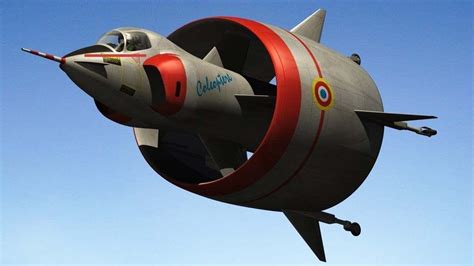
The origins of the ring-wing concept stretch even further back than Lockheed. Early French aviation experiments explored circular wing designs, including aircraft with dual ring structures—one at the front and another at the rear.
These early prototypes struggled to achieve sustained flight, often limited to short, unstable hops. The technology of the time simply couldn’t support the aerodynamic precision required for such unconventional designs. As a result, the concept faded into obscurity, resurfacing only occasionally in experimental research.
Today, however, those early limitations are being systematically dismantled. Recent research using Clark Y airfoil baselines and low-speed simulations has demonstrated that ring-wing configurations can achieve favorable lift-to-drag ratios, particularly when optimized for thickness, tapering, and structural integration.
These findings suggest that the ring-wing concept holds genuine aerodynamic potential, especially in applications where speed is secondary to endurance, stability, and payload capacity—precisely the conditions of modern drone warfare.
Aerodynamics Reimagined: Why Ring Wings Work for Drones
The key to understanding the resurgence of ring-wing designs lies in scale and purpose. For large passenger aircraft, the penalties of drag and manufacturing complexity proved fatal. For drones, those same factors are far less restrictive.
In a compact FPV drone:
- The closed-wing structure reduces energy loss, improving efficiency over longer distances.
- The design enhances structural rigidity, protecting internal components during high-speed maneuvers.
- It provides greater stability in turbulent conditions, a critical advantage in low-altitude combat environments.
Moreover, drones do not require the same fuel efficiency standards or passenger safety considerations as commercial aircraft. This freedom allows engineers to prioritize mission effectiveness over economic viability, making unconventional designs far more attractive.
The addition of fiber-optic guidance systems further amplifies these advantages. By eliminating reliance on radio signals, the KVS drone can operate in heavily contested electronic environments, maintaining control where traditional drones would fail.
The Future of Ring-Wing Technology in Warfare and Beyond
The reappearance of the ring-wing design in Russia’s KVS drone raises a compelling question: is this a niche innovation or the beginning of a broader trend?
Early indications suggest the latter. As both Russia and Ukraine continue to iterate on drone technology, designs that offer even marginal advantages can quickly become standardized across entire fleets. If the ring-wing configuration proves effective in real-world conditions, it could trigger a wave of copycat designs and rapid adoption.
Beyond the battlefield, the implications are equally intriguing. With modern simulation tools enabling precise optimization, the ring-wing concept may yet find a second life in commercial or hybrid aviation, particularly for short-haul or specialized aircraft.
However, significant challenges remain. As recent studies emphasize, real-world testing and structural optimization are still necessary to validate theoretical gains. Aerodynamics alone cannot guarantee success; durability, manufacturability, and cost will ultimately determine whether the design can scale.
What is clear is that the line between past and future innovation has blurred. A concept once dismissed as impractical is now flying—literally—at the forefront of modern warfare.
And in a conflict defined by rapid adaptation, even the most unconventional ideas can become decisive.