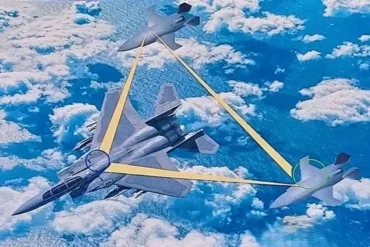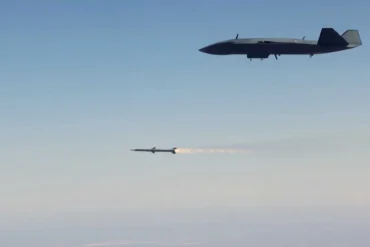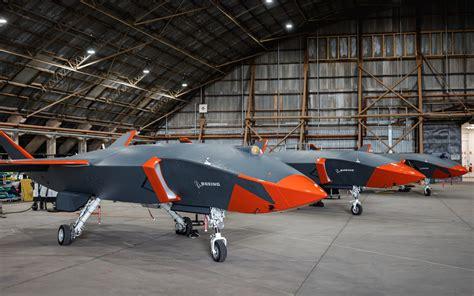
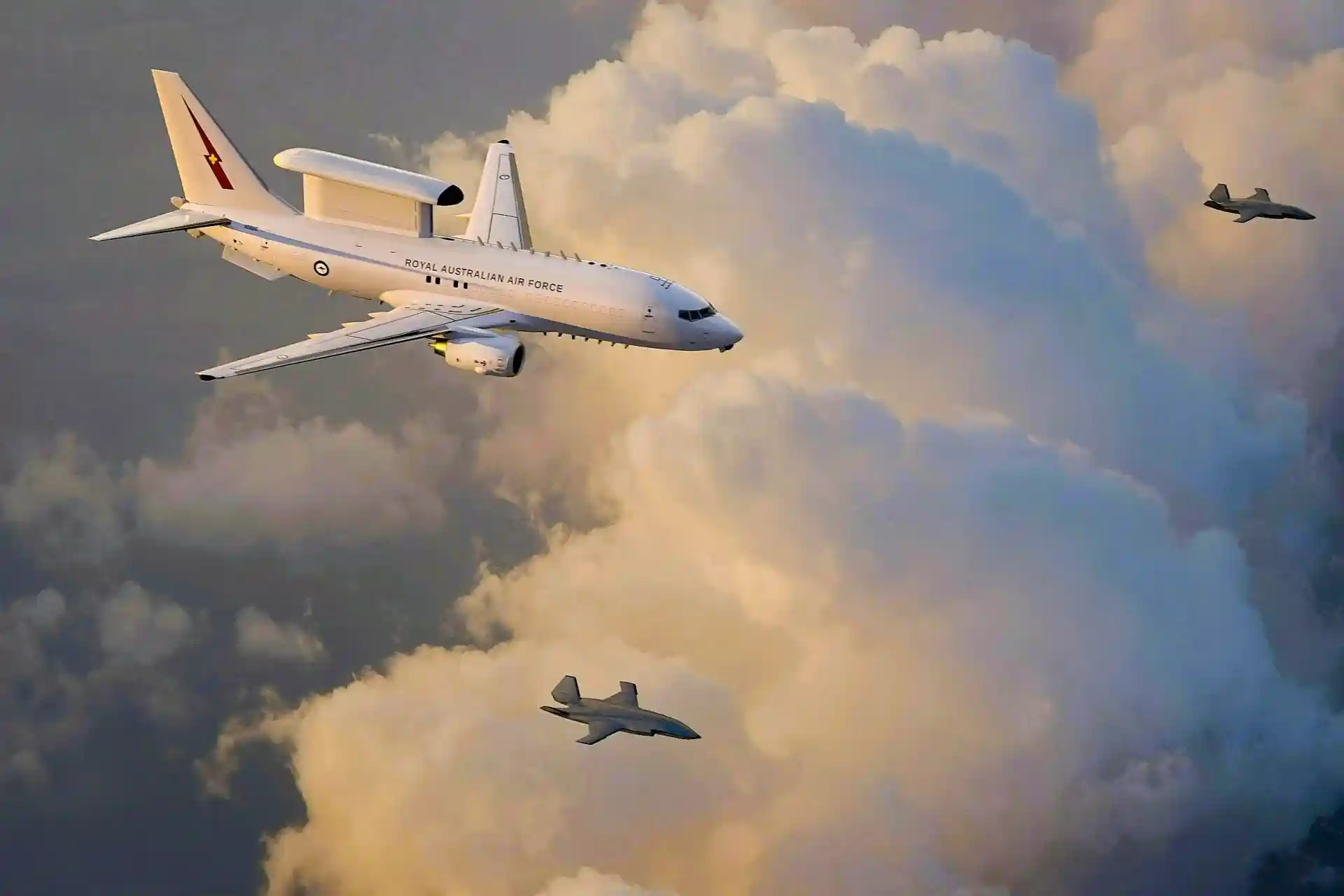
On June 16, 2025, the Royal Australian Air Force (RAAF) reached a defining moment in autonomous warfare capability by successfully controlling two MQ-28 Ghost Bat combat drones from a single operator aboard an E-7A Wedgetail aircraft. The demonstration, conducted over the Woomera Test Range in South Australia, marks the first time an airborne early warning and control (AEW&C) platform has orchestrated multiple autonomous drones in real-time flight, solidifying Australia’s commitment to networked air power and manned-unmanned teaming.
A Leap Forward in Airborne Command and Control
This successful trial, conducted under Capability Demonstration 2025 (CD25), signifies a transformative moment in the integration of uncrewed systems into the operational fold of the RAAF. Aboard the E-7A Wedgetail, a single crew member coordinated not only two live MQ-28 drones but also a simulated third aircraft, achieving seamless command and control across multiple platforms. The Ghost Bats, acting as forward-deployed sensors, relayed tactical information back to the mothership and the strike package, proving their worth as force multipliers in a contested and evolving battlespace.
The MQ-28 drones effectively extended the reach of the E-7A’s surveillance and strike capabilities, flying ahead to scout and provide early warning. This arrangement represents a critical expansion of situational awareness, allowing crewed aircraft to remain at safer standoff distances while autonomous assets conduct high-risk reconnaissance and targeting operations deep into hostile airspace.
MQ-28 Ghost Bat: Modular, Smart, and Combat-Ready
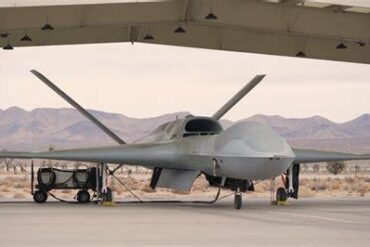
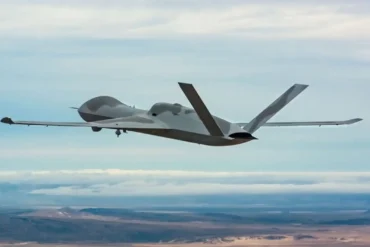
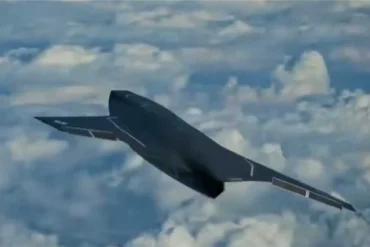
The MQ-28 Ghost Bat, developed by Boeing Defence Australia in partnership with Australia’s Defence Science and Technology Group and the U.S. Air Force Research Laboratory, is designed for autonomy, survivability, and flexibility. Its modular design, featuring an open architecture system, enables the rapid swapping of mission-specific payloads and streamlined integration into diverse operational environments.
At roughly 11.7 meters long, with a range exceeding 3,700 kilometers, the MQ-28 can operate alongside platforms such as the F/A-18F Super Hornet, F-35A Lightning II, and the P-8A Poseidon, supporting them as an autonomous wingman. With stealth shaping, internal weapons bays, and AI-assisted decision-making, the Ghost Bat is engineered for operations where speed, discretion, and adaptability are paramount.
The Role of the E-7A Wedgetail in the New Combat Ecosystem
The E-7A Wedgetail, based on the Boeing 737-700 platform, plays a central role in the RAAF’s aerial command-and-control architecture. Outfitted with the Northrop Grumman Multi-role Electronically Scanned Array (MESA) radar, the aircraft delivers 360-degree situational awareness, long-range target detection, and multi-domain coordination. Now, with demonstrated capability to command autonomous drones, the Wedgetail has transitioned from a passive sensor node into a dynamic battlefield orchestrator.
This expanded control role reshapes its tactical profile. By simultaneously coordinating multiple drones and distributing command functions to onboard crew, the Wedgetail can assume centralized control over decentralized assets, facilitating real-time responsiveness across vast operational areas, particularly relevant in the Indo-Pacific theatre where geography demands wide-area surveillance and rapid mobility.
Human-Machine Teaming: The Future of Combat
What sets this event apart is not merely technological execution but the philosophy of warfare it represents. The successful management of multiple drones by a single operator demonstrates a shift towards human-machine teaming, where artificial intelligence and autonomy extend human cognitive reach rather than replace it. This reduces operator burden, enhances decision-making speed, and enables missions that would otherwise be infeasible with traditional manned aircraft alone.
As the RAAF embraces this model, a single pilot or sensor operator will be able to coordinate a swarm of semi-autonomous assets—each with its own onboard AI, mission parameters, and real-time adaptability. This facilitates a far more distributed and resilient force structure, capable of surviving in highly contested environments where peer or near-peer adversaries pose credible anti-access and area-denial threats.
Strategic Implications in the Indo-Pacific Region
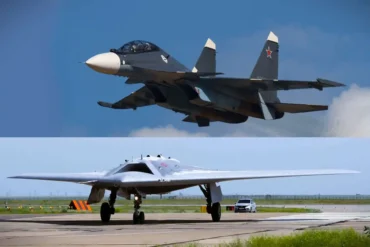
The strategic backdrop of this milestone cannot be overlooked. As geopolitical tensions simmer in the Indo-Pacific, particularly around Taiwan and the South China Sea, the ability to field and control autonomous assets from airborne platforms provides Australia and its allies with a decisive operational edge. With the People’s Liberation Army Air Force (PLAAF) ramping up its drone and fifth-generation fighter inventory, the West must find scalable ways to preserve superiority in both reach and survivability.
By delegating tasks such as surveillance, decoy, electronic warfare, and even precision strikes to uncrewed platforms like the MQ-28, the RAAF can reserve manned fighters for complex missions, thereby improving operational longevity and survivability. Additionally, this approach complicates adversary targeting, forcing them to contend with an ambiguous and distributed threat matrix.
Industry Partnerships and Defense Modernization
The success of this test owes much to the synergistic partnership between Boeing and the Australian defense establishment. Funded through initiatives such as CD25, this collaboration exemplifies how public-private partnerships and co-development with research institutions can rapidly transition technologies from concept to combat readiness.
Boeing’s role in this evolution is pivotal—not only in airframe manufacturing but in developing the underlying software architecture and secure communication protocols that allow seamless integration with legacy and future platforms. Their commitment aligns with broader defense modernization efforts seen across allied nations, where AI, autonomy, and network-centric warfare dominate strategic procurement priorities.
Expanding the Family-of-Systems Concept
The MQ-28’s integration into a “family-of-systems” framework points toward a broader doctrinal shift. Rather than deploying monolithic, high-value platforms, the RAAF is embracing an ecosystem of interoperable systems that support, protect, and amplify each other’s capabilities. The Ghost Bat complements the E-7A Wedgetail’s command role, the F-35’s strike profile, and the Super Hornet’s versatility, collectively creating a multi-domain combat web rather than isolated nodes of power.
In future iterations, this family could expand to include loyal wingman swarms, underwater drones linked via satellite relay, and AI-enabled battle management systems—all under the watchful orchestration of human operators who guide, rather than micromanage, the battlespace.
Road Ahead: Challenges and Future Development
While this trial signals a remarkable achievement, challenges remain. Cybersecurity, data fusion latency, contested-spectrum resilience, and AI-ethics must all be addressed to fully realize the operational benefits. Ensuring interoperability with U.S. and NATO systems will also be crucial as coalition warfare remains the most probable mode of engagement.
Furthermore, scalability will be the next benchmark. Controlling two drones is a tactical milestone, but true force multiplication lies in coordinating dozens of assets, across air, land, sea, and space domains. That will require not only advances in computing power and interface design, but new concepts of operation, war-gaming, and human training regimens tailored to an autonomy-rich battlespace.
Conclusion: A Defining Moment in 21st-Century Air Warfare
The June 16 test was more than a technological demonstration—it was a strategic bellwether. It showcased the rapid evolution of autonomous airpower and the emerging dominance of collaborative combat systems in 21st-century warfare. For the Royal Australian Air Force, this achievement underscores its readiness to lead the charge into a new era of networked, intelligent, and survivable air dominance.
The E-7A Wedgetail’s successful control of multiple MQ-28 Ghost Bat drones sends an unambiguous message to allies and adversaries alike: the future of combat is already airborne.