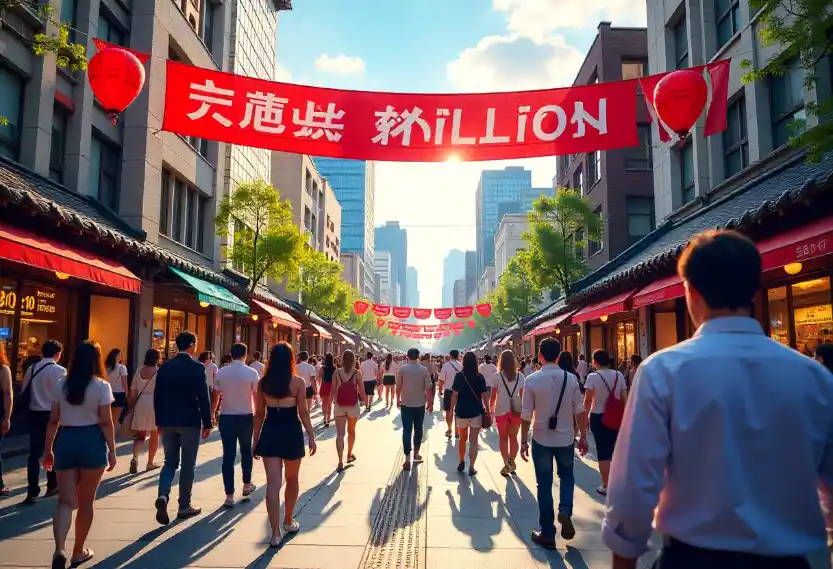
In a remarkable development, South Korea has achieved a significant milestone in June, with its foreign resident population surpassing two million. This increase not only underscores the country’s rising appeal as a destination for professionals, students, and workers from around the globe but also highlights its growing integration into the global community. Factors such as economic opportunities, a diverse array of industries, and robust educational institutions continue to draw individuals from various backgrounds, contributing to this record growth.
As per the latest government report released on Sunday, South Korea’s foreign population, which includes ethnic Koreans holding foreign citizenship, has reached an unprecedented 2.73 million. Among these, nearly a third are Chinese nationals, reflecting the strong ties between the two nations. As of the end of June, there were 1.56 million registered foreign nationals in South Korea, alongside 552,419 ethnic Koreans with foreign citizenship, according to immigration data from the Ministry of Justice. The country also welcomed 620,403 foreign visitors for short-term stays, including tourists, adding to the vibrant multicultural landscape.

This surge follows a significant decline in the foreign population during the COVID-19 pandemic. Before the crisis, South Korea’s foreign resident population had peaked at 2.52 million in 2019. However, due to travel restrictions and other pandemic-related disruptions, this number plummeted to 1.96 million by 2021. Fortunately, as the world gradually recovers from the pandemic, the foreign population has shown resilience, rebounding to 2.51 million by 2023. By the close of last year, the figure climbed to 2.65 million, indicating a robust recovery and a return to normalcy in international travel and migration.
Recent data indicates a 1.5 percent increase in the foreign resident population compared to the previous month, continuing this upward trend. A closer examination of the demographic breakdown reveals that Chinese nationals represent the largest segment, accounting for 35.6 percent of the total foreign population, equating to 972,176 individuals. Following them are Vietnamese nationals at 341,153, Americans at 196,664, Thais at 173,710, and Uzbeks at 98,457. This distribution not only highlights the diversity within South Korea’s foreign population but also illustrates its appeal to both neighboring Asian countries and Western nations.
The age profile of foreign residents in South Korea is particularly noteworthy. Nearly half of these individuals fall within the 20 to 39 age range, a demographic that largely comprises the workforce, students, and young professionals who have chosen South Korea for work, study, or entrepreneurial opportunities. In terms of visa status, the largest group, approximately 20 percent, holds F-4 visas, which cater to overseas Koreans. These individuals gain residency rights based on their ethnic Korean heritage. Around 12 percent of foreign residents are on E-9 visas, designed for non-professional workers, including laborers across various sectors. Other significant visa categories include F-5 permanent residency visas, D-2 student visas, and B-2 tourist visas, which collectively account for the remaining foreign population.
Geographically, a significant portion of South Korea’s foreign population resides in Seoul and its surrounding metropolitan area, which remains the country’s primary hub for employment, education, and business. More than 50 percent of foreign nationals live in this region, demonstrating the capital’s continued allure as a melting pot of cultures and opportunities. Meanwhile, other regions, including the central Chungcheong area and southern provinces, also host sizable foreign populations, particularly near industrial zones and major universities.
The increase in foreign residents correlates with broader trends of globalization. As South Korea enhances its appeal to talented individuals, skilled workers, and students worldwide, the influx of new cultural influences, skills, and perspectives enriches the nation’s social fabric. The ongoing expansion of immigration and international exchange is anticipated to further bolster the foreign resident population, playing a crucial role in South Korea’s strategy to strengthen its global ties, support economic growth, and nurture a more multicultural society.
Looking ahead, as South Korea continues to open its borders post-pandemic, the expectation is for the foreign population to keep rising. This growth is vital not only for the economy but also for fostering a society that embraces diversity and inclusivity. With the ongoing evolution of its demographic and economic landscape, South Korea is poised to become an even more dynamic and interconnected player on the global stage, shaping its future through the contributions of its increasingly diverse population.