Modern aircraft carriers represent one of the most advanced achievements in naval aviation, allowing fighter jets to operate far from land bases and project air power across oceans. One of the most impressive moments in carrier operations is the launch sequence, when a fully loaded aircraft accelerates from a stationary position on a moving ship and becomes airborne within seconds. The question of how fast fighter jets take off from an aircraft carrier reveals the incredible engineering behind naval aviation.
The speed required for a carrier launch is not achieved by the aircraft engine alone. Instead, specialized systems called catapults provide the extra acceleration needed to send fighters into the air. Modern carriers mainly use two types of launch technology: traditional steam catapults and the newer Electromagnetic Aircraft Launch System (EMALS). Both systems are designed to accelerate aircraft to roughly 165 mph or more before they leave the carrier deck.
How Aircraft Carrier Catapults Launch Fighter Jets
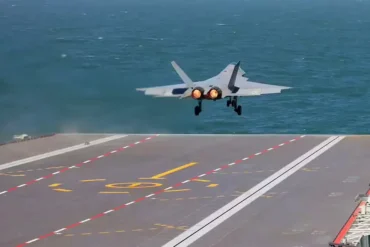
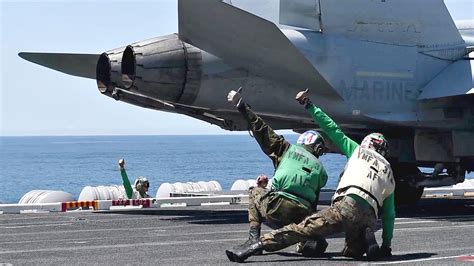
A fighter jet preparing for launch begins at a complete stop on the carrier’s flight deck. The aircraft is connected to the catapult system, and once the launch sequence begins, enormous force pushes it forward. Within only a few seconds, the jet reaches the required launch speed and travels beyond the deck edge into the open air.
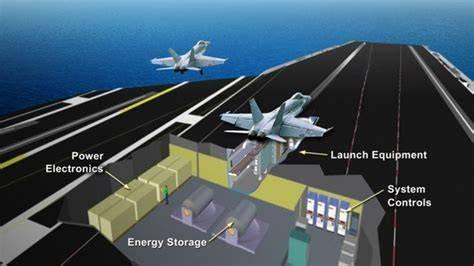
On Nimitz-class aircraft carriers, steam-powered catapults have been the standard launch method for decades. These systems use high-pressure steam stored below the flight deck to drive a piston that pulls the aircraft forward. A single launch can require around 1,200 pounds of steam, demonstrating the tremendous energy needed to move a fighter jet weighing many tons.
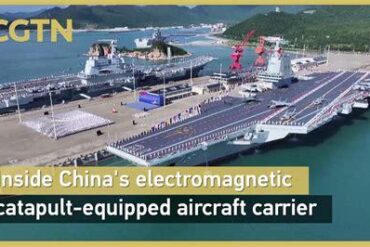
The newer EMALS technology, installed on the Gerald R. Ford-class carriers, replaces steam with electromagnetic force. This system uses a linear induction motor to smoothly accelerate aircraft from zero to more than 180 mph. Compared with older systems, EMALS reduces mechanical complexity, improves efficiency, and allows carriers to launch a wider range of aircraft.
The Forces Pilots Experience During Carrier Launches
A carrier takeoff is one of the most physically demanding experiences for a military pilot. During acceleration, pilots experience approximately 3 to 4 times the force of gravity, commonly called G-force. This intense pressure lasts for around two to three seconds as the aircraft rapidly moves from a standstill to launch speed.
The sudden acceleration pushes pilots backward into their seats while the aircraft moves down the short carrier deck. Although the experience is extreme, naval aviators train extensively to handle these conditions safely. Aircraft are also specially designed with reinforced landing gear and structures capable of surviving repeated launches and recoveries.
Why Carrier Launch Speed Matters
The ability to launch aircraft quickly gives an aircraft carrier a major strategic advantage. A carrier strike group can position dozens of fighters and support aircraft at sea and rapidly respond to military situations without depending on nearby airfields.
Launch speed is especially important during high-tempo operations. Modern carrier systems can launch aircraft approximately every 20 seconds when operating at maximum efficiency. This rapid cycle allows carriers to generate significant air power while maintaining flexibility during missions.
However, carrier launches involve more than simply achieving maximum speed. Engineers must balance aircraft weight, fuel load, weapons configuration, weather conditions, and catapult performance. A heavily armed fighter may require different launch settings compared with a lighter aircraft carrying fewer weapons.
The Future of Fighter Jet Carrier Takeoffs
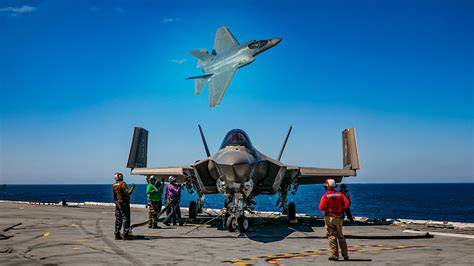
Although vertical takeoff aircraft have changed naval aviation possibilities, traditional catapult launches remain essential for large aircraft carriers. The ability to quickly launch heavier and more capable fighter jets makes catapult systems difficult to replace.
As more Ford-class aircraft carriers enter service, electromagnetic launch technology will continue improving. These systems represent the future of naval aviation by providing greater efficiency, reliability, and operational capability.
A fighter jet leaving an aircraft carrier may appear effortless from a distance, but the process involves incredible engineering, extreme forces, and precise coordination. Reaching more than 165 mph in just seconds, these launches demonstrate why aircraft carriers remain among the most powerful military platforms in the world.