When we board a commercial aircraft, takeoff usually feels routine. The engines spool up, the aircraft accelerates along the runway, the nose rises, and within seconds the airport disappears below us. Yet that familiar sequence becomes considerably more complicated when the runway is thousands of feet above sea level. At the world’s highest airports, the atmosphere itself becomes a significant part of the flight crew’s performance calculations.
Airports located above roughly 6,500 feet (2,000 meters) operate in an environment where the air is thinner and atmospheric pressure is lower. Those differences might be almost invisible to passengers, but they have a direct effect on an aircraft’s engines, wings, tires, runway requirements, fuel planning, and takeoff weight. A departure from an elevated airport therefore involves considerably more than simply using a longer runway.
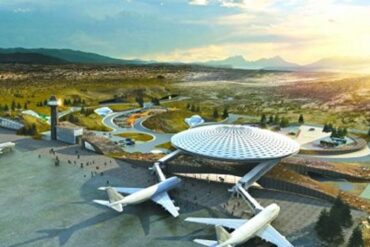
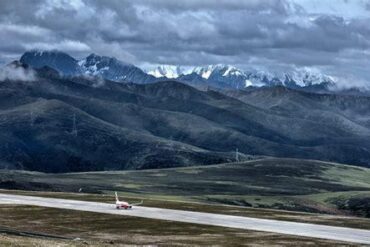
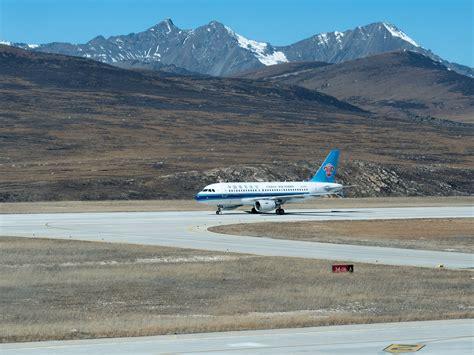
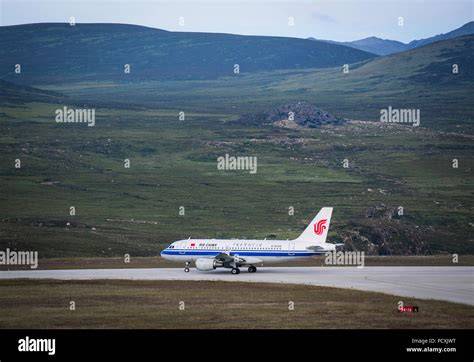
The effect becomes especially dramatic at airports on the Tibetan Plateau and in the Andes. Daocheng Yading Airport in China sits at approximately 14,472 feet (4,411 meters), while Qamdo Bamda Airport is even higher at around 14,764 feet (4,334 meters). At such elevations, aircraft and crews operate within performance margins that are very different from those encountered at airports close to sea level.
1. Thin Air Changes Aircraft Takeoff Performance
The first thing passengers may not realize is that air density has a major influence on takeoff performance. An aircraft needs enough air flowing over its wings to generate lift, while its engines need sufficient air mass moving through them to produce thrust. As altitude increases, atmospheric pressure falls and the air becomes less dense. The aircraft can still fly perfectly well, but it must reach the required aerodynamic conditions in a thinner atmosphere.
This creates a subtle but important distinction between indicated airspeed and true airspeed. The wings respond primarily to aerodynamic pressure rather than simply the aircraft’s speed across the ground. In thinner air, an aircraft may need a higher true airspeed to generate the same aerodynamic effect. Consequently, the aircraft can cover more ground while accelerating toward its takeoff speed.
The engines are affected as well. Jet engines depend on air entering their compressors, and thinner ambient air means less mass flow for a given volume of air. This reduces available thrust compared with the same aircraft operating at a lower elevation. The result is a takeoff roll that can require substantially more runway and a climb that may initially be less powerful.
A commonly used rule of thumb suggests that aircraft performance can decline by roughly 3% for every 1,000 feet of altitude, although this should never be treated as a universal calculation. Aircraft type, temperature, weight, engine configuration, runway condition, wind, and operating procedures all influence the actual result. At Aspen/Pitkin County Airport, for example, the elevation approaches 8,000 feet, creating a markedly different operating environment from a coastal airport.
This challenge has influenced aircraft design for decades. When Boeing was discussing future aircraft requirements with major American airlines in the late 1950s and early 1960s, United Airlines was particularly concerned about performance from its Denver hub, which was located at approximately 5,333 feet. Additional engine power became an important consideration because high-altitude operations could otherwise restrict aircraft performance.
2. Extremely Long Runways Give Aircraft More Room
The second hidden factor is runway length. When an aircraft needs more time and distance to accelerate, the most straightforward solution is to provide more pavement. That is why some of the highest airports in the world have remarkably long runways, even when their passenger demand might not appear to justify such infrastructure.
At Daocheng Yading Airport (DCY), the runway extends approximately 13,780 feet (4,200 meters). That is a substantial length under any circumstances, but it becomes particularly important when aircraft are departing from more than 14,000 feet above sea level. The runway provides additional space for an aircraft to build the required speed before reaching the point where it must become airborne.
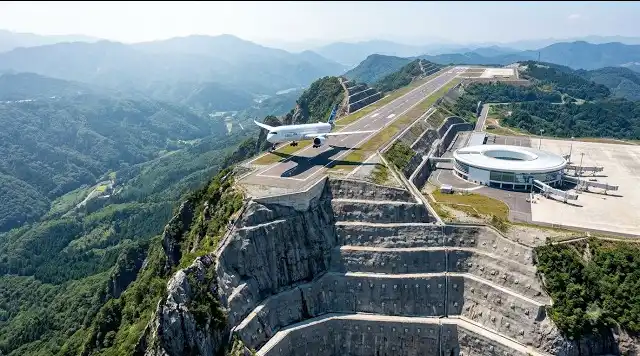
Qamdo Bamda Airport (BPX) provides an even more striking example. Located at roughly 14,764 feet (4,334 meters), it has historically been associated with an exceptionally long paved runway measuring about 18,045 feet (5,500 meters). A second runway measuring approximately 14,800 feet (4,511 meters) was opened in 2015. Such dimensions illustrate just how seriously airport planners must account for the performance penalty created by elevation.
Runway length also matters after landing. An aircraft arriving at a high-altitude airport may have higher true and ground speeds than passengers expect. Although braking systems remain highly capable, additional runway provides a valuable safety margin for deceleration. High elevation therefore affects both ends of the flight: aircraft need sufficient pavement to accelerate before departure and enough distance to slow safely after arrival.
3. Hot Weather Can Make High-Altitude Takeoffs Harder
Elevation is only half of the problem. Temperature can make a high-altitude departure significantly more demanding, producing what aviation professionals commonly describe as a hot-and-high operation.
Warm air is less dense than cool air. At an elevated airport, the atmosphere is already relatively thin because of altitude. When temperatures rise, density decreases further. The combined effect can reduce both aerodynamic lift and engine thrust, making an aircraft’s performance margins tighter than they would be on a cool day at the same airport.
This is why passengers may encounter restrictions that seem mysterious. An aircraft might have plenty of empty seats, yet the airline may still refuse to sell additional tickets. Cargo might be left behind. Fuel planning may be adjusted. A flight could even be scheduled for a different time of day. These decisions are not necessarily related to commercial demand; they can be direct consequences of aircraft performance limitations.
Airlines often prefer cooler periods, particularly early morning or later evening, when the temperature is lower and air density is higher. A flight departing before sunrise can therefore have more favorable performance characteristics than the same flight leaving during the hottest part of the afternoon.
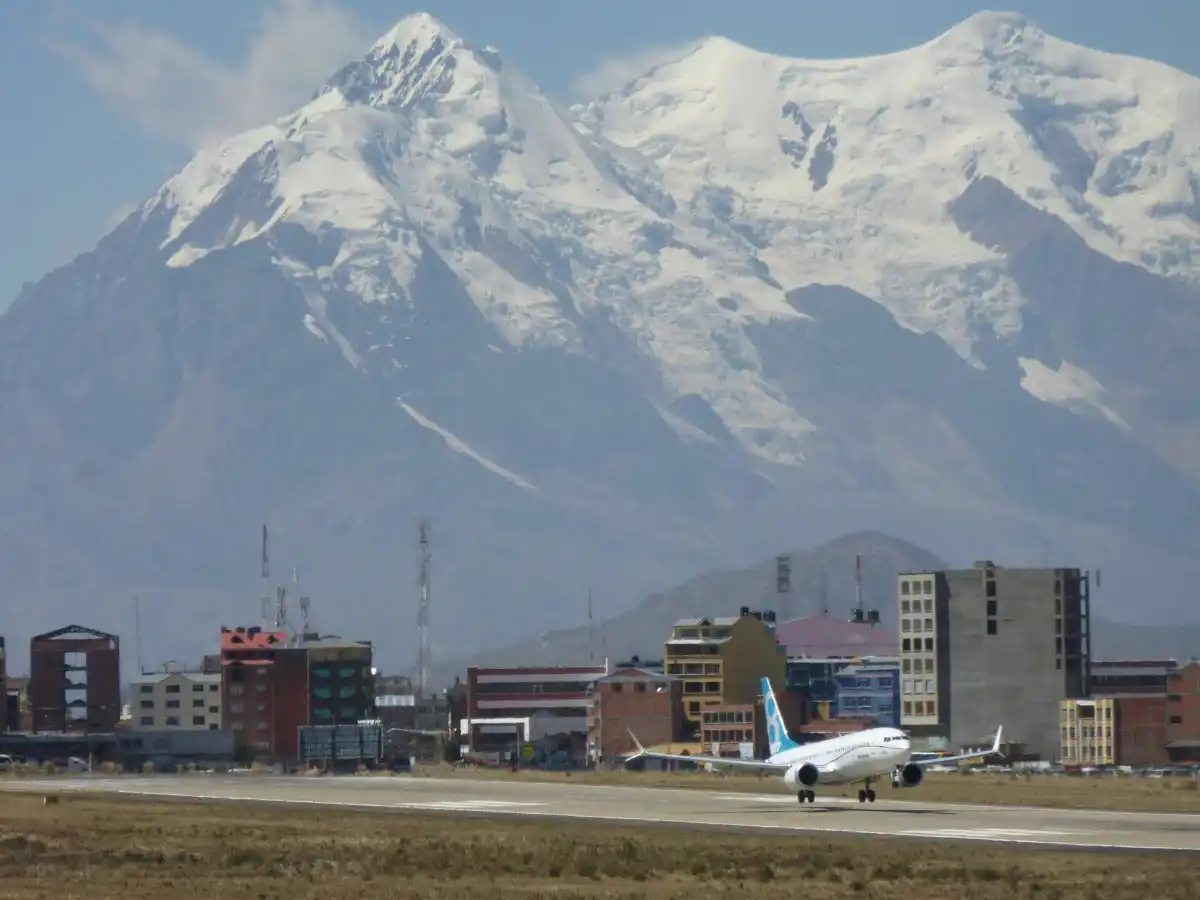
The same principle affects airports such as El Alto International Airport near La Paz, Bolivia, where the elevation is approximately 13,327 feet (4,062 meters). The combination of extreme elevation and seasonal temperature variations makes performance planning especially important. What passengers experience as a simple departure time can therefore reflect detailed calculations performed long before the aircraft reaches the runway.
4. Aircraft Tires Face Higher-Speed Demands
One of the least obvious effects of high-altitude operations involves something passengers rarely think about: aircraft tires. We normally associate tires with weight and braking, but their certified speed capability also becomes important when an aircraft operates from a high-elevation runway.
Because the air is thinner, the aircraft generally needs a higher true airspeed to generate the aerodynamic lift required for takeoff. Depending on the wind conditions, this can translate into a higher ground speed. The tires must therefore withstand the rotational and mechanical stresses associated with these higher speeds while carrying enormous loads.
Modern aircraft tires are engineered to tolerate extraordinary conditions. They can support extremely heavy aircraft and operate at speeds approaching 235 mph (378 km/h) in appropriate applications. Nevertheless, certification requirements must account for the most demanding combinations of aircraft weight, takeoff speed, field elevation, and temperature.
The European Union Aviation Safety Agency (EASA) incorporates these considerations into aircraft tire certification requirements. High-altitude airports can therefore influence equipment specifications in ways passengers would never notice. There is no obvious visual clue from the cabin that an aircraft’s tires have been selected or certified with a particular operating environment in mind.
This is an excellent example of how high-altitude aviation extends beyond engines and wings. The entire aircraft must be capable of handling the environmental conditions. A departure from a plateau airport is a system-level challenge involving propulsion, aerodynamics, landing gear, tires, runway length, aircraft weight, and operational procedures.
5. Flight Crews May Need Supplemental Oxygen Before Takeoff
Perhaps the most surprising detail concerns the people operating the aircraft. Passengers are protected from the thin outside atmosphere by the pressurized cabin, but the situation changes when the aircraft is parked at an extremely high-altitude airport with its doors open.
Commercial aircraft typically maintain a cabin altitude equivalent to roughly 7,000 feet during cruise, even when flying at 35,000 feet or higher. This allows passengers and crew to breathe comfortably without being exposed directly to the extremely thin air found outside the aircraft.
At an airport such as El Alto International Airport, however, the outside elevation exceeds 13,000 feet. Once the aircraft doors are opened at the gate, the crew is physically exposed to an atmosphere that contains considerably less available oxygen than at sea level.
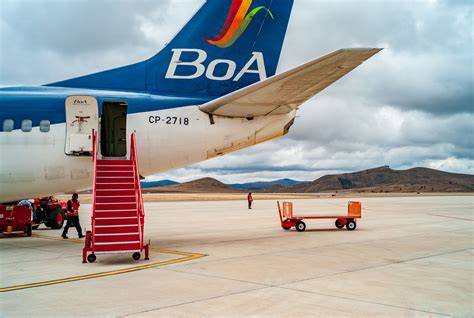
For that reason, flight crews operating at exceptionally high-altitude airports may use supplemental oxygen while the aircraft is parked. Procedures vary by airline and operation, but oxygen can be used as a precaution while the aircraft remains exposed to the high-altitude environment. Once the aircraft takes off and the pressurized cabin reaches its normal operating conditions, the situation changes.
For passengers, this can be an unusual sight. We may see pilots wearing oxygen equipment at the gate and assume something is wrong with the aircraft. In reality, it can be a normal operational procedure associated with the airport’s extreme elevation. The aircraft may be perfectly serviceable; the environment is simply demanding.
Why High-Altitude Takeoffs Feel Normal to Passengers
Despite all these challenges, a passenger sitting inside a modern airliner may notice almost nothing unusual during a high-altitude departure. That is precisely what sophisticated aviation planning is designed to achieve. The difficult calculations happen before the aircraft begins its takeoff roll.
Dispatchers determine whether the aircraft can depart at its planned weight. Pilots review temperature, pressure, runway conditions, wind, terrain, and performance data. Airlines may restrict payload, adjust fuel, select a cooler departure time, or modify operational procedures. The runway itself may be unusually long because airport planners have already accounted for the limitations imposed by the atmosphere.
The mountains surrounding some of these airports add another layer of complexity. A high-altitude departure is not simply a longer version of a normal takeoff. The aircraft must achieve sufficient climb performance after becoming airborne, and terrain can make that performance especially important. Every kilogram loaded onto the aircraft can matter when the available thrust and lift are reduced by environmental conditions.
The world’s highest civil airports demonstrate just how adaptable commercial aviation has become. Daocheng Yading, Qamdo Bamda, El Alto, and other elevated airports connect remote communities and major destinations despite operating in environments that would have presented formidable challenges to earlier generations of aircraft.
For passengers, the lesson is simple but fascinating: a takeoff that looks completely ordinary from the cabin can represent an intricate performance exercise behind the scenes. Thin air, extreme elevation, high temperatures, runway length, tire speed, aircraft weight, and crew procedures all play a role. The next time an aircraft accelerates down a runway more than 13,000 feet above sea level, that apparently routine takeoff will be anything but routine.