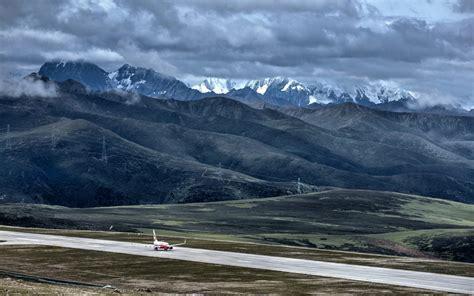
Commercial aviation is designed around predictable physics: dense air, long runways, and engines that breathe easily. Yet in a few rare corners of the planet, aircraft routinely defy those comfortable assumptions. The world’s highest altitude airports still in operation stand thousands of meters above sea level, where thin air erodes lift, stretches takeoff rolls, and punishes both machine and human physiology. These airports are not anomalies; they are lifelines—strategic, economic, and cultural arteries connecting some of the most remote highlands on Earth.
Most major international hubs sit close to sea level for a reason. As altitude increases, air density decreases. That single variable quietly reshapes everything. Jet engines ingest less oxygen, producing less thrust. Wings slice through thinner air, generating less lift at a given speed. Aircraft must accelerate faster to fly, which demands longer runways. Pilots must factor in reduced climb performance and tighter margins. Every departure becomes a precise calculation rather than a routine roll down asphalt.
Only a tiny fraction of global airports sit above 6,500 feet (2,000 meters). Fewer still cross the extreme threshold of 14,000 feet (4,267 meters). Yet on two colossal high plateaus—the Tibetan Plateau in Asia and the Altiplano in South America—aviation has carved out permanent footholds at elevations that feel closer to mountaineering than metropolitan travel.
The Physics of Flight at Extreme Elevation
At high-altitude airports, “density altitude” becomes the defining concept. Density altitude refers to the altitude corrected for nonstandard temperature. On a warm day in a high plateau city, the aircraft can perform as if it were operating at an even higher elevation than the airport’s official figure. In practice, that means slower acceleration, longer takeoff distances, and reduced climb gradients.
To compensate, airport designers stretch runways to extraordinary lengths. Aircraft weight is often restricted, limiting passenger loads or cargo. Specialized pilot training becomes mandatory. Performance charts are studied with the seriousness of a laboratory experiment, because at 14,000 feet, the difference between acceptable and unsafe is measured in margins thinner than the air itself.
These are not hypothetical constraints. They define daily operations at the highest altitude airports still serving scheduled commercial flights.
The Tibetan Plateau: The Planet’s Aviation Roof
The Tibetan Plateau is the world’s largest and highest plateau, averaging around 14,800 feet (4,500 meters). It spans far beyond the Tibet Autonomous Region, extending into Qinghai, Sichuan, Xinjiang, and Gansu, and touching the fringes of Nepal, India, Bhutan, Pakistan, Tajikistan, and Kyrgyzstan. In aviation terms, it is unmatched. The highest concentration of operational high-altitude airports on Earth lies here.
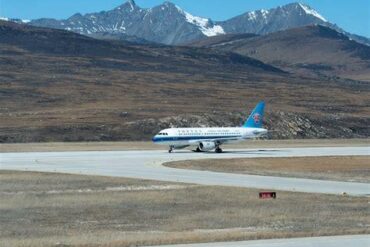
Among them stands the undisputed champion: Daocheng Yading Airport in Sichuan, China, at 14,472 feet (4,411 meters) above sea level.
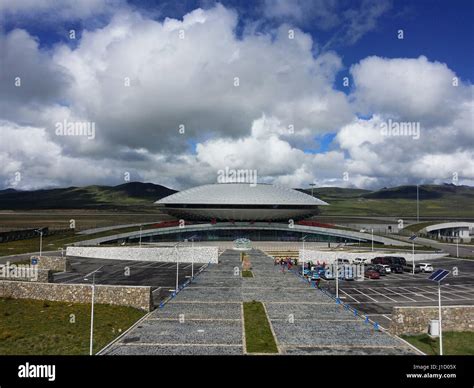
Daocheng Yading is not a novelty airstrip; it handles scheduled commercial services from carriers such as Air China and Sichuan Airlines, linking this remote alpine region to major hubs like Chengdu. Its runway stretches approximately 13,780 feet (4,200 meters), a necessity rather than a luxury. At this elevation, even modern jetliners require every available meter to accelerate to safe liftoff speed.
Just slightly lower, but still in rarefied territory, is Qamdo Bamba Airport at 14,219 feet (4,334 meters). It once held the title of the world’s longest commercial runway before upgrades reduced its length. That record was not about prestige; it was about survival margins. When air density drops dramatically, length becomes life.
Other Tibetan Plateau giants include:
- Shigatse Tingri Airport – 14,163 feet (4,317 meters)
- Garze Kangding Airport – 14,042 feet (4,282 meters)
- Ngari Gunsa Airport – 14,022 feet (4,274 meters)
Each of these airports exists in an environment where winter temperatures plunge, terrain rises abruptly, and alternate airports may be hours away. The combination of elevation and mountainous geography compounds operational complexity. Terrain awareness systems, strict departure procedures, and careful fuel planning are integral parts of daily operations.
Below the 14,000-foot threshold, the plateau remains formidable. Ngari Burang Airport (13,944 feet), Garze Gesar Airport (13,346 feet), and Yushu Batang Airport (12,762 feet) maintain connectivity across vast expanses where road travel can mean days over rugged terrain. Even Lhasa Gonggar International Airport, serving Tibet’s capital at 11,713 feet (3,570 meters), qualifies as a high-altitude airport by global standards.
China’s dominance in this category is not accidental. Infrastructure development across the Tibetan Plateau has been both strategic and economic, enabling tourism, trade, and state integration in one of the planet’s most geographically isolated regions.
The Altiplano: South America’s High-Plain Aviation Frontier
On the opposite side of the globe, the Altiplano, or Andean Plateau, forms the second great stronghold of ultra-high aviation. Located primarily in Bolivia and southern Peru, with extensions into Chile and Argentina, this high plain averages around 12,500 feet (3,800 meters). It is home to the world’s highest capital city: La Paz, Bolivia.
Serving La Paz is El Alto International Airport, perched at 13,323 feet (4,061 meters).
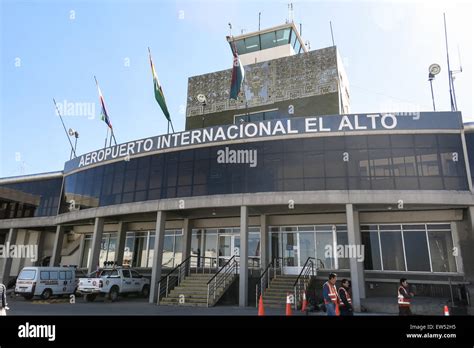
El Alto holds a special distinction. It is the only commercial airport outside China above 4,000 meters with regular scheduled jet service. Handling roughly 2.6 million passengers annually, it is not a niche facility but a major national gateway.
Aircraft manufacturers such as Boeing and Airbus have used El Alto for high-altitude certification testing. When engineers want to see how an airframe performs in thin air under real-world conditions, this is the proving ground. Engines spool differently here. Takeoff performance margins shrink. Systems are stressed in ways sea-level airports simply cannot replicate.
Bolivia’s Captain Nicolas Rojas Airport in Potosí rises to 12,913 feet (3,936 meters), though with more limited operations. In Peru, Inca Manco Cápac International Airport in Juliaca sits at 12,552 feet (3,826 meters) and features a 4,200-meter runway, one of the longest in the region, built specifically to counteract altitude-induced performance penalties.
Additional high-altitude Andean airports include:
- Juan Mendoza Airport (12,146 feet)
- Uyuni Airport (12,024 feet)
- Andahuaylas Airport (11,299 feet)
The Altiplano is geographically dramatic but topographically more uniform than the Himalayas. Unlike narrow mountain valleys, many Andean airports sit on relatively broad plains, reducing terrain constraints even as altitude remains punishingly high.
The Himalayas and the Edges of the Plateau
Beyond China and Bolivia, several airports cling to the margins of the Tibetan Plateau and Himalayan ranges. Nepal offers striking examples. Syangboche Airport, at 12,402 feet (3,780 meters), lies near Everest trekking routes. While it does not handle regular commercial jet service, it is technically capable of fixed-wing operations.
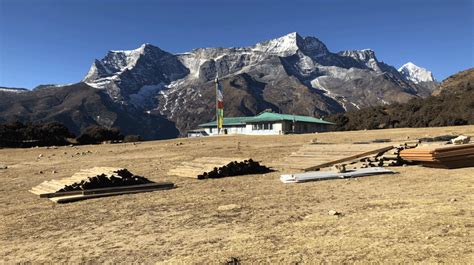
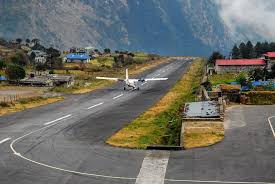
Nepal’s mountainous terrain creates a different kind of challenge. Airports such as Manang Airport (11,000 feet), Simikot Airport (9,245 feet), and Dolpa Airport (8,200 feet) combine high elevation with narrow valleys and steep approach paths. Unlike plateau airports, where horizontal space may be available, Himalayan airfields often demand precision flying through terrain corridors.
India’s Leh Airport (Kushok Bakula Rimpochee Airport) sits at 10,682 feet (3,256 meters), serving the Ladakh region. Though lower than the Tibetan and Bolivian giants, it still requires special operational considerations. Bhutan’s Paro International Airport, at 7,365 feet (2,244 meters), is less about altitude and more about terrain confinement. Surrounded by abrupt mountains and nestled in a valley, Paro demands one of the most technically challenging approaches in commercial aviation.
Pakistan’s Skardu International Airport at 7,301 feet functions as a gateway to K2 and the Karakoram range. In Central Asia, Tajikistan’s Murghab Airport reaches 11,962 feet (3,646 meters), and Kyrgyzstan’s Naryn Airport sits at 6,998 feet (2,133 meters), illustrating how the Tibetan Plateau’s geological influence radiates outward.
The Ethiopian Plateau: High, But Not Extreme
The Ethiopian Plateau ranks as the third-largest and third-highest major plateau globally. Though significantly lower than Tibet or the Altiplano, its elevation—generally between 7,500 and 8,500 feet—places many of its airports solidly within high-altitude operational territory.
Addis Ababa Bole International Airport stands at 7,625 feet (2,326 meters).
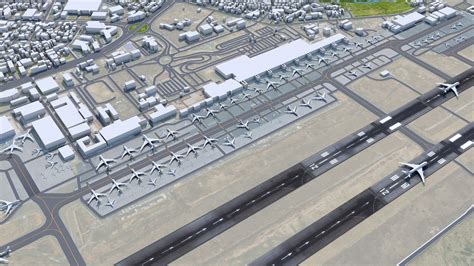
Ethiopia is unusual in that a large portion of its airports sit at moderately high elevation. Facilities such as Debre Tabor Airport, Mekane Salem Airport, and Debre Markos Airport range between 8,000 and 8,500 feet. While not extreme by Tibetan standards, these elevations still influence aircraft performance and require calibrated procedures.
For Ethiopian Airlines, which operates a global network including long-haul widebody flights, high-elevation departure performance is a routine engineering calculation rather than a rare event.
Other High-Altitude Outliers Around the World
Beyond the dominant plateaus, several airports push altitude limits within their respective regions. In Ecuador, Mariscal Sucre International Airport in Quito rises to 9,186 feet (2,800 meters). Colombia’s El Dorado International Airport in Bogotá stands at 8,360 feet (2,548 meters) and regularly accommodates widebody aircraft from major U.S. carriers.
In North America, Telluride Regional Airport in Colorado reaches 9,708 feet (2,958 meters), while Leadville–Lake County Airport climbs to 9,934 feet (3,026 meters), making it the highest in North America—though without scheduled commercial service.
Europe’s highest commercial airport, Samedan Airport (Engadin Airport) in Switzerland, sits at 5,637 feet (1,719 meters). France’s Courchevel Altiport is higher at 6,558 feet (2,008 meters) but serves only very small aircraft on a dramatically sloped runway. In southern Africa, Lesotho’s Moshoeshoe International Airport rests at 5,349 feet (1,630 meters), reflecting the country’s status as the only nation entirely above 1,000 meters.
Aviation at the Limits of Atmosphere
The world’s highest altitude airports still in operation represent more than geographic trivia. They are laboratories of aerodynamics, endurance, and infrastructure engineering. At 14,000 feet, every takeoff is a quiet negotiation with physics. Every landing is a demonstration of calculated restraint.
On the Tibetan Plateau and the Altiplano, aviation bridges landscapes where roads are long, terrain is unforgiving, and communities would otherwise remain isolated. These airports prove that commercial flight is not confined to coastal megacities. It can thrive where oxygen thins, mountains dominate horizons, and the sky feels just a little closer.
In these rarefied environments, aviation reveals its most elemental truth: flight is never effortless. It is engineered possibility, carved into the highest inhabited places on Earth, where the margin between ground and sky is measured not just in meters—but in mastery.