The history of military aviation is often told through icons: sleek fighter jets, enormous strategic bombers, and rugged cargo aircraft that quietly keep global operations running. The United States Air Force alone operates some of the most recognizable machines ever built, from the F-22 Raptor to the endlessly reliable C-130 Hercules. Yet the road to technological dominance has never been smooth or predictable. Hidden among the celebrated aircraft is a strange menagerie of experimental designs, modified airframes, and unusual engineering experiments that look more like science-fiction props than real military hardware.
These machines were not built merely for spectacle. Many emerged from the relentless scientific impulse to test boundaries: new propulsion concepts, unconventional aerodynamics, or entirely new categories of weaponry. Aviation engineers often treat prototypes like hypotheses in a giant laboratory. Build it, fly it, measure it, and discover what the laws of physics have to say about your clever idea.
The result is a fascinating catalog of aircraft that appear almost surreal. Some carried laser weapons capable of destroying missiles, others quietly sniffed the atmosphere for evidence of nuclear detonations, and one famously flew without wings at all. Each machine looks odd because it was designed to answer a specific technical question—sometimes successfully, sometimes not.
What follows is a closer look at four of the weirdest aircraft ever flown by the U.S. Air Force, machines that reveal how experimentation and curiosity often shape the future of aviation in unexpected ways.
YAL-1 Airborne Laser Test Bed: A Jumbo Jet With a Missile-Destroying Laser
At first glance, the YAL-1 Airborne Laser Test Bed looks like a normal Boeing 747 freighter. The distinctive hump of the jumbo jet is there, the wings stretch outward exactly as expected, and the engines hang beneath them like familiar mechanical ornaments. But the illusion of normality evaporates the moment you look at the aircraft’s nose. Mounted there is a massive turret housing a megawatt-class chemical oxygen iodine laser, a weapon that sounds more at home in science fiction than on a commercial airliner.
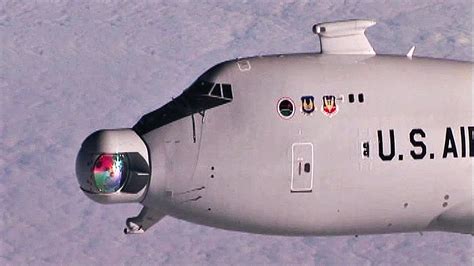
The concept behind the YAL-1 was bold. Ballistic missiles are most vulnerable during their boost phase, the brief period after launch when their engines are still firing and their structure is stressed by intense heat and vibration. During that window, even small damage can cause catastrophic failure. The Air Force theorized that a high-energy laser mounted on an aircraft could strike missiles at long distances, heating the missile’s skin until structural failure destroyed it.
To test the idea, engineers modified a Boeing 747-400F, transforming its interior into a flying energy laboratory. Chemical tanks, beam control systems, targeting sensors, and tracking radars filled the aircraft’s cavernous fuselage. The laser itself required a complex chemical reaction to produce energy—far from the compact power systems imagined in futuristic movies. In practice, firing the weapon involved mixing specialized chemicals that generated the intense beam needed to burn through a missile’s casing.
Testing took place largely from Edwards Air Force Base in California, a location that has hosted countless experimental aircraft over the decades. During flight trials in the late 2000s, the system demonstrated its ability to track and destroy test targets. Engineers successfully shot down ballistic missile surrogates, proving that the underlying physics worked.
Yet practicality ultimately defeated the program. The aircraft required enormous logistical support, and the chemical laser system could fire only a limited number of times before needing replenishment. Maintaining a fleet of such aircraft would have been extremely expensive, especially given the rapid development of alternative missile defense technologies.
The program was officially cancelled in 2011, but its legacy remains important. Modern militaries are still exploring directed-energy weapons, particularly compact lasers powered by electrical systems rather than chemical reactions. In that sense, the YAL-1 was less a failure and more a technological stepping stone—a proof of concept that giant airborne lasers could indeed strike targets hundreds of kilometers away.
WC-135R Constant Phoenix: The Aircraft That Sniffs Nuclear Explosions
Some aircraft carry missiles. Others carry bombs. The WC-135R Constant Phoenix carries something far more subtle: the ability to detect microscopic traces of nuclear explosions drifting through the atmosphere.
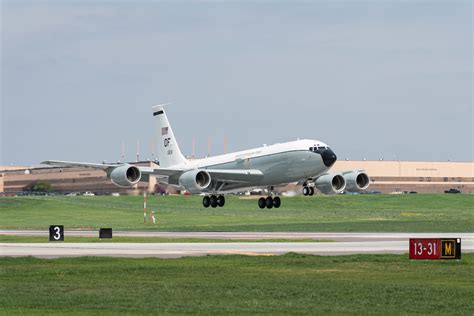
The aircraft is a heavily modified version of the C-135 Stratolifter, itself related to the Boeing 707 family of early jet airliners. But the similarities end quickly once you look at the mission equipment installed aboard the Constant Phoenix. Its interior houses an elaborate atmospheric collection system designed to capture airborne particles and gases as the aircraft flies through suspected radiation plumes.
When a nuclear device detonates—whether during a test or an accident—it releases distinct radioactive isotopes into the air. These particles disperse across the atmosphere and can travel vast distances. The Constant Phoenix flies through these invisible clouds, collecting samples that scientists later analyze to determine the type, strength, and origin of the nuclear event.
The aircraft’s nickname within aviation circles is the “nuke sniffer,” and the description is surprisingly accurate. Sensors draw outside air through specialized filters that trap radioactive material. Additional equipment can capture air samples in tanks, preserving them for detailed laboratory analysis once the aircraft returns to base.
Despite the seemingly niche mission, the Constant Phoenix plays a vital role in international security. The Limited Nuclear Test Ban Treaty of 1963 prohibits nuclear detonations in the atmosphere, underwater, and in outer space. Monitoring compliance requires reliable detection systems, and airborne sampling remains one of the most precise methods available.
Throughout its operational history, the aircraft has quietly participated in some of the world’s most serious crises. After the Chernobyl disaster in 1986, Constant Phoenix aircraft helped track the spread of radioactive particles across Europe. The data allowed scientists to map the movement of contamination through global weather systems.
Only two aircraft currently operate in this role, making them rare visitors at international airfields. When one appears overseas, aviation enthusiasts take notice, but the aircraft’s true purpose lies in its scientific instruments rather than its outward appearance. In a world where nuclear technology still carries enormous geopolitical weight, a plane capable of literally smelling atomic explosions remains one of the Air Force’s most unusual—and important—assets.
NT-43A RAT55: The Radar Monster That Studies Stealth Aircraft
If you happened to see the NT-43A RAT55 sitting on a runway, the first impression might be that someone accidentally bolted a pair of giant growths onto a Boeing 737. The aircraft’s nose bulges outward. The tail appears swollen with equipment. Its silhouette looks oddly distorted compared with the clean lines of a normal airliner.
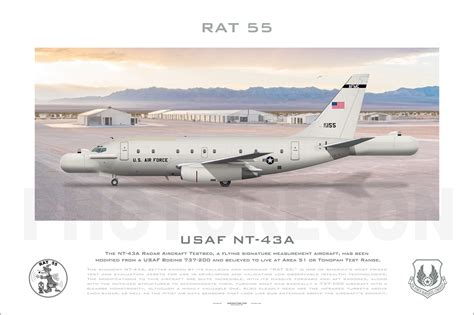
Those strange shapes exist for a very specific scientific purpose. The RAT55 is essentially a flying laboratory designed to measure radar cross section, the technical term describing how detectable an object is by radar systems.
Stealth aircraft rely on carefully shaped surfaces and specialized materials to scatter radar waves away from their source. Measuring how well those techniques work is extremely difficult in real flight conditions. Radar signals bounce, scatter, and interact with atmospheric conditions in complicated ways. Engineers needed a dedicated platform capable of capturing extremely precise radar data while other aircraft performed maneuvers nearby.
Enter the RAT55.
The aircraft began life as a Boeing 737-200, an early variant of one of the most successful airliners in history. Instead of carrying passengers, however, it was converted into the Radar Airborne Testbed, packed with sophisticated instrumentation capable of measuring radar reflections from aircraft flying within its observation envelope.
Those unusual nose and tail structures house arrays of radar sensors that track how signals bounce off nearby aircraft. By analyzing the data, engineers can determine exactly how visible a supposedly stealthy aircraft appears to radar systems under different conditions.
The information gathered by the RAT55 has been crucial for refining stealth designs used by aircraft such as the F-22 Raptor and B-2 Spirit bomber. Small adjustments in shape—sometimes only a few centimeters—can dramatically change how radar waves reflect. Having a flying platform capable of measuring those effects in real time gives engineers a powerful diagnostic tool.
The aircraft has frequently operated around Tonopah Test Range Airport in Nevada, not far from the legendary Area 51 complex where many classified aircraft projects have historically been tested. Public information about the RAT55 remains limited, which only adds to its mystique.
What is known, however, is that this oddly swollen 737 continues to serve as one of the Air Force’s most valuable measurement platforms. In the strange ecology of military aviation, a plane that looks like a mutated airliner quietly helps make stealth fighters even harder to detect.
HL-10 Lifting Body: The Wingless Aircraft That Helped Shape Spaceflight
The final aircraft on this list appears to violate one of the most basic expectations of aviation: airplanes have wings. The HL-10 lifting body does not.
Instead, the entire fuselage acts as a lifting surface. The aircraft looks vaguely like a flattened teardrop or, as pilots jokingly described it, a “flying bathtub.”
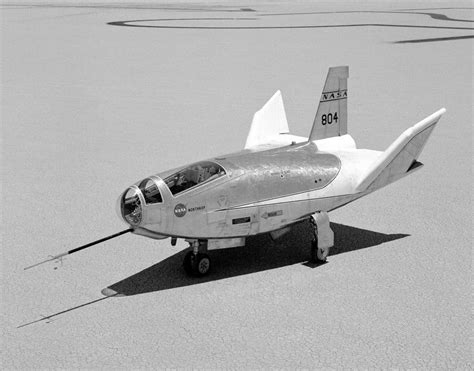
The HL-10 emerged from a fascinating line of research conducted jointly by NASA and the U.S. Air Force during the 1960s. Engineers were exploring whether spacecraft returning from orbit could glide safely through the atmosphere rather than descending under parachutes like earlier capsules.
The central idea was the lifting body concept. Traditional aircraft rely on wings to generate lift, the upward force that keeps them airborne. But a carefully shaped fuselage can also produce lift if air flows around it correctly. By designing a spacecraft whose body itself acted like a wing, engineers hoped to create vehicles capable of controlled atmospheric flight during reentry.
The HL-10 was one of several experimental vehicles built to test this theory. It measured just over 22 feet in length, weighed around 9,000 pounds, and was powered by a Chemical Reaction Motors XLR-11 rocket engine—the same family of engines used in early supersonic research aircraft.
Flight testing followed a dramatic routine. The HL-10 was carried aloft beneath the wing of a B-52 Stratofortress bomber. At high altitude, the test vehicle would drop free and ignite its rocket engine, accelerating rapidly as pilots evaluated its handling characteristics during descent.
Despite its unconventional shape, the aircraft proved remarkably capable. In the hands of test pilot Peter Hoag, the HL-10 reached speeds of Mach 1.86, nearly twice the speed of sound. Engineers collected valuable data about stability, glide performance, and maneuverability during high-speed reentry-like conditions.
The insights gained from the lifting body program influenced the development of later spacecraft, particularly the Space Shuttle, which relied on aerodynamic lift to glide back to Earth after orbit. Although the shuttle ultimately used wings rather than a pure lifting-body shape, the underlying aerodynamic research proved invaluable.
From a visual standpoint, the HL-10 remains one of the strangest aircraft ever flown. Yet its odd shape represented a serious scientific experiment about how vehicles might travel between Earth and space.
In the grand narrative of aerospace engineering, such peculiar machines are not anomalies. They are the prototypes that quietly reshape the future. Today’s sleek stealth fighters, reusable spacecraft, and experimental hypersonic vehicles all descend from decades of trial, error, and daring creativity.
The weird aircraft of the U.S. Air Force are reminders that progress often begins with something that looks ridiculous on a runway. History has a funny habit of turning yesterday’s strange experiment into tomorrow’s technological revolution.