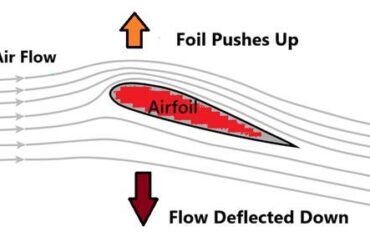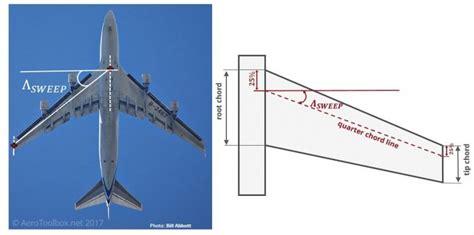
At its most fundamental level, the trailing edge is where airflow that has traveled along the surface of the wing meets and exits, contributing to the wake and flow dynamics behind the aircraft. The sweep angle of the trailing edge influences how this airflow behaves at higher angles of attack, affecting stability, control surfaces, and the aerodynamic wake. The curvature shape of the trailing edge, whether straight or curved, can affect the way airflow detaches from the wing, impacting both lift and drag characteristics.
While the leading edge of a wing is commonly designed to reduce supersonic drag (as seen with delta wings), the trailing edge has a more nuanced role. Its design is crucial in controlling how the wing wake interacts with control surfaces such as elevons or flaps, which ultimately influences aircraft stability, particularly during high angles of attack or at slow speeds.
The Trailing Edge Sweep Angle: A Key Design Factor
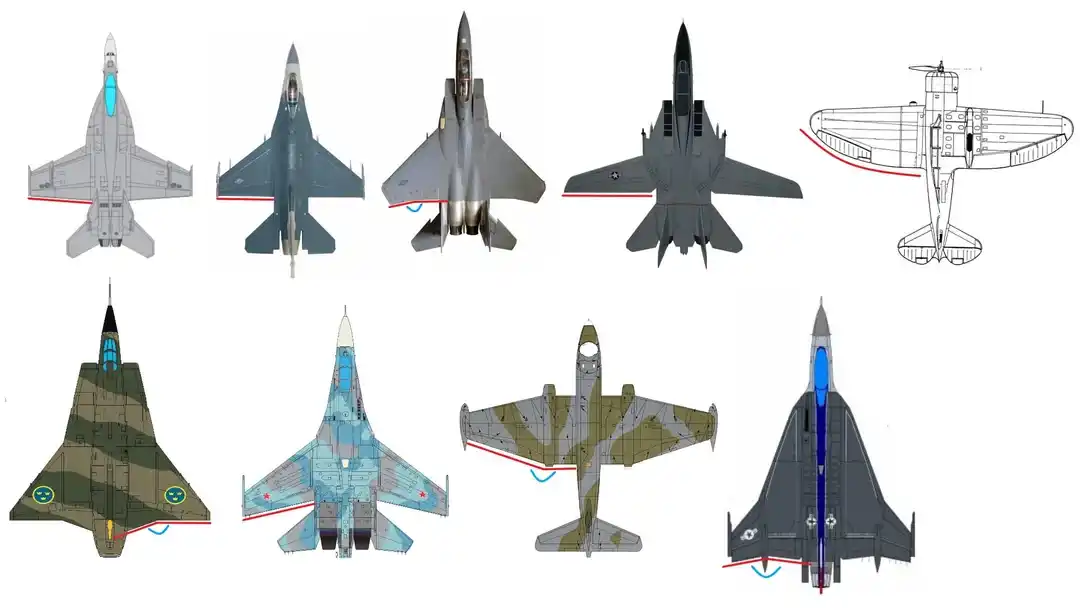
Aerodynamic Wake and Stability at High Angles of Attack
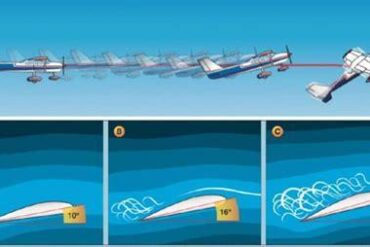
The sweep angle of the trailing edge has a profound effect on the wing’s wake characteristics, particularly when the aircraft is flying at high angles of attack (i.e., when the aircraft is at steep pitch angles during slow-speed flight or maneuvering). The angle at which the trailing edge is swept determines the flow direction of the wake, which in turn influences the stability and control of the aircraft.
For example, when the trailing edge is swept backwards, the airflow tends to remain attached to the wing for a longer period of time before detaching, allowing for smoother airflow over the control surfaces. This results in more predictable control responses, especially during high-alpha flight regimes. Conversely, a non-swept or less swept trailing edge may cause turbulence in the wake earlier, which can affect the efficiency of control surfaces like elevons or flaps.
Influence on Lift Distribution and Aircraft Performance
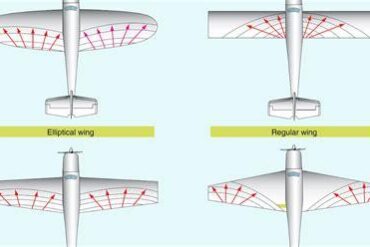
The sweep angle also affects the lift distribution across the wing. A forward-swept trailing edge, as seen on aircraft like the Saab Draken, tends to produce a more uniform lift distribution across the span of the wing, improving stability and maneuverability at high speeds. On the other hand, a backward-swept trailing edge, such as on the Su-27, can increase lift at the wing root while reducing lift at the wingtip, enhancing stability but potentially reducing aerodynamic efficiency at higher speeds.
In fighter aircraft, particularly, the backward-swept trailing edge is often a design choice made to provide positive static margin, improving stability at slower speeds and higher angles of attack. This stability is particularly important in combat scenarios, where rapid and controlled maneuvers are necessary.
Curvature of the Trailing Edge: Shape Matters for Flow Detachment
Impact on Drag and Lift Coefficients
While the sweep angle is important, the curvature of the trailing edge also plays a significant role in aerodynamics. The shape of the trailing edge can influence how the airflow detaches from the surface of the wing. A sharp trailing edge creates a cleaner flow separation, potentially reducing drag and induced drag. However, this can come at the cost of reduced lift at high angles of attack.
On the other hand, a blunt trailing edge or a rounded curve can cause the flow to detach in a more controlled manner, reducing turbulence and drag but potentially increasing the induced drag due to the larger wake. The balance between drag and lift efficiency is crucial for achieving optimal aerodynamic performance.
Control Surface Effectiveness and High Alpha Flight
The design of the trailing edge curvature is particularly relevant to the positioning and effectiveness of control surfaces. Aircraft like the F-15 use a backward-swept trailing edge to work in conjunction with the elevon leading edge. This configuration minimizes the effect of wing wake on the elevon’s vortex generation, which is essential for maintaining control authority during high-alpha flight, such as during slow-speed maneuvers or stall recovery.
The F-16, however, has a straight trailing edge and relies on fly-by-wire technology to maintain control at negative static margins. This allows the aircraft to maintain manoeuvrability and control without the need for extensive modifications to the trailing edge, making it a more flexible design for agile combat missions.
Stealth Aircraft and the Trailing Edge
In stealth aircraft design, the trailing edge also plays a role, although the considerations are more focused on radar signature reduction than aerodynamic performance. Stealth aircraft like the F-22 or F-35 use parallel trailing edges that are carefully designed to minimize the radar cross-section (RCS). These aircraft may have elevons mounted near the trailing edge to reduce the number of angles at which radar waves can bounce back to a detecting source. Although stealth is not directly related to aerodynamics, the trailing edge design can still influence the overall aerodynamic behavior, especially when combined with other stealth features.
Case Studies: Aircraft Wing Design Comparisons
The F-16 and Its Straight Trailing Edge
The F-16 Fighting Falcon employs a simple, straight trailing edge design. This allows for a predictable flow over the wing during high-speed flight, providing excellent aerodynamic performance. However, during slower flight or at high angles of attack, the F-16 relies on fly-by-wire technology to prevent instability that would otherwise arise due to the simple design of the trailing edge. This choice allows for high maneuverability and responsive controls, which are essential for air combat situations.
The F-15 and Its Backward-Swept Trailing Edge
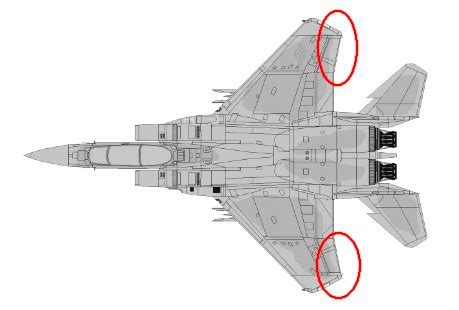
The F-15 Eagle features a more complex design, with the outer half of the trailing edge swept backwards. This helps to manage aerodynamic wake and ensure smooth airflow over the elevons during high-angle maneuvers, especially at low speeds. This configuration contributes to the aircraft’s stability and maneuverability, particularly in dogfights or close-quarters combat.
The Saab Draken and the Forward-Swept Trailing Edge
The Saab Draken is known for its innovative forward-swept trailing edge design. This approach helps to maintain a uniform lift distribution along the wing, enhancing maneuverability at high speeds and reducing drag. The unique shape also contributes to the aircraft’s stability in high-alpha flight, allowing for greater control during aggressive maneuvers, such as tight turns or improvised evasions.
Conclusion: The Strategic Role of the Trailing Edge
The trailing edge of an aircraft wing is much more than a passive feature in the overall design. Its sweep angle and curvature play crucial roles in determining the aircraft’s aerodynamic characteristics, including lift distribution, drag, stability, and control surface effectiveness. Whether a straight, backward-swept, or forward-swept trailing edge, the design choice must balance a variety of factors, including the aircraft’s mission profile, operating conditions, and the need for maneuverability or stability. The optimization of the trailing edge is an essential aspect of wing design, influencing not just aerodynamic performance but also combat capability, especially in high-performance aircraft.