Porter Airlines has reached a defining moment in its evolution, surpassing 10 million scheduled seats for the first time in its history in 2026. With approximately 10.34 million two-way seats planned across its network, the Canadian carrier has achieved a milestone that would have seemed unimaginable when it launched as a niche regional airline focused primarily on short-haul routes from Toronto. The achievement underscores the extraordinary transformation of Porter Airlines from a turboprop specialist into one of North America’s fastest-growing airlines.
The record-setting capacity figure represents more than just a numerical achievement. It reflects years of strategic investment, fleet modernization, network diversification, and a deliberate effort to challenge established competitors across Canada and the United States. As Porter continues expanding its footprint, the airline is increasingly positioning itself as a major force in North American aviation.
A Historic Capacity Milestone for Porter Airlines
Porter’s scheduled capacity growth over the past several years highlights the scale of its transformation. The airline offered only 693,352 seats in 2021, a period heavily impacted by pandemic-related disruptions that affected airlines worldwide. However, recovery came quickly.
By 2022, capacity had risen to more than 3.1 million seats, signaling the beginning of a dramatic rebound. Growth accelerated further in 2023, when scheduled seats exceeded 5.3 million, before climbing to 7.87 million in 2024 and 8.83 million in 2025.
The leap to 10.34 million seats in 2026 represents the largest annual increase in the carrier’s history. Adding more than 1.5 million additional seats in a single year demonstrates both strong market confidence and the airline’s ability to execute a highly ambitious expansion strategy.
Unlike many carriers that focus growth primarily on frequency increases, Porter has combined higher frequencies with extensive route development, enabling it to reach entirely new passenger markets across North America and beyond.
The Embraer E195-E2: The Aircraft Behind the Transformation
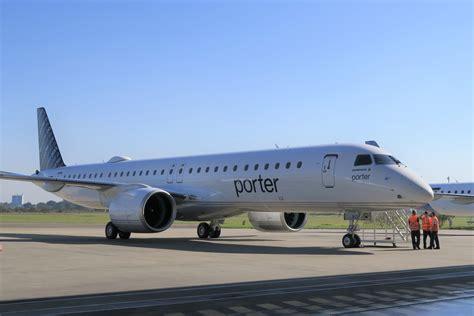
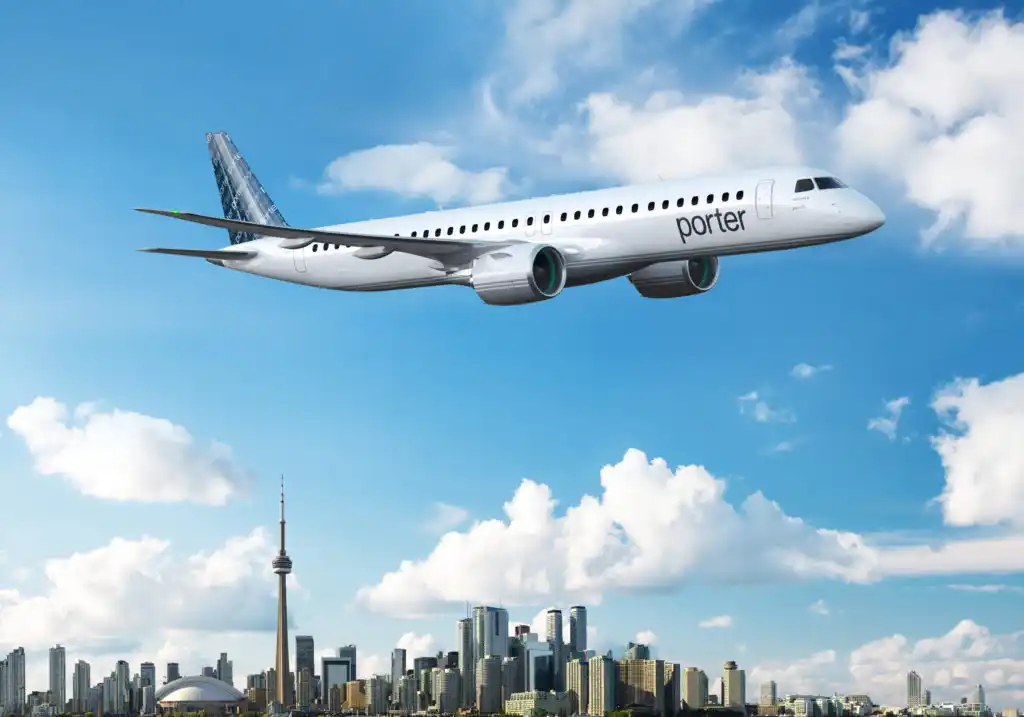
At the center of Porter’s growth story is the Embraer E195-E2, a next-generation narrowbody jet that has fundamentally changed what the airline can accomplish.
For much of its history, Porter relied heavily on the De Havilland Dash 8-400 turboprop, an aircraft ideally suited for short regional routes but limited in range and passenger capacity. While the Dash 8 helped establish Porter’s reputation for efficient regional service, it constrained the airline’s ability to compete on longer routes.
The arrival of the E195-E2 changed everything.
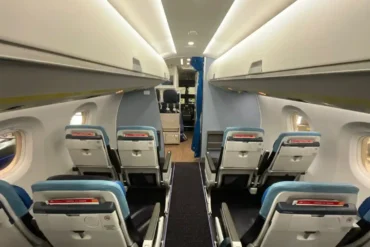
The aircraft offers significantly greater range, higher passenger capacity, lower operating costs per seat, and improved passenger comfort. These advantages have allowed Porter to enter markets that were previously inaccessible under its traditional operating model.
The numbers clearly illustrate the aircraft’s impact. In 2023, Porter scheduled approximately 1.8 million E195-E2 seats. Within a year, that figure surged to 4.6 million seats. By 2025, E2 capacity reached 5.59 million seats, and in 2026 it climbs again to approximately 7.16 million seats.
Today, the E195-E2 accounts for the majority of Porter’s network capacity, making it the primary engine behind the airline’s record-breaking expansion.
Toronto Pearson Emerges as Porter’s Largest Growth Hub
For years, Porter Airlines was closely associated with Billy Bishop Toronto City Airport, where its distinctive operation helped establish a loyal customer base among business travelers and frequent flyers.
While Billy Bishop remains an important component of the airline’s network, growth dynamics have shifted dramatically.
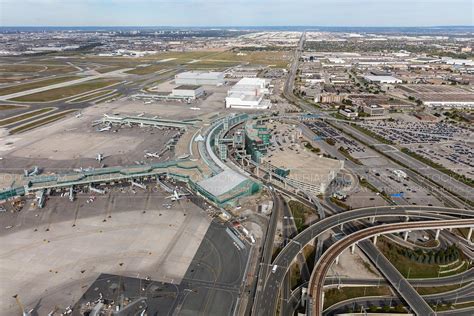
The airline’s rapid expansion has elevated Toronto Pearson International Airport into a central pillar of its long-term strategy. Pearson’s extensive infrastructure, international connectivity, and ability to accommodate larger aircraft make it the ideal platform for the airline’s next phase of growth.
The E195-E2 fleet performs particularly well from Pearson, enabling Porter to operate longer routes efficiently while connecting travelers to a broader range of destinations throughout North America and the Caribbean.
As a result, Toronto Pearson has increasingly become the airline’s primary launch point for new markets and expanded services.
Expanding Across the United States
One of the most significant developments in Porter’s transformation has been its growing presence in the United States.
In 2008, the airline scheduled only 102,620 seats to U.S. destinations. Over time, that figure steadily increased, reaching nearly 710,000 seats by 2017. Following the pandemic recovery, growth accelerated substantially.
U.S. capacity exceeded 1.05 million seats in 2024, climbed to 1.30 million seats in 2025, and reaches approximately 1.34 million seats in 2026.
This expansion reflects a deliberate strategy to capture both business and leisure travelers while diversifying revenue sources beyond the Canadian domestic market.
The E195-E2 has played a crucial role in this effort. Its range and economics allow Porter to operate longer cross-border routes efficiently, giving the airline opportunities to compete against larger North American carriers while maintaining its premium economy-focused onboard experience.
The airline’s growing visibility in American markets is also helping reshape public perception. What was once viewed as a regional Canadian airline is increasingly recognized as a continent-wide competitor.
New Routes Strengthen International Ambitions
Porter’s growth story extends beyond Canada and the United States. The airline has also accelerated its entry into international leisure markets, launching an array of new destinations beginning in 2026.
Among the most notable additions are services connecting Toronto to Boston, Chicago O’Hare, and Nashville, alongside an expanding portfolio of sun destinations that appeal to Canadian travelers seeking year-round leisure options.
The network now includes destinations such as Austin, Phoenix, Las Vegas, Fort Lauderdale, Cancún, Aruba, Montego Bay, Puerto Vallarta, San José del Cabo, and San José, Costa Rica.
These routes highlight the versatility of the E195-E2 fleet, which allows Porter to connect Canadian cities directly with high-demand vacation and business destinations without relying solely on traditional hub-and-spoke models.
From Regional Specialist to Major North American Airline
Porter Airlines’ achievement of more than 10 million scheduled seats in 2026 represents far more than a capacity record. It symbolizes one of the most remarkable airline transformations seen in North America over the past decade.
Driven by the rapid expansion of its Embraer E195-E2 fleet, strengthened by a growing presence at Toronto Pearson, and supported by aggressive network development across Canada, the United States, and international leisure markets, Porter has successfully reinvented itself for a new era.
The airline continues to launch new routes, add capacity, and broaden its reach while preserving the customer-focused service model that helped build its reputation. With fleet growth continuing and additional destinations likely to emerge in the coming years, Porter appears well-positioned to maintain its momentum.
What began as a regional carrier serving short-haul markets has evolved into a rapidly expanding North American competitor, and the record-breaking 10.34 million-seat milestone may prove to be only the beginning of an even larger growth story.