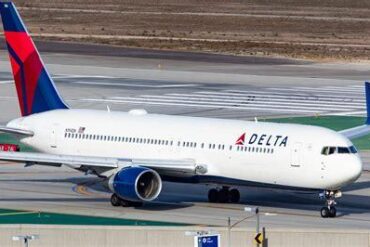
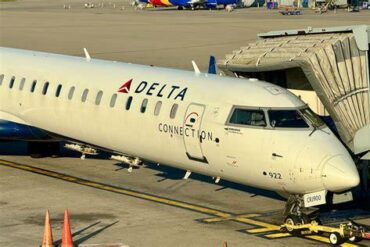
Delta Air Lines is making a notable adjustment to its network at Hartsfield-Jackson Atlanta International Airport (ATL), removing nonstop service to eight destinations that have appeared in its schedule during the past several years. The changes are striking because Atlanta is not simply another Delta station. It is the airline’s most important hub and the world’s busiest airport, handling 106.3 million passengers in 2025. Delta currently advertises nearly 1,000 peak-day departures from Atlanta to more than 200 destinations, making even a relatively small group of route cuts significant.
The affected markets stretch across the United States, Canada, the Caribbean and Europe. They include Fresno, Oakland, Rapid City, Santa Barbara, St. Vincent, Stuttgart, Traverse City and Vancouver. Their circumstances are far from identical. Some routes were short-lived experiments, some were seasonal services that will not return, one was a major international link with decades of history, and another was a new Caribbean route that failed to produce the passenger demand Delta expected.

The most interesting part of the story, however, is that load factor alone does not explain most of the cuts. Department of Transportation data shows that six of the eight routes recorded average load factors of roughly 80% or higher during the periods examined. Rapid City reached an impressive 91.8%, while Vancouver recorded 90.7%. Fresno was 84.8%, Traverse City 80.6%, Oakland 80.1% and Stuttgart 79.7%. Those figures demonstrate that an aircraft can leave Atlanta with plenty of occupied seats and still fail to justify retaining the route.
Delta’s Eight Atlanta Route Cuts
Cirium’s historical and forward-looking schedule data reveals eight Delta-operated Atlanta routes that have disappeared from the carrier’s future network through July 2027. The affected services are diverse, and their final operating dates tell very different stories.
Fresno service returned in June 2024 and operated daily with Boeing 737-800 aircraft before its final service in September 2025. Oakland also returned during Delta’s June 2024 expansion, operating daily with Boeing 737-900ER aircraft before ending in June 2025. Santa Barbara followed the same California expansion and operated daily with Airbus A220-300 aircraft until January 2026. Its importance was partly symbolic: the Atlanta route became the longest scheduled route in Santa Barbara Airport’s history.
Rapid City is a more recent example. Delta launched the route in May 2025 with four weekly Airbus A319 flights, but September 2026 marks the end of the service. Traverse City, meanwhile, has been linked with Atlanta since May 2021, operating four times weekly with A319 aircraft. Both markets were seasonal and will finish their current September operations without returning in the forward schedule.
The international cuts are equally revealing. Delta’s Atlanta-Stuttgart service dates back to 1986, although the route experienced a suspension before being restored in 2023. Its final flight actually operated in October 2024. The connection had a particularly strong corporate rationale because of the industrial and automotive links between Stuttgart and the United States, including the presence of major companies such as Mercedes-Benz and Porsche.
Vancouver is the newest addition to the list in terms of Delta’s current operation. Weekly Boeing 737-900ER service began in May 2026 but will disappear after September. Yet this is not a complete loss of nonstop Atlanta-Vancouver capacity because WestJet continues operating the route. Delta’s Canadian partner also gives the airline a way to maintain connectivity and customer benefits without operating its own aircraft.

St. Vincent Is the Clear Economic Failure
Among all eight routes, St. Vincent stands apart. Delta launched the Atlanta-Saint Vincent connection in December 2025, initially offering ambitious daily Boeing 737-800 service. The airline subsequently reduced the schedule before ending the route in September 2026, making it one of the clearest examples of a new route failing to meet expectations.
DOT data puts the average load factor at only 47.1% between December 2025 and May 2026. In February, the figure fell as low as 39.1%, although it recovered to 66.3% by May. St. Vincent’s tourism minister later said Delta had reported passenger volumes well below projections, insufficient premium demand and high fuel costs. With the aircraft flying less than half full on average during the first six months, the economics were difficult to defend.
Santa Barbara also showed signs of weakening demand. Its average load factor was 78.7%, but the monthly figures deteriorated from 83.1% in June 2025 to 69.7% by January 2026. That downward trend provides a more convincing explanation for its removal than the headline average alone.
Fresno and Rapid City are much harder to explain using passenger occupancy. Fresno averaged 84.8% during the June-September 2026 period used in the analysis, while Rapid City reached 91.8%, including an extraordinary 96.6% in September. A casual reading of those numbers might suggest that Delta made a mistake by abandoning the routes. Airline economics, however, are considerably more complicated.
Why Delta Can Cut Full Flights
A load factor measures how many seats are occupied, not how much money each passenger generates. Two aircraft can both leave Atlanta 85% full while producing very different financial results. The difference can come from fares, connecting traffic, premium-cabin demand, cargo revenue, operating costs, seasonality and the opportunity cost of using the aircraft on one route instead of another.
This distinction is especially important at a giant hub such as Atlanta. Delta has thousands of possible ways to deploy aircraft and crews, and a route that looks healthy on a seat-occupancy chart may still be weaker than another opportunity available elsewhere in the network. If the same aircraft can generate stronger yields or more strategically valuable connectivity on another route, moving it may make sense even when the original flight remains well occupied.
The Atlanta hub also gives Delta another advantage: it can sometimes retain the customer without retaining the nonstop flight. That makes route cuts less painful than they would be for an airline without a broad connecting network.
Delta’s Alternatives After the Atlanta Cuts
Fresno passengers can continue traveling with Delta through Salt Lake City, although the market remains exposed to American and United connecting options through their respective hubs. Oakland has a similar solution through Salt Lake City, while Delta also serves the Bay Area through nearby San Francisco.
Rapid City is particularly well protected. Delta continues to operate four daily flights between Rapid City and Minneapolis-St. Paul, providing a practical alternative for passengers who still want to remain within Delta’s network. Traverse City has an even broader retention strategy, with service to Detroit and Minneapolis-St. Paul. Its current September schedule includes two daily Detroit flights plus another daily Minneapolis service.
Santa Barbara provides another clear example of hub-based retention. As Atlanta service disappeared, Delta increased its Salt Lake City schedule to three daily departures, preserving a significant portion of the airline’s connectivity even though the nonstop link to Atlanta was removed.
The Stuttgart case demonstrates the value of Delta’s joint-venture partnerships. Passengers losing the Atlanta nonstop can be routed through Amsterdam Schiphol or Paris Charles de Gaulle, with KLM and Air France providing onward connections. Delta therefore does not necessarily lose the entire customer relationship simply because its own aircraft no longer flies between Atlanta and Stuttgart.
Vancouver is the simplest case. WestJet continues to fly nonstop between Vancouver and Atlanta, while Delta customers can benefit from the partnership, codesharing arrangements and reciprocal SkyMiles benefits. In other words, Delta can maintain access to the market without dedicating its own aircraft to the route.
Atlanta Capacity Is Moving Rather Than Simply Disappearing
The broader Atlanta picture makes these decisions easier to understand. Delta’s peak schedule has expanded by roughly 12% across just two summers, reaching nearly 1,000 daily departures and more than 1.1 million weekly seats. That is a huge amount of capacity to manage, even for one of the world’s largest airlines.
Consequently, the eight discontinued routes should not automatically be interpreted as evidence that Delta is shrinking its Atlanta hub. In many cases, the opposite is happening: Delta is reallocating capacity within an increasingly large network. Aircraft, crews and airport resources are finite, and every flight must compete for those resources against another possible use.
The route cuts therefore reveal a more nuanced side of airline network planning. St. Vincent appears to have struggled to generate sufficient demand, while Santa Barbara showed a clear deterioration. But Fresno, Rapid City, Traverse City, Stuttgart and Vancouver demonstrate that strong seat occupancy does not guarantee a route’s survival.
For Delta, the bigger question is not simply whether an Atlanta flight is full. It is whether that flight produces enough revenue, strategic value and network benefit to justify the aircraft and resources it consumes. With Atlanta continuing to expand, eight route cuts can ultimately be less about retreat and more about making room for the next set of opportunities.