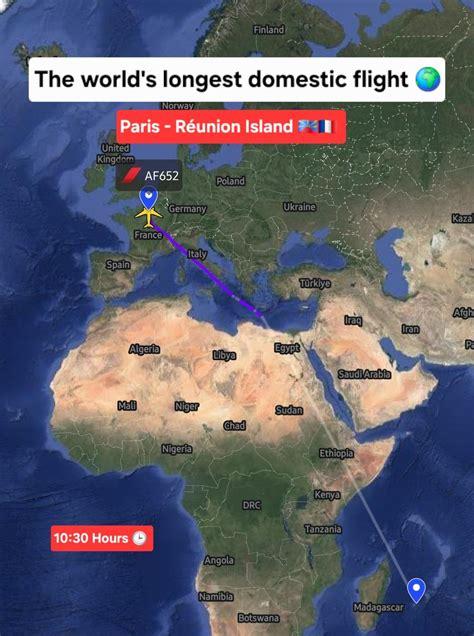
A flight of nearly 12 hours normally suggests a journey between two countries, perhaps a transatlantic crossing or a long-haul service linking Europe with Asia. Yet one of the aviation world’s most extraordinary routes breaks that assumption entirely. The nonstop service between Paris and Saint-Denis, Réunion, covers approximately 5,048 nautical miles (9,349 kilometers), crossing thousands of miles of ocean and several airspace regions while remaining a domestic flight.
The reason is political geography rather than physical geography. Réunion is a French overseas department in the Indian Ocean, meaning that the island has the same constitutional status as departments in mainland France. For passengers, that creates an unusual situation: a flight can leave metropolitan France, cross two hemispheres and much of the African continent’s surrounding airspace, and arrive at an airport nearly 6,000 miles away without crossing an international border.
That makes the Paris–Réunion corridor one of the clearest examples of how aviation records can be shaped by national borders, constitutional arrangements and aircraft technology as much as by distance. The route is not merely a geographic curiosity. It is a crucial transportation link between a remote island and Europe, carrying passengers, cargo, medical supplies and other essential goods on widebody aircraft throughout the year.
Why Paris to Réunion Is Classified as a Domestic Flight
The most important detail behind the record is Réunion’s constitutional status within France. Located east of Madagascar in the Indian Ocean, Réunion has been an overseas department of France since 1946. Under Article 73 of the French Constitution, overseas departments such as Réunion have a legal status fundamentally different from independent foreign countries.
Geographically, the island is thousands of miles from Europe. Politically, however, it remains part of France. That distinction is what allows a Paris–Réunion flight to be classified as domestic rather than international.
A passenger traveling from Paris Charles de Gaulle Airport (CDG) or Paris Orly Airport (ORY) to Roland Garros Airport (RUN) in Saint-Denis is therefore traveling between two parts of the same sovereign state. The aircraft does not arrive in another country simply because the destination is located in the Indian Ocean.
The practical consequences are significant. Réunion uses the euro, follows French law and is integrated into France’s national administrative systems. For eligible European travelers, the journey does not have the same passport and immigration procedures associated with a conventional international flight. In other words, the enormous physical distance does not change the route’s domestic classification.
This is why the Paris–Saint-Denis service can hold such a remarkable record. Domestic aviation is ultimately defined by sovereignty, not by how many oceans, continents or time zones separate the origin from the destination.
A 5,048-Nautical-Mile Journey Across Two Hemispheres
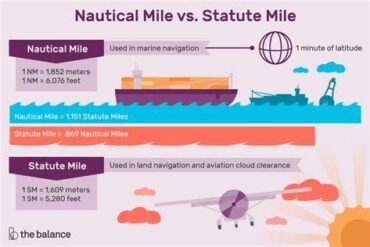
The nonstop route stretches approximately 5,048 nautical miles, equivalent to around 5,810 statute miles or 9,349 kilometers. A southbound flight can take roughly 11 hours and 40 minutes, depending on winds, aircraft type, routing and operational conditions.
That distance puts the route firmly into the territory normally associated with intercontinental flying. For perspective, many famous long-haul routes between Europe and North America are substantially shorter. Paris to New York, London to New York and other traditional transatlantic sectors can look relatively modest when placed beside the Paris–Réunion operation.
The route’s unusual nature becomes even clearer when looking at the flight path. An aircraft departing Paris does not simply fly over open ocean for 12 hours. It crosses extensive distances over Europe and Africa and operates through multiple international flight information regions. The aircraft can therefore interact with air traffic systems belonging to different jurisdictions while still connecting two airports inside French sovereign territory.
That distinction between airspace jurisdiction and national destination is essential. Overflying another country’s airspace does not automatically transform a domestic flight into an international one. What matters for the route classification is the sovereign status of the departure and arrival locations.
For passengers sitting inside the cabin, however, the constitutional explanation may be the last thing on their minds. Eleven hours on a narrowbody would be remarkable; nearly 12 hours on a widebody is a completely different proposition, requiring long-range aircraft, careful fuel planning and a route capable of supporting substantial passenger and cargo demand.
Why Nonstop Paris–Réunion Flights Were Once Impossible
The current operation is the result of decades of technological and infrastructure development. Modern aircraft make the journey appear routine, but reaching Réunion directly from mainland France was once considerably more complicated.
During the 1960s, 1970s and 1980s, long-haul aircraft lacked the combination of range, payload capability and operational efficiency needed to make the journey reliably nonstop. Air France and other operators therefore used intermediate stops in locations such as Cairo, Djibouti and Nairobi.
Aircraft including the Boeing 707 and Boeing 747 could cover enormous distances by the standards of their era, but a fully loaded aircraft still faced significant limitations when attempting to depart Réunion with enough fuel for the entire journey to metropolitan France.
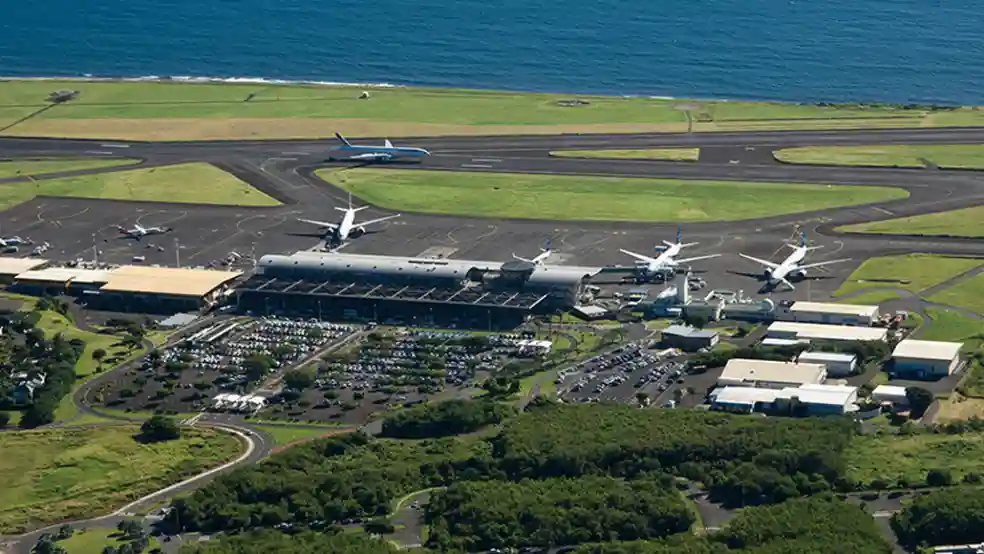
The problem was particularly severe at Roland Garros Airport. The airport’s earlier runway measured about 8,760 feet (2,670 meters). A heavy widebody departing from a tropical island needs considerable runway performance, and the combination of high temperatures, humidity, aircraft weight and fuel requirements can significantly reduce available takeoff performance.
Airlines consequently faced an uncomfortable trade-off. They could carry more passengers and cargo but make a technical stop, or reduce payload to carry enough fuel for a nonstop operation. For a commercially important route, neither option was ideal.
The technical stop was therefore not simply an inconvenience for passengers. It was an operational necessity created by the interaction between aircraft performance and airport infrastructure.
The Runway Expansion That Changed the Route
A major turning point arrived on November 26, 1994, when Roland Garros Airport opened its second runway. Runway 12/30 extended approximately 10,499 feet (3,200 meters), providing significantly more runway length for large, heavily loaded aircraft.
That infrastructure improvement changed the economics of the route. With additional pavement available, widebody aircraft could depart with the fuel and payload necessary for a nonstop journey to metropolitan France.
The technical stops could finally be eliminated, transforming a complicated multi-leg journey into a direct connection of less than 12 hours.
This was an important milestone because the Paris–Réunion route was already more than a passenger service. Réunion’s geographic isolation makes reliable air transport fundamental to its connection with mainland France. Improving the airport therefore had consequences far beyond reducing travel time.
The longer runway effectively created the physical foundation on which today’s ultra-long domestic route could operate. Later generations of aircraft would add another layer of capability, allowing airlines to carry substantial passenger loads while making the journey more efficiently than earlier widebodies could.
Boeing 777 and Airbus A350 Aircraft Power the Route
Modern aircraft have made the Paris–Réunion connection much more practical. The route is served by several airlines, including Air France, Air Austral, French bee and Corsair, creating a remarkably competitive market for such a remote island.
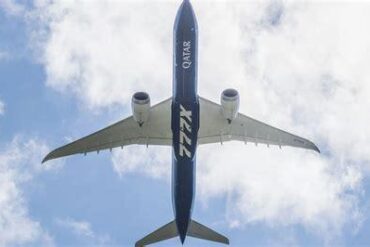
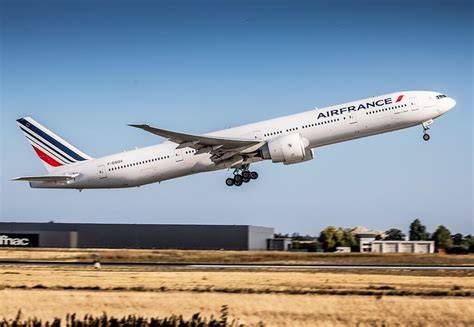
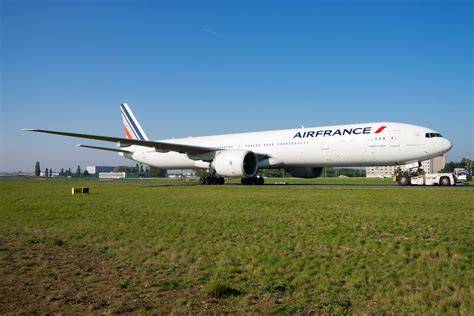
Air France uses the Boeing 777-300ER on the corridor, including high-density configurations capable of carrying hundreds of passengers. The aircraft’s combination of long range, large passenger capacity and substantial belly cargo capability makes it particularly well suited to a route where both passenger and freight demand matter.
Air Austral, Réunion’s home carrier, also uses long-range widebodies, including Boeing 777 and 787 aircraft, to connect the island with mainland France. Its fleet strategy reflects the importance of maintaining a dependable long-haul bridge between the island and metropolitan Europe.
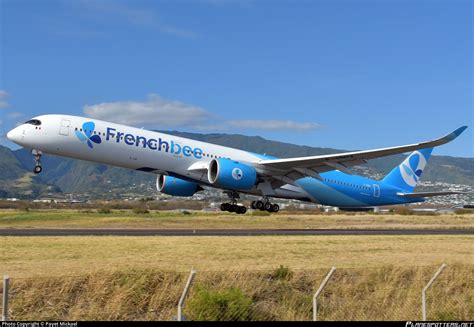
French bee brings a different operating model. The long-haul low-cost airline operates an all-Airbus A350 fleet, including the A350-1000, which can be configured with a very high passenger capacity. Its presence demonstrates how newer-generation widebodies can make ultra-long routes commercially viable even under a lower-cost business model.
Corsair has likewise modernized its fleet with the Airbus A330-900neo. The aircraft combines modern aerodynamics with efficient Rolls-Royce Trent 7000 engines, reducing fuel consumption compared with older generations while providing the range required for the long Indian Ocean crossing.
Why the Route Needs Long-Range Aircraft and Precise Fuel Planning
Flying nearly 5,000 nautical miles nonstop is not simply a matter of filling the fuel tanks and pointing the aircraft south. Long-haul airline operations involve detailed calculations covering aircraft weight, weather, winds, alternate airports, route restrictions and reserve fuel requirements.
The Paris–Réunion corridor also falls within the operational environment governed by Extended-range Twin-engine Operational Performance Standards (ETOPS). Modern twin-engine aircraft are extraordinarily reliable, but airlines must still plan for scenarios in which an aircraft needs to divert following an engine or other significant systems problem.
Fuel planning becomes particularly important because the aircraft must carry enough fuel for the scheduled route, legally required reserves and potential deviations without exceeding its takeoff or landing performance limitations.
Every additional kilogram of fuel also represents additional weight. That creates a constant balancing act: carrying enough fuel to protect operational flexibility while maximizing the payload that can generate revenue.
Modern widebodies are exceptionally good at this equation. The Boeing 777-300ER, Boeing 787, Airbus A350 and A330neo were designed around the economics of long-distance flying, allowing airlines to cover routes that previous generations could operate only with compromises or technical stops.
More Than a Passenger Route: Réunion’s Air Bridge to Europe
The Paris–Réunion service is important because the island does not have an alternative land-based connection with mainland France. There is no railway, highway or conventional maritime passenger network capable of replacing the role played by long-haul aviation.
As a result, the aircraft cabin represents only one part of the route’s importance. Widebody aircraft also carry substantial belly cargo, including pharmaceuticals, food, mail, high-value goods and other supplies required by the island’s economy and population.
The route also supports major social and administrative connections. Students traveling to universities in mainland France, patients requiring specialist medical treatment, government personnel and families separated by geography all depend on reliable air services.
This helps explain why multiple airlines operate the corridor throughout the year. The route has characteristics of a major domestic trunk route even though its physical geography makes it look like an international long-haul service.
The distance is extraordinary, but the underlying demand is remarkably conventional: people need to travel, businesses need to move goods and an isolated population needs a dependable connection with the larger national economy.
The Pandemic Created an Even Longer French Domestic Flight
The Paris–Réunion route holds the record for the longest regularly scheduled domestic flight, but it has not always been the longest domestic flight ever operated.
The COVID-19 pandemic temporarily produced even more extreme examples within French sovereignty. In March 2020, travel restrictions disrupted conventional routing arrangements and forced airlines to rethink how they connected French overseas territories with metropolitan France.
Air Tahiti Nui operated a Boeing 787-9 from Papeete to Paris on March 15, 2020, covering approximately 8,485 nautical miles nonstop in around 15 hours and 45 minutes. The flight was extraordinary by any measure, but its classification as a domestic French sector came from the same underlying principle: French Polynesia and metropolitan France are both under French sovereignty.
Two months later, French bee operated an even longer nonstop flight from Papeete to Paris Orly. An Airbus A350-900 covered approximately 8,709 nautical miles, or about 16,129 kilometers, in roughly 16 hours and 49 minutes while carrying a reduced payload that included medical supplies.
These flights temporarily pushed the concept of domestic range to an extreme. They were special operations created by extraordinary pandemic conditions rather than stable year-round schedules.
Once normal international transit patterns returned, airlines restored their conventional stopovers in the United States. The temporary records therefore disappeared, while Paris–Réunion retained its distinction as the longest regularly scheduled, year-round domestic route.
Why Paris–Réunion Still Holds the Record
The remarkable part of the Paris–Réunion operation is not simply that an aircraft can physically fly 5,048 nautical miles. Modern widebodies can travel considerably farther. The remarkable part is that airlines operate this distance repeatedly as a domestic service, carrying large passenger loads and commercial cargo while maintaining a regular schedule.
The route exists because several unusual factors align. Réunion is geographically remote but constitutionally part of France. Roland Garros Airport gained the runway infrastructure needed for heavy long-haul departures. Modern twin-engine widebodies subsequently delivered the range and efficiency necessary for nonstop operation.
Together, those factors turned what was once a complicated multi-stop journey through Africa into a direct air bridge between Europe and the Indian Ocean.
A Domestic Flight That Feels Like an Intercontinental Expedition
The Paris–Saint-Denis route illustrates just how different political geography and physical geography can be. On a map, Réunion appears extraordinarily far from France. From an aviation and constitutional perspective, however, the two destinations remain connected by one national transportation system.
Passengers can spend almost half a day traveling across continents and oceans without actually leaving the same country. The aircraft may pass through multiple air traffic control regions, cross enormous stretches of the Indian Ocean and travel between the Northern and Southern Hemispheres, yet its journey remains domestic.
That unusual combination has made the route an enduring aviation record. The 5,048-nautical-mile flight is long enough to rival many famous intercontinental services, but its purpose is far more fundamental than simply setting a distance record. It keeps Réunion connected to mainland France for passenger travel, trade, healthcare, education and everyday life.
In that sense, the world’s longest regularly scheduled domestic route is not merely a strange entry in an aviation record book. It is a demonstration of how sovereignty, airport infrastructure and modern aircraft technology can combine to create a flight that would seem impossible if judged by geography alone. Every time a widebody leaves Paris for Saint-Denis and heads south across the globe, it turns that unusual constitutional arrangement into one of the most remarkable routine journeys in commercial aviation.