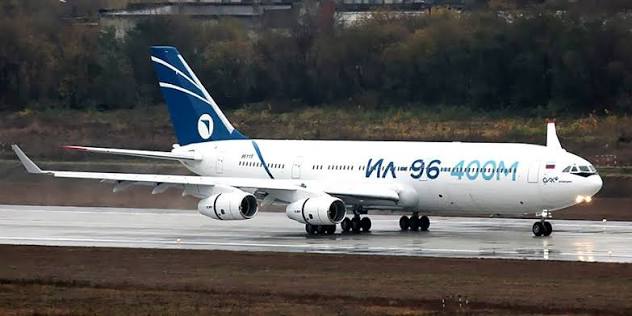
The Ilyushin Il-96 was supposed to represent the Soviet Union’s return to the world of modern long-haul aviation. Instead, the four-engine widebody became one of the clearest symbols of how dramatically Russia’s commercial aerospace industry declined after the Soviet collapse. Now, decades after the aircraft first entered service, the Il-96 may be finding a new purpose that has little to do with carrying ordinary airline passengers.
Russia is reportedly considering a small number of heavily modified Il-96-400M aircraft for a highly specialized military role. The potential mission is far more important than commercial aviation: replacing aging aircraft used as airborne command posts for Russia’s strategic nuclear forces. If the reports prove accurate, an airliner that struggled to compete with Boeing and Airbus could ultimately become one of the most important aircraft in Russia’s nuclear command-and-control system.
That possibility would represent an extraordinary transformation. The Il-96-400M has sometimes been presented as Russia’s answer to aircraft such as the Boeing 777X and Airbus A350, but it never had the production scale, economics, or technology base necessary to become a genuine competitor. Its future as a commercial aircraft remains uncertain. Its future as a military platform, however, could be considerably more practical.
The Il-96 Was Built for a Different Aviation Era
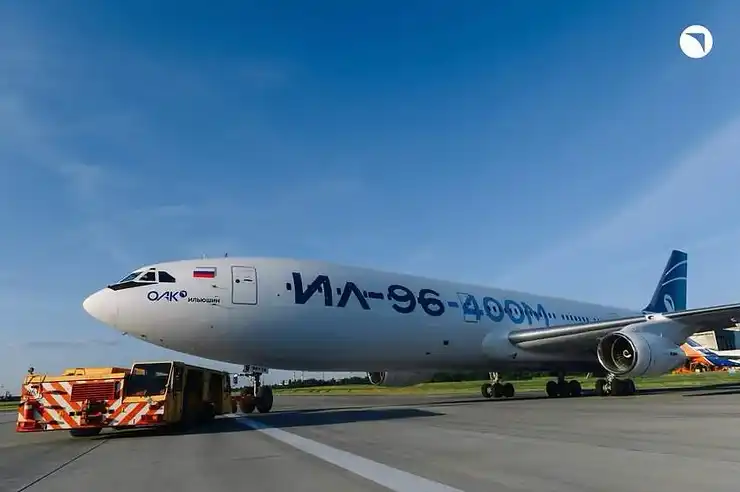
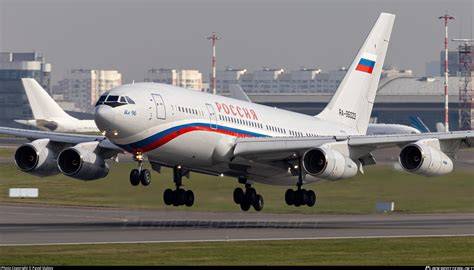
The Il-96 originated during the final years of the Soviet Union, when Moscow still possessed an enormous industrial and engineering base capable of developing large passenger aircraft. The prototype first flew in 1988, and the aircraft entered Aeroflot service in 1992, just as the Soviet Union itself disappeared.
The timing was disastrous for the program. Airlines across Russia and other former Soviet republics quickly moved toward Western-built aircraft, particularly Boeing and Airbus models. These aircraft offered better fuel efficiency, modern engines, stronger global support networks, and much greater economies of scale. The Il-96 therefore entered an international market that was rapidly moving away from the four-engine widebody concept.
The aircraft itself was not insignificant. The Il-96-300 measured approximately 55.35 meters in length and was designed to carry around 300 passengers in a single-class configuration. It was powered by four PS-90A turbofans and provided Russia with a domestic long-haul aircraft when few other options existed.
Yet the commercial market was changing too quickly. Twin-engine aircraft were becoming increasingly capable of flying long oceanic routes, while fuel consumption became one of the most important factors in airline economics. A four-engine aircraft with relatively old engines faced an obvious disadvantage against newer-generation twin-engine designs.
Only a small number of Il-96s were eventually built. According to the reference fleet data, approximately 34 aircraft have been produced since 1992, including prototypes and incomplete or retired airframes. Only a fraction remain active today, and most of those are associated with Russian government or military operations rather than mainstream passenger airlines.
The Il-96-400M Became Russia’s Unlikely Widebody Hope
Russia nevertheless refused to completely abandon the Il-96. The aircraft represented more than a commercial product. It was also a statement that Russia could still design and manufacture a large widebody aircraft domestically.
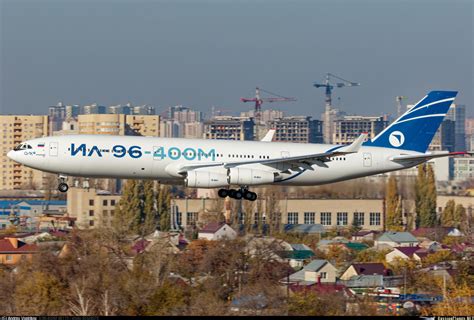
During the 2010s, Russia attempted to revive the concept through the Il-96-400M, a substantially stretched and modernized version. At roughly 64.69 meters long, the aircraft was significantly larger than the Il-96-300 and was intended to accommodate as many as 370 passengers in a single-class configuration.
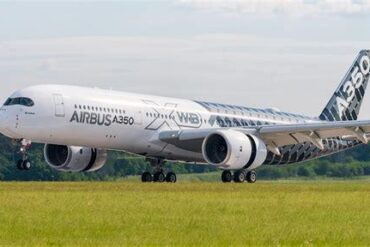
This was the point when comparisons with the Boeing 777X and Airbus A350 began appearing more frequently. Such comparisons had some value in describing the intended market segment, but they could easily create the wrong impression. The Il-96-400M was never a realistic economic peer of the newest Western widebodies.
Its four PS-90A1 engines remained a major limitation. The aircraft also depended on imported Western avionics and other technologies in its modernized configuration. That dependence became especially problematic after Russia’s invasion of Ukraine in 2022 and the subsequent sanctions that restricted access to Western aerospace technology.
The irony was striking. Sanctions created a powerful reason for Russia to produce domestic aircraft, but they simultaneously removed many of the components needed to make the modernized Il-96 commercially viable.
Sanctions Changed the Il-96’s Entire Mission
Before 2022, Russia could still imagine its domestic aircraft programs as part of a broader commercial strategy. The country was developing the MC-21, the Superjet successor program, the Tu-214, and other aircraft intended to reduce dependence on Boeing and Airbus.
After 2022, the strategic objective became much more basic: keep the Russian aviation system operating despite restricted access to foreign aircraft, engines, avionics, spare parts, and technical support.
Moscow announced ambitious plans to produce around 1,000 aircraft by 2030, covering multiple aircraft families. The plan included Il-96 production, although the projected number remained extremely small compared with the overall target. The planned quantity of Il-96-300 aircraft was increased from 12 to 14 in 2024, but the industrial realities surrounding Russian aerospace make the full target difficult to achieve.
The Il-96 therefore exists in an unusual position. Russia needs domestic widebody aircraft more than it did before, yet it lacks the industrial ecosystem necessary to produce large numbers of competitive modern widebodies quickly.
A Russian aviation specialist quoted by the BBC in 2024 described the fundamental problem: the country was effectively returning to an old four-engine aircraft because it had no new long-haul program ready to replace it. The specialist also highlighted the aircraft’s inefficient engines and the need for state subsidies to support operations.
That makes the Il-96 particularly poorly suited to normal airline economics.
It does not, however, make the aircraft useless.
Why a Nuclear Command Aircraft Changes the Equation
An aircraft used as a nuclear command-and-control platform operates under completely different economic rules from an airline aircraft.
An airline must minimize fuel burn, maximize passenger revenue, maintain high utilization, and compete against other carriers. A strategic command aircraft does not need to satisfy any of those requirements. Its value comes from surviving a crisis and providing communications, command facilities, personnel capacity, and endurance when ground-based command centers may be threatened.
This is where the Il-96-400M could become attractive.
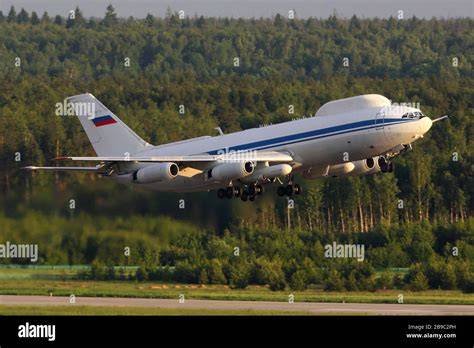
Russia currently operates a small fleet of specialized aircraft based on the Il-80, itself derived from the older Il-86 widebody. These aircraft are intended to provide airborne command, control, and communications capabilities during an extreme national emergency, including a major nuclear confrontation.
The proposed successor program is reportedly known as Zveno-3S. Public information about the program remains extremely limited, and much of what has appeared online consists of reporting, speculation, or interpretation rather than confirmed technical information.
If the Il-96-400M becomes the basis for this aircraft, however, the logic is relatively straightforward. A larger and newer widebody airframe could provide more internal volume for communications equipment, mission systems, operators, command personnel, power-generation equipment, and other specialized installations.
The aircraft’s commercial shortcomings would also matter much less.
Fuel efficiency is important, but endurance and survivability can take priority in a strategic command aircraft. Passenger comfort becomes largely irrelevant. The aircraft does not need to sell tickets, fill seats, or compete for airline contracts. Its mission is to provide a mobile national command facility when normal infrastructure may no longer be available.
Russia Would Need to Russify the Il-96-400M
There is one major complication.
The existing Il-96-400M test aircraft was developed using Western technology that Russia can no longer reliably access. A future military version therefore could not simply be pulled from the production line and converted without substantial changes.
A new Russian configuration would likely require domestic avionics, communications systems, navigation equipment, mission electronics, and other components. The resulting aircraft could therefore differ considerably from the Il-96-400M originally intended for civilian service.
This process would also explain why relatively small production numbers might make sense.
Russia does not need dozens of strategic airborne command posts. A small specialized fleet could theoretically provide the required capability while avoiding the enormous cost of creating a full commercial production program.
The same basic logic has already shaped much of Russia’s modern military aviation industry. Aircraft designs that struggle to find civilian customers can remain useful when their platforms are adapted to government or military missions.
The American E-4B Provides a Useful Reference Point
The closest American equivalent is the E-4B, the airborne command post operated by the United States Air Force. The aircraft is based on the Boeing 747-200 and was designed to provide a highly survivable command center during a national emergency.
The comparison is useful because it demonstrates why an old airliner design can remain relevant long after it has become commercially obsolete.
The 747-200 is an aircraft from a completely different generation of commercial aviation. Yet its enormous internal volume and long-range capability make it suitable for carrying sophisticated command-and-control equipment and large numbers of personnel.
The United States is now replacing the E-4B through the Survivable Airborne Operations Center program. Sierra Nevada Corporation acquired five Boeing 747-8 aircraft formerly operated by Korean Air for conversion into the next generation of American strategic command aircraft.
Russia appears to face a similar underlying problem, although with different industrial resources and a very different modernization pathway. Its Il-80 fleet is based on an older generation of Soviet widebody aircraft, and replacement becomes increasingly important as those airframes age.
The Il-96-400M therefore offers an existing Russian-built platform with substantial range, internal volume, and an established production lineage.
The PD-35 Could Eventually Change the Equation
One of the most intriguing elements surrounding Russia’s large-aircraft ambitions is the PD-35 turbofan.
The engine is being developed with a target thrust of approximately 77,000 pounds, or 35 tonnes. It was originally associated with the Russian-Chinese CR929 widebody project, which eventually became the Chinese-led C929 after Russia’s role in the program diminished.
A sufficiently mature PD-35 could theoretically provide a future Il-96 derivative with much greater efficiency than the existing PS-90 engine family. However, that possibility should not be treated as an established Il-96 upgrade plan.
The PD-35 remains a major development project, and there is no current production aircraft using it. Certification and industrialization remain significant hurdles.
For the potential nuclear command aircraft, that may not matter immediately. A strategic platform could potentially continue using existing propulsion technology while the larger engine program develops separately.

Voronezh Production Activity Adds Another Piece to the Puzzle
The Voronezh aircraft plant is another important part of the story. In late 2025, Russian reporting indicated that the facility was reorganizing its workload across multiple aircraft programs while planning to retain its core workforce and potentially hire between 1,500 and 2,000 additional employees.
The plant is associated with several important Russian aircraft programs, including the Il-76, Il-78, Il-112V, Il-96, and Il-114-300.
Some reports interpreted the planned hiring as evidence that Russia was preparing to increase production of military Il-96-400 aircraft. That conclusion remains uncertain. The available information does not establish exactly which programs will require the additional personnel.
That distinction is important because Russia has several competing industrial priorities. The Il-76 family remains strategically important, while the Il-114-300 has recently moved closer to serial production. The country is also attempting to expand domestic engine production and sustain aircraft programs under severe resource constraints.
Consequently, workforce expansion at a facility associated with the Il-96 should not automatically be treated as proof that the Zveno-3S program is entering production.
From Failed Airliner to Strategic Aircraft
The potential transformation of the Il-96 illustrates something unusual about modern Russian aviation.
The aircraft failed to become a major commercial competitor because the world moved toward more efficient twin-engine widebodies. Russia’s proposed successor programs have also faced delays, sanctions, industrial limitations, and shortages of critical technology.
Yet those weaknesses do not necessarily eliminate the value of the basic airframe.
A platform does not need to win the commercial market to be useful as a military aircraft. In fact, the requirements can be almost opposite. A strategic command aircraft can accept high operating costs if it provides capabilities that cannot easily be obtained elsewhere.
That makes the Il-96-400M an intriguing candidate for a future Russian nuclear command aircraft. It offers a relatively large fuselage, long-range potential, domestic production, and a foundation that can be modified for specialized military equipment.
The biggest unanswered question is whether Russia can actually industrialize the aircraft in a sufficiently modern, reliable, and domestically supported configuration.
The “Doomsday Plane” Label Needs Context
Calling the proposed aircraft a “Doomsday plane” makes for a powerful headline, but the terminology can obscure the technical reality.
These aircraft are not designed to cause a nuclear war. Their purpose is to preserve national command, control, and communications capabilities if conventional command infrastructure becomes unavailable or compromised.
For Russia, maintaining that capability is closely connected to its nuclear deterrence architecture. For the United States, the E-4B serves a related strategic purpose.
The important point is therefore not that the Il-96 has suddenly become a revolutionary new weapon. Rather, a commercially unsuccessful airliner could be repurposed into an unusually valuable strategic platform because its size, range, and domestic manufacturing base make it suitable for a mission where airline economics no longer matter.
Russia’s Il-96 Future Is Still Far From Certain
There is currently no public evidence sufficient to establish that a fleet of Il-96-400M nuclear command aircraft is definitely entering operational service. The Zveno-3S program is highly classified, and public reporting provides only fragments of information.
Nor is it clear whether the Russian government intends to manufacture new Il-96-400M airframes specifically for the mission, modify existing aircraft, or pursue another platform altogether.
What is clearer is the strategic logic behind the idea. Russia needs to maintain a survivable airborne command capability, while its existing Il-80 fleet is aging. At the same time, the country’s commercial widebody ambitions remain constrained by sanctions, technology shortages, production capacity, and the absence of a competitive modern long-haul aircraft.
The Il-96 therefore occupies an unusual position. It failed as a mass-market answer to Boeing and Airbus, and the Il-96-400M never became the true Boeing 777X rival that some Russian messaging implied. But the same characteristics that made the aircraft commercially unattractive may make it useful for a much narrower mission.
A large Russian-built airframe with long range, substantial internal space, and the ability to host specialized equipment does not need to compete with the 777X to have strategic value.
If Russia ultimately turns the Il-96-400M into the next generation of its airborne nuclear command fleet, the aircraft would have completed one of the strangest journeys in modern aviation: from a Soviet-era attempt to preserve an independent passenger-airliner industry, through an unsuccessful revival as a Western widebody challenger, to a potential role as a strategic airborne command center designed for the most extreme national emergency.