The idea of a “doomsday plane” sounds like science fiction, yet it remains one of the most real and sobering components of American national defense. When the United States test-launched an unarmed nuclear missile in late 2025, public attention briefly shifted to an uncomfortable question: where does presidential authority go if the ground below becomes uninhabitable? The answer is not underground alone, but airborne, sealed inside a heavily modified Boeing 747 known as the National Airborne Operations Center, or E-4B Nightwatch.
First delivered to the U.S. Air Force in 1980, the E-4B has outlived generations of consumer electronics, commercial aircraft designs, and even entire military doctrines. Despite its age, it remains indispensable. The aircraft is designed to survive electromagnetic pulses, nuclear shockwaves, and global communications collapse while maintaining uninterrupted command over America’s nuclear forces. What seems outdated on paper is, in reality, one of the most resilient systems ever built.
This is not nostalgia or bureaucratic inertia at work. The continued reliance on 1980s-era technology inside America’s doomsday plane is a deliberate strategic choice rooted in physics, survivability, and control. In a nuclear conflict, reliability beats novelty, and the E-4B embodies that philosophy with almost uncomfortable clarity.
The Flying Pentagon Built for the End of the World
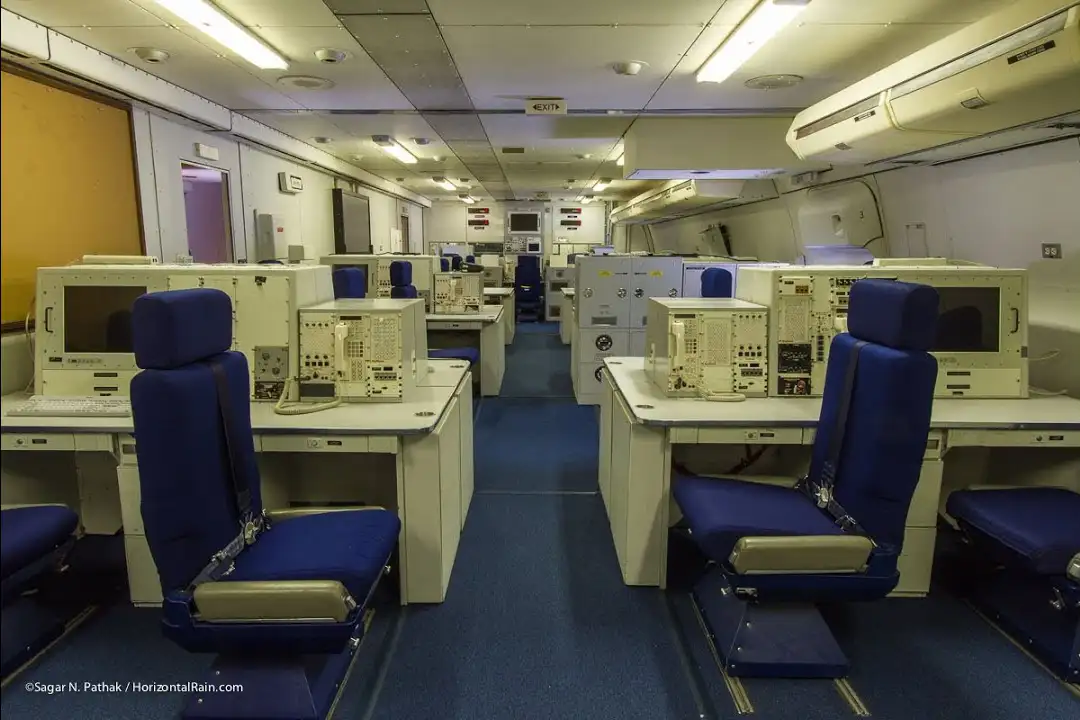
The E-4B is not merely a transport aircraft with radios bolted on. It is a self-contained command ecosystem, capable of housing up to 111 personnel, including the President, Secretary of Defense, Joint Chiefs of Staff, and technical operators. Its interior is divided into multiple functional zones: command centers, briefing rooms, conference areas, communications hubs, offices, and rest quarters. Every square foot is designed to function under extreme conditions.
What truly sets the aircraft apart is its communications architecture. The E-4B can connect to every leg of the U.S. nuclear triad—land-based missile silos, ballistic missile submarines, and strategic bombers—using hardened electronics that resist jamming and EMP disruption. Systems like the Milstar satellite network enable secure, jam-resistant transmission even when conventional satellites are compromised.
The plane’s trailing low-frequency antenna, capable of extending nearly five miles behind the aircraft, allows it to communicate with submerged submarines without forcing them to surface. This capability alone justifies the aircraft’s continued operation, as no modern commercial platform can support such hardware without massive structural modification.
Why Old Technology Survives When New Systems Fail
In most industries, aging technology signals inefficiency. In nuclear command and control, it signals tested survivability. The E-4B’s electronics are intentionally less miniaturized than modern systems. Larger components are easier to shield, repair, and harden against electromagnetic interference. Advanced consumer-grade microelectronics, while powerful, are also fragile in high-radiation environments.
Modern fly-by-wire systems and AI-assisted avionics may offer efficiency, but they also introduce new points of failure. The Nightwatch relies on redundant, analog-heavy systems that can continue operating even if large portions of the aircraft are damaged. In nuclear planning, predictability under stress is more valuable than innovation under ideal conditions.
The Aircraft No One Builds Anymore
One of the most misunderstood reasons for the E-4B’s longevity is purely industrial. The aircraft requires a large, four-engine airframe to support its immense power demands, antenna systems, shielding, and onboard personnel. Commercial aviation has largely abandoned this category. Boeing and Airbus no longer mass-produce aircraft comparable to the 747-200 in size and electrical capacity.
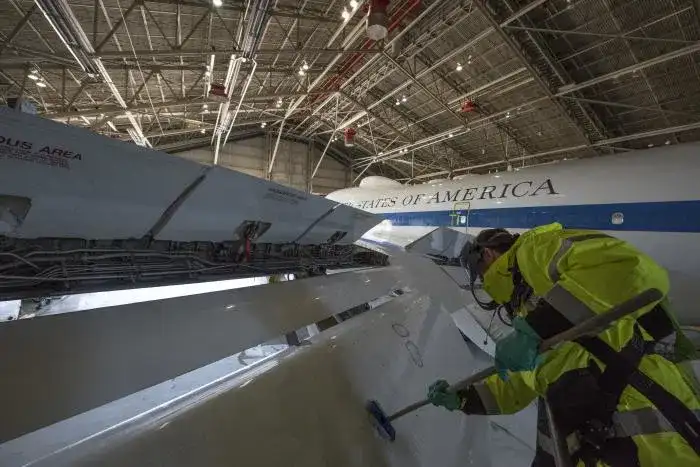
As a result, the Air Force had no choice but to rely on secondhand aircraft even when the fleet was first assembled. Today’s E-4Bs are among the oldest 747s still flying, powered by GE CF6-50E2 engines that have long disappeared from commercial service. No U.S. airline operates this model anymore, making parts sourcing increasingly difficult.
This industrial reality explains why replacement timelines stretch decades rather than years. Designing an entirely new aircraft from scratch, capable of matching the E-4B’s unique requirements, is neither quick nor cheap.
Maintenance, Obsolescence, and Strategic Risk
Age has consequences. The E-4B fleet reportedly maintains a mission availability rate of around 55%, a troubling figure for aircraft that must be ready at all times. As vendors discontinue parts and specialized components fall out of production, maintenance costs continue to rise. Technicians often resort to custom fabrication or cannibalization to keep the planes operational.
Air Force leadership has acknowledged the problem openly. In 2024, General Charles Q. Brown summarized the dilemma bluntly, noting that at some point, sustaining aging platforms becomes more expensive than developing replacements. This acknowledgment marked a turning point in the aircraft’s long service life.
The Future Successor and the End of an Era
That turning point arrived with the announcement of the Survivable Airborne Operations Center program. In a $13 billion contract awarded to Sierra Nevada Corporation, the Air Force committed to building a new generation of airborne command aircraft. The company has already acquired five Boeing 747-8 airframes, signaling a continuation of the large-aircraft philosophy rather than a departure from it.
If current timelines hold, the new fleet will not enter service until 2036. By then, the Nightwatch will be approaching six decades of continuous operation, an almost unprecedented lifespan for a frontline military aircraft. The successor will undoubtedly feature updated systems, improved efficiency, and modernized defenses, but it will inherit the same core mission: to function when everything else fails.
Why the 1980s Still Matter
The continued operation of America’s doomsday plane is not a failure of modernization. It is a reflection of strategic conservatism in the face of existential risk. Nuclear command and control is one domain where untested innovation can be more dangerous than aging reliability. The E-4B’s 1980s technology endures because it has already proven it can survive the worst-case scenario.
In an era obsessed with speed, automation, and artificial intelligence, the Nightwatch stands as a reminder that some systems are built not to evolve quickly, but to endure absolutely.