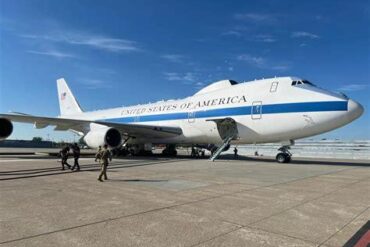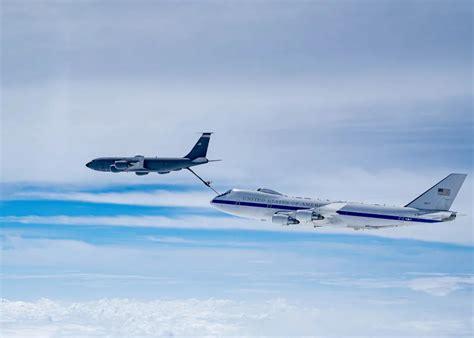
The sudden decision by the United States Air Force to expand its legendary Nightwatch doomsday aircraft fleet has less to do with theatrics and far more to do with cold operational math. Nuclear command-and-control does not tolerate downtime, aging airframes do not forgive delays, and global security conditions have grown more volatile rather than calmer. Against that backdrop, the move to potentially grow the fleet from four aircraft to as many as eight represents a calculated shift toward redundancy, resilience, and survivability at the highest level of national defense.
At the center of this shift is the transition from the aging E-4B Nightwatch to the next-generation E-4C Survivable Airborne Operations Center, or SAOC. While officially framed as a replacement program, mounting evidence suggests the Air Force is quietly preparing for a larger force structure than it has ever operated before. That expansion carries strategic, financial, and political implications that extend well beyond a simple aircraft upgrade.
The Nightwatch mission is unique even by military aviation standards. These aircraft are not designed for routine travel or symbolic flyovers. They exist for one purpose only: to ensure the continuity of U.S. government command in the event that ground-based leadership and communications infrastructure are destroyed. That mission cannot pause for maintenance cycles, parts shortages, or training gaps, and the Air Force has reached the uncomfortable conclusion that four aircraft are no longer enough.
Signals From Offutt Air Force Base Reveal Bigger Plans
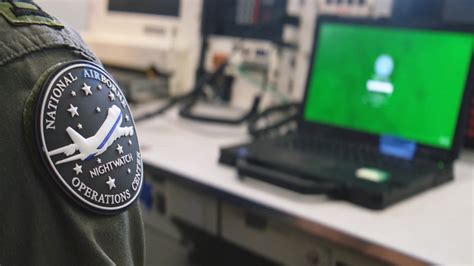
The clearest evidence of expansion surfaced quietly through Offutt Air Force Base construction planning documents reviewed by Aviation Week. Slides dated January 22 show facilities sized to support six to eight E-4C aircraft, not merely a one-for-one replacement of the existing E-4B fleet. The plans include a new two-bay maintenance hangar capable of fully enclosing Boeing 747-8I-based aircraft, a clear departure from infrastructure built for just four jets.
Additional facilities outlined in the planning package include a fuel-cell hangar, dedicated training spaces, expanded supply storage, a new fire station, and taxiway upgrades designed around the operational footprint of the 747-8I. An environmental assessment is scheduled to run through September 2026, aligning neatly with the expected transition timeline from development into early operational capability.
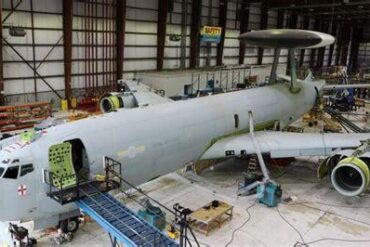
From a programmatic perspective, the SAOC effort crossed a critical threshold in April 2024 when the Air Force awarded Sierra Nevada Corporation a development contract valued at approximately $13 billion. The company has already acquired five Boeing 747-8Is, and testing reportedly began in 2025, signaling that conversion work is no longer theoretical. The physical infrastructure now being planned strongly implies that more aircraft are coming.
What Makes the E-4 Nightwatch Indispensable
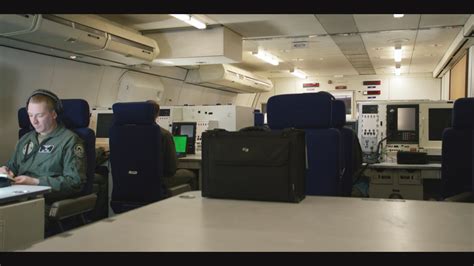
The E-4B Nightwatch serves as the Air Force’s National Airborne Operations Center, built on a heavily modified Boeing 747-200 platform. Its purpose is stark and uncompromising: to keep the President, Secretary of Defense, and Joint Chiefs of Staff connected and in command if terrestrial command centers are destroyed or rendered unusable.
Inside, the aircraft is divided into six specialized operational zones covering command, briefing, conferencing, operations, communications, and crew rest. It can support roughly 111 personnel, spanning flight crews, maintenance specialists, security teams, and joint operations staff. The aircraft is hardened against electromagnetic pulse effects, shielded against nuclear and thermal threats, and equipped with advanced satellite communications that allow global reach under extreme conditions.
Unlike Air Force One, the Nightwatch rarely carries the President in routine operations. Instead, it frequently supports the Secretary of Defense and remains on continuous alert status. At least one aircraft is airborne-ready at all times, a requirement that places enormous strain on a fleet that has been flying since the Cold War era.
Aging Airframes and the Maintenance Trap
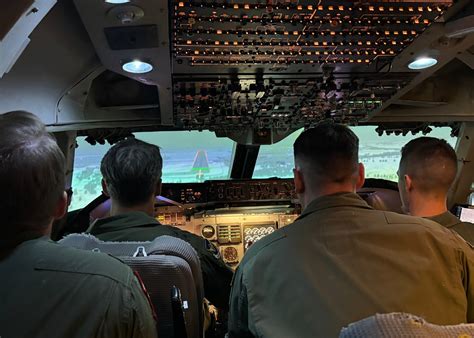
The push to expand the fleet is driven as much by engineering reality as by strategy. The E-4B airframes are decades old, increasingly expensive to maintain, and reliant on parts that are no longer produced at scale. Keeping four aircraft mission-ready already requires intense logistical effort. Any unexpected grounding immediately reduces national command resilience.
By increasing the fleet size, the Air Force gains maintenance breathing room, improved training availability, and far greater operational flexibility during the transition to the E-4C. Nuclear command-and-control systems cannot accept single points of failure, and a larger fleet ensures continuous coverage even during heavy maintenance cycles or modernization work.
The Financial Weight of Doubling the Fleet
Expanding the Nightwatch fleet does not come cheaply. Program spending surged from approximately $94 million in 2023 to more than $700 million in 2024, with a staggering $1.7 billion request submitted for 2025, all before the first operational E-4C enters service. Fielding six to eight aircraft increases costs not only through procurement, but through additional spares, mission systems, training pipelines, and specialized crews.
Infrastructure costs compound the burden. Hangars, ramps, taxiways, and support facilities sized for 747-8I operations represent long-term investments that will define Offutt Air Force Base for decades. Meanwhile, the Air Force must continue flying the E-4B fleet throughout the transition, creating an overlap period that is among the most expensive phases of any major aircraft modernization program.
Strategic Meaning Beyond the Aircraft
The decision to expand the Nightwatch fleet sends a clear signal about how the United States views the modern threat environment. Continuity of government is no longer treated as a theoretical contingency but as an operational requirement demanding additional redundancy. The E-4C is not merely a replacement aircraft; it is a recognition that command survivability must scale alongside emerging risks.
In that sense, the expansion is less about aircraft numbers and more about institutional certainty. The Air Force is buying time, resilience, and margin for error in a domain where failure is unthinkable. The Nightwatch fleet has always existed in the shadows, but its quiet growth speaks volumes about how seriously the United States is preparing for the worst while hoping it never arrives.