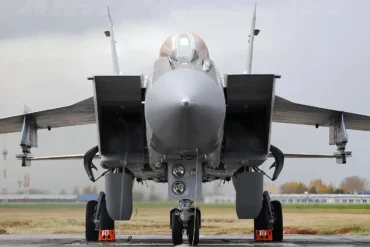
The MiG-25 Foxbat and MiG-31 Foxhound are two of the most iconic high-speed interceptor aircraft ever produced by the Soviet Union. At first glance, it may seem counterintuitive that the older MiG-25—powered by less sophisticated engines—was able to achieve a higher top speed than the MiG-31, which benefits from advancements in propulsion, avionics, and structural materials. However, this phenomenon is rooted in a complex interplay of aerodynamics, mission design philosophy, thermodynamic constraints, and airframe survivability.
MiG-25: A Blunt Instrument of Raw Speed
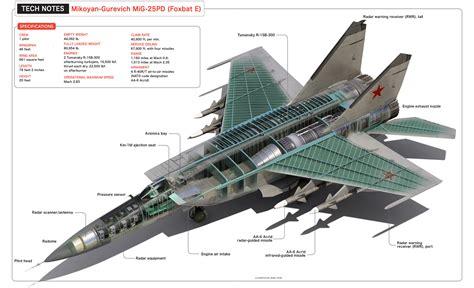
The MiG-25, introduced in the 1970s, was born out of Cold War urgency. Designed to counter the perceived threat of the American XB-70 Valkyrie and SR-71 Blackbird, its primary directive was speed—to climb rapidly and intercept high-altitude threats before they could penetrate Soviet airspace. To achieve this, Mikoyan engineers designed the MiG-25 around two massive Tumansky R-15B-300 turbojet engines.
These engines delivered an impressive thrust of 100 kN (22,500 lbf) each in afterburner mode. Despite being inefficient and relatively crude, the R-15s allowed the MiG-25 to reach Mach 2.83 operationally, and Mach 3.2 under emergency conditions—although doing so would often lead to severe engine damage due to thermal stress.
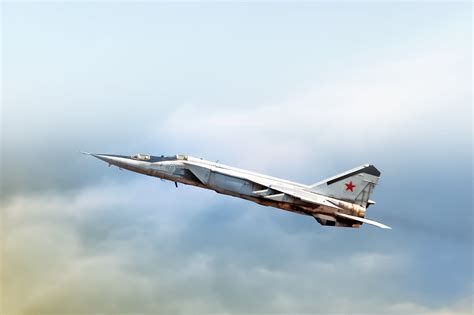
To support this raw velocity, the MiG-25 was built using nickel-steel alloy, with limited use of titanium due to cost and production complexity. This made it extremely rugged but also heavier and less maneuverable. The airframe was optimized for stability and linear acceleration rather than agility. Its wings were thin and highly swept, reducing drag at high speeds but also limiting performance at lower speeds and altitudes.
MiG-31: A Sophisticated Multi-Role Interceptor
The MiG-31 was not just a replacement for the MiG-25—it was a redefinition of the interceptor role. Developed in the late 1970s and entering service in the 1980s, the MiG-31 incorporated a host of innovations. Most notably, it was the first fighter to carry a Zaslon phased-array radar, and it was equipped for long-range interdiction missions against cruise missiles, low-flying aircraft, and strategic bombers.
At the heart of the MiG-31’s powerplant are the Soloviev D-30F6 turbofan engines, each generating up to 152 kN (34,172 lbf) of thrust with afterburner. These engines were significantly more thermally efficient and reliable than those in the MiG-25. So why doesn’t the MiG-31 fly faster?
Key Differences Driving the Speed Limitation
1. Engine Thermal Management and Operational Limits
While the MiG-25 could hit Mach 3.2, doing so would exceed the safe temperature threshold of its engines, leading to irreparable damage. The MiG-31, on the other hand, was deliberately capped at around Mach 2.83 to preserve engine longevity and avoid structural overheating.
The D-30F6 engines, being high-bypass turbofans rather than turbojets, are optimized for fuel efficiency and sustained supersonic cruising, not sheer top-end bursts. They deliver more thrust at altitude but are thermodynamically limited in how much heat they can safely tolerate. The MiG-25’s engine design allowed brief excursions into extreme speed zones at the cost of engine life, while the MiG-31’s designers built in strict safeguards to ensure mission continuity.
2. Airframe and Structural Considerations
Despite appearances, the MiG-31 is aerodynamically more complex. Its wing loading is lower, and it has features like canards and larger surfaces to support low-altitude supersonic flight and improve handling. However, these enhancements create additional drag at extreme velocities.
Furthermore, the MiG-31 was built using high-strength stainless steel and titanium, which helped with durability but also meant that materials would deform or fatigue under continuous exposure to high thermal loads. To maintain the structural integrity of the frame, the maximum allowable speed was reduced, even though the engines could, theoretically, push it further.

3. Mission Evolution and Strategic Role Shift
Perhaps the most crucial element in understanding the speed differential lies in mission intent. The MiG-25 was a point-defense interceptor, designed to respond to a very specific threat at very high altitudes and escape speeds. The MiG-31, by contrast, was tasked with networked air defense over vast swaths of Soviet and later Russian territory.
The MiG-31’s avionics, radar, and targeting systems allow it to engage multiple aerial targets across hundreds of kilometers, removing the need for extreme dash speed. It can loiter for longer, operate cooperatively with other fighters, and perform under diverse conditions. The shift in doctrine from speed-based interception to integrated air defense management fundamentally deprioritized maximum velocity.
4. Aerodynamic Refinements and Drag Penalties
Although the MiG-31 resembles its predecessor externally, it features refined aerodynamic shaping that favors stability and payload capacity over drag reduction. The MiG-25’s narrow fuselage and simplified inlet geometry were tuned to channel air more aggressively into the engines, reducing frontal drag at the cost of efficiency and adaptability.
The MiG-31’s intakes, wing structure, and fuselage were reshaped for versatility rather than maximum acceleration. Additionally, carrying advanced avionics and weapons systems added significant weight and surface complexity, further reducing its practical top speed.
The Thermodynamic Ceiling: Limits of Air-Breathing Flight
Supersonic aircraft operate at the intersection of thrust generation and heat management. As velocity increases, so too does the kinetic heating of the airframe—a factor that becomes critical above Mach 2.5. The MiG-25 was famously known to return from high-speed runs with wavy, heat-warped panels and engines requiring complete overhaul.
The MiG-31, benefiting from advancements in material science and engineering discipline, had to obey stricter limitations to remain combat-effective across a wider mission profile. Even though it had more powerful engines, its operating environment was not purely defined by top speed—it was designed for repeatable, sustainable operations, rather than sprint interceptions.

Top Speed vs Combat Effectiveness: A Shift in Design Philosophy
In evaluating aircraft performance, it’s important to consider what “top speed” actually implies. For the MiG-25, it was a metric born of necessity. For the MiG-31, it was a design trade-off. Soviet aerospace engineers understood that pushing the MiG-31 to the same top speeds as its predecessor would require compromises in radar size, fuel capacity, and endurance—all vital to its real-world combat role.
Ultimately, the MiG-31 is a product of evolved threat perception and multi-role combat necessity. It trades raw top speed for advanced interception systems, extended range, better endurance, and survivability.
Conclusion: Why Speed Isn’t Everything
The MiG-25 was an engineering marvel of its time—brutally fast but fragile. The MiG-31 is more than its successor in number; it is a superior tool for modern air defense. Its engines, while stronger, are part of a tightly controlled thermodynamic system. Its airframe is heavier and more complex to support new-age avionics and weapons. The result is a jet that is strategically superior but tactically slower.
Speed, as it turns out, is not the final arbiter of excellence in fighter design. In the evolution from MiG-25 to MiG-31, Soviet engineers demonstrated an understanding that operational effectiveness, not raw velocity, defines air superiority in the real world.