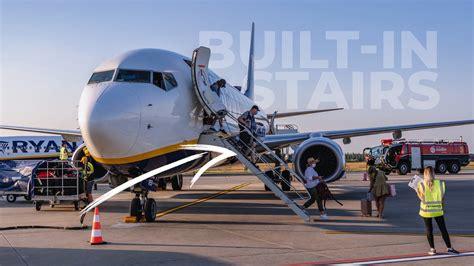
Commercial aviation has a habit of sanding away charming oddities in the name of efficiency. Tail galleys disappeared, lounge bars vanished upstairs, and flight engineers quietly exited the cockpit. One feature, however, survived long enough to become a quiet anachronism rather than a nostalgic footnote: the built-in airstair. Once common on short-haul jets serving modest airfields, the integrated stairway has all but vanished from mainline fleets. In the United States, a single aircraft family still carries the torch. That aircraft is the Boeing 737, and its stubbornly practical staircase tells a deeper story about design philosophy, airline economics, and why old ideas sometimes outlast newer ones.
The notion of an airplane bringing its own stairs now feels quaint, even rebellious, in a world ruled by jet bridges and tightly choreographed turnarounds. Yet for decades, those folding steps were not a novelty. They were essential hardware, baked into the aircraft’s identity. The fact that the 737 still offers them today, even on the 737 MAX, is not an accident or a nostalgic indulgence. It is the result of decisions made in the 1960s that continue to echo through modern aviation.
Understanding why the 737 remains the last mainline American aircraft with an optional built-in airstair requires stepping back into a very different era of air travel, when airports were smaller, infrastructure was inconsistent, and versatility was a competitive weapon rather than a marketing slogan.
A Time When Aircraft Had to Be Self-Sufficient
In the early jet age, airlines could not assume that every destination would offer jet bridges, ground power units, or mobile stairs waiting neatly on the ramp. Many airports were little more than paved runways with a terminal building that resembled a bus station. Aircraft designers responded by making airplanes that could fend for themselves. Integrated airstairs allowed passengers to board directly from the tarmac, eliminating dependence on airport equipment and speeding operations at remote stands.
Classic jets like the Boeing 727 and the McDonnell Douglas DC-9 embodied this philosophy. Both featured built-in stairs, often mounted in the rear fuselage, and both were optimized for short to medium routes into secondary cities. These aircraft were not designed for the hub-and-spoke megacenters that dominate today’s networks. They were designed to go anywhere, reliably, with minimal support.
When Boeing launched the 737 program, it leaned heavily into that same idea. The aircraft was conceived as a large regional jet, capable of operating from underdeveloped airfields without specialized ground equipment. The airstair was not a luxury add-on. It was part of the mission.
Why the Boeing 737 Still Offers Integrated Airstairs
The Boeing 737 is the oldest commercial jetliner still in production, with a lineage stretching back to 1968. Across four generations—Original, Classic, Next Generation, and MAX—its fundamental architecture has remained recognizable. One of the most telling remnants of that architecture is its ability to accept an integrated airstair at the forward left door.
Boeing continues to offer this feature as an option. Operators willing to accept the modest weight penalty can equip even brand-new 737 MAX aircraft with electrically operated, fully integrated stairs. These stairs require no external equipment and can be deployed from inside or outside the aircraft, making the jet remarkably self-reliant on the ground.
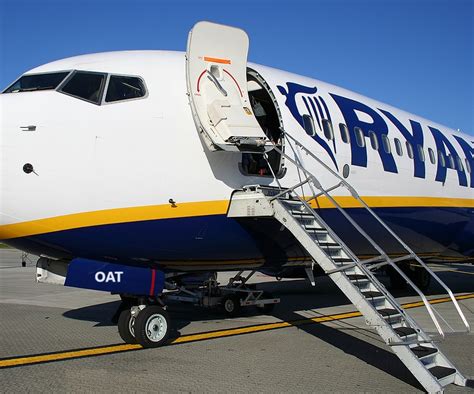
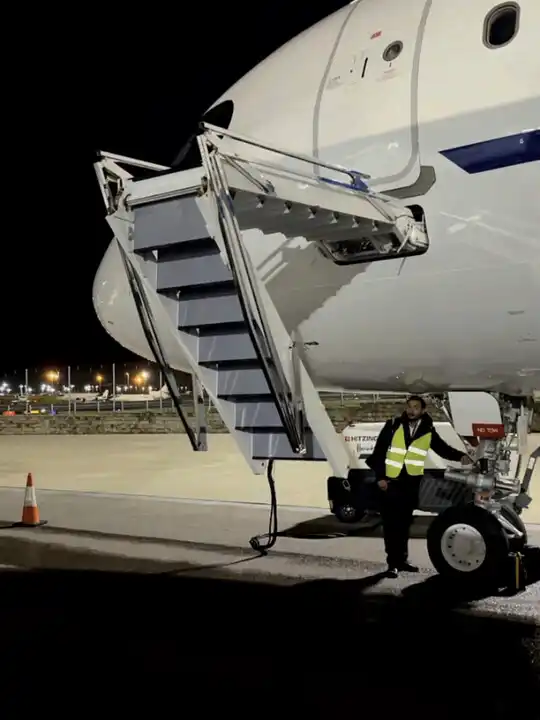
The system itself is elegantly simple. The stairs are folded within the fuselage and extend automatically when activated. A control panel inside the cabin allows crew members to deploy or retract them with a single command, whether the door is open or closed. From outside, a discreet handle flush with the fuselage provides identical functionality. While the extension is automated, the handrails must be manually secured, a small reminder that even clever engineering still relies on human hands.
Crucially, this system exists because the 737 sits low to the ground. That design choice, made over half a century ago, is what makes the entire concept viable.
Low to the Ground by Design, Not by Accident
The 737’s low stance is one of its most defining characteristics. Unlike newer narrowbodies such as the Airbus A320 or the Boeing 757, the 737 was deliberately engineered with short landing gear. This allowed passengers to board via stairs without climbing an impractically steep incline and enabled ground crews to service the aircraft without specialized loaders.
From an engineering perspective, height matters. An aircraft that sits too tall would require longer, heavier stair assemblies, quickly eroding any operational benefit. For modern designs optimized around jet bridges and standardized airport infrastructure, built-in stairs simply do not make economic sense.
The 737 slipped through a narrow window in aviation history. It was designed early enough to prioritize self-sufficiency, yet it proved successful enough to remain relevant long after airports evolved. That combination left it uniquely positioned to retain features that newer aircraft never needed.
Why Integrated Airstairs Faded Away
As aviation matured, airports invested heavily in infrastructure. Jet bridges became standard at major hubs, offering weather-protected boarding and tighter control over passenger flows. Even smaller airports acquired fleets of mobile stairs, making aircraft-specific solutions redundant.
At the same time, airlines grew more sensitive to weight. Every additional system on an aircraft represents fuel burn over thousands of cycles. For most carriers, carrying a staircase that would rarely be used made little sense. As a result, integrated airstairs quietly disappeared from new mainline designs.
The transformation of the 737 itself reflects this shift. What began as a rugged, flexible workhorse for secondary airports became the backbone of global airline fleets, operating dense schedules between major hubs. For many operators, the airstair option became unnecessary. For a few, it became strategically valuable.
Why Low-Cost Carriers Still Care
Budget airlines think about costs differently. While paying extra for an integrated stair may seem counterintuitive, the long-term math can favor self-contained solutions. Airports often charge fees for jet bridge use, and even mobile stairs can come with per-turn costs. For airlines operating high-frequency, short-haul schedules, those fees add up quickly.

Ryanair is the most famous example. The airline equips its 737 fleet with integrated airstairs and routinely avoids jet bridges even when they are available. Passengers walk across the apron and board via the aircraft’s own steps, reducing airport charges and maintaining operational control. The result is a leaner turnaround process aligned with the airline’s ultra-low-cost philosophy.
In this context, the airstair is not a relic. It is a competitive tool.
Why Other Modern Aircraft Don’t Follow Suit
Regional aircraft continue to use integrated stairs, but their implementation differs. Jets like the Bombardier CRJ, Embraer ERJ, and turboprops such as the ATR 72 often incorporate stairs directly into the main cabin door. These systems are usually standard and reflect the aircraft’s role in serving small airports.
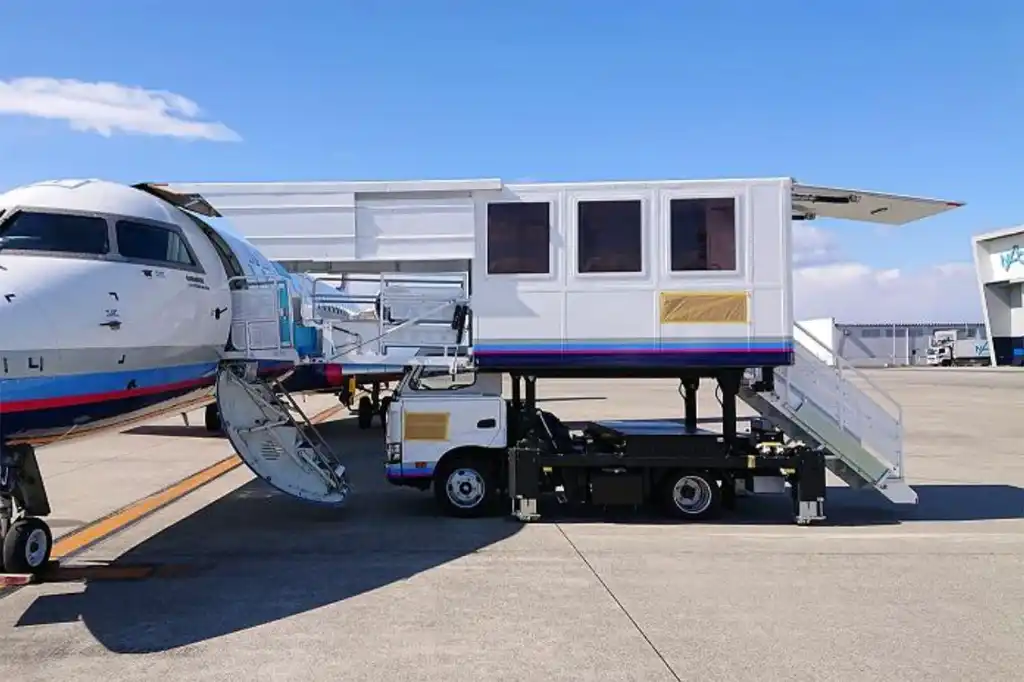
The Embraer E-Jet family occupies a middle ground. Taller and more mainline-oriented, E-Jets cannot easily accommodate door-integrated stairs. Embraer offers retractable steps similar to the 737’s, but the option is rarely selected. The added weight and lack of low-cost operators in the E-Jet customer base make it a niche choice rather than a defining feature.
Among true mainline narrowbodies, the 737 stands alone.
Design Choices That Echo Beyond the Airstair
The 737’s low-slung design has implications beyond boarding. Because it sits closer to the ground, baggage can be loaded without powered belt loaders at smaller stations. Overwing exits do not require inflatable slides, saving weight. The landing gear itself is lighter, contributing to overall efficiency.
These advantages are partly the result of grandfathered certification standards, which allowed Boeing to retain older design assumptions as the aircraft evolved. While this has introduced challenges in recent years, it also preserved characteristics that newer aircraft simply do not have.
In many ways, the integrated airstair is a visible symbol of a deeper philosophy: an airplane designed to be independent, adaptable, and tolerant of imperfect infrastructure.
The Private Aviation Parallel
In business aviation, built-in stairs never went away. From light jets like the Embraer Phenom 100 to long-range flagships from Gulfstream and Bombardier, airstairs are standard equipment. They enable access to remote airfields and reinforce the autonomy that private operators expect.
This philosophy carries over into the Boeing 737 BBJ. Unlike Airbus Corporate Jets, which rely on mobile stairs, the BBJ can be equipped with integrated airstairs, expanding the range of airports it can serve without coordination or additional equipment. For heads of state, corporations, and charter operators, that flexibility has tangible value.
Why the Last One Still Matters
The Boeing 737’s built-in airstair is more than an odd technical footnote. It is a reminder that aviation once prioritized adaptability over optimization, and that some of those choices remain relevant in unexpected ways. While most passengers will never notice whether they board via a jet bridge or a set of folding steps, airlines notice the costs, the logistics, and the freedom that comes with not depending on ground infrastructure.
In an industry obsessed with the new, the 737’s airstair endures as a quiet counterargument. Sometimes the smartest feature is not the most modern one, but the one that still works everywhere, fifty years after it was first imagined.