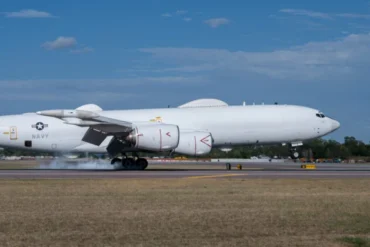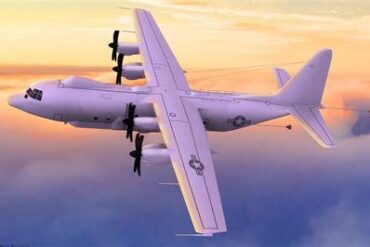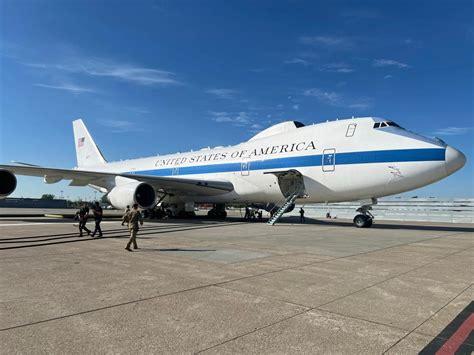
The phrase “Doomsday Plane” sounds like something torn from speculative fiction, yet it describes a very real aircraft that has quietly shaped U.S. nuclear strategy for decades. While stealth bombers and hypersonic weapons tend to dominate headlines, the most consequential aircraft in the U.S. Air Force inventory is not designed to attack, evade, or intimidate. Its sole purpose is to ensure command survives when everything else fails. In that sense, it is less a weapon than a guarantee of continuity, a flying assertion that even the worst day imaginable does not end decision-making.
The aircraft officially known as the Boeing E-4B Nightwatch occupies a unique position in American military doctrine. It is the most expensive aircraft in the U.S. Air Force to operate per flight hour, not because of exotic propulsion or radical materials, but because it carries an airborne government with it. A single mission can involve up to 112 crew members, including pilots, engineers, communications specialists, security personnel, and senior military staff. The jet is not merely flown; it is staffed, defended, and governed in real time.
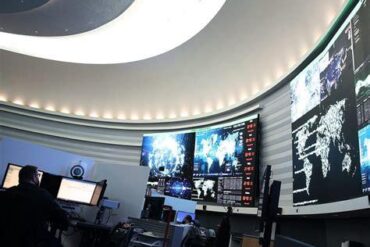
Unlike fighters or bombers that project power outward, the Doomsday Plane is about preserving control inward. It exists for a narrow but terrifying scenario: a large-scale nuclear attack that cripples ground-based command centers. In that moment, this aircraft becomes the nerve center of U.S. military authority, capable of directing forces across land, sea, air, and space. It is not meant to be seen often. It is meant to work once, flawlessly, when there are no second chances.
The Nightwatch’s significance becomes clearer when placed beside more famous aircraft. The B-2 Spirit may hold the title of most expensive aircraft to build, but the E-4B quietly surpasses it in operational cost and strategic centrality. If the B-2 represents deterrence by threat, the E-4B represents deterrence by resilience. Together, they form two halves of the same grim equation.
A Flying Bunker Built for the End of the World
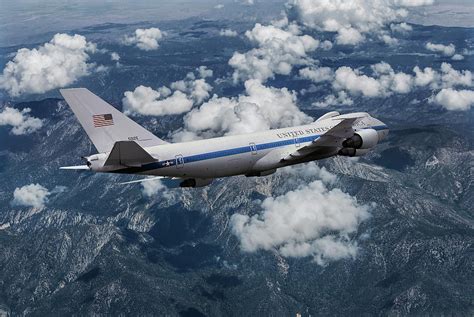
The E-4B is based on a heavily modified Boeing 747-200, but that lineage is almost misleading. Beneath its familiar jumbo-jet silhouette lies an aircraft engineered to survive conditions that would cripple conventional aviation. Its structure is hardened against electromagnetic pulse (EMP) effects generated by nuclear detonations, ensuring that its electronics remain functional even when ground-based systems go dark. Thermal shielding and radiation protection further enable the aircraft to operate in environments shaped by nuclear fallout.
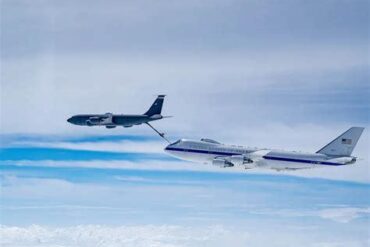
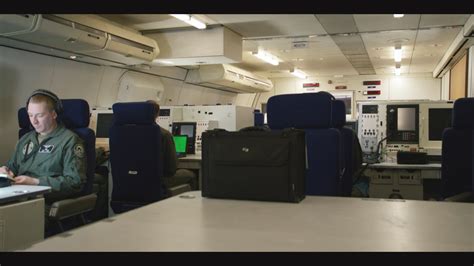
Internally, the aircraft resembles a secure government complex more than a passenger jet. Multiple decks house briefing rooms, command centers, communications suites, and crew rest areas designed for extended operations. With aerial refueling, the E-4B can remain airborne for days, theoretically up to a week, allowing national leadership to command global forces without ever touching the ground. This endurance transforms the aircraft into a mobile sovereign space, detached from the vulnerabilities of geography.
What makes this capability truly exceptional is the scale of redundancy built into every system. Communications are routed through multiple hardened channels, antennas are distributed across the airframe, and critical electronics often rely on older, analog technologies specifically because they are less susceptible to EMP damage. In an era obsessed with digital speed, the Doomsday Plane deliberately retains technological conservatism where survival demands it.
Why the E-4B Costs More to Fly Than Any Other Aircraft
The E-4B’s reputation as the most expensive aircraft to operate per flight hour stems from a convergence of factors rather than a single extravagance. The most visible contributor is manpower. Few aircraft in the world require a triple-digit crew complement, and fewer still require those personnel to be highly specialized, security-cleared, and continuously trained for nuclear command roles.
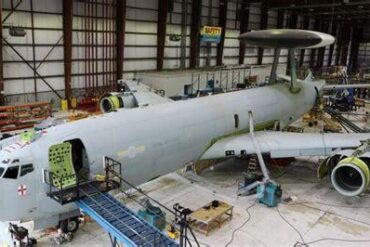
Maintenance compounds the expense. The E-4B fleet is aging, with airframes approaching half a century of service. Many components are no longer in production, forcing the Air Force to rely on custom fabrication or dwindling inventories. Each hour in the air accelerates wear on systems that cannot be easily replaced, driving costs upward with every mission.
Operational readiness has also suffered. Mission-capable rates for the E-4B fleet have dropped alarmingly, at times falling near 55 percent. This decline is not a reflection of negligence but of inevitability. Keeping Cold War-era aircraft viable in a modern threat environment is a battle against physics, supply chains, and time itself. The cost of winning that battle is measured not just in dollars, but in strategic risk.
From Cold War Vigil to Modern Crisis Response
The E-4B’s origins lie deep in Cold War anxiety, when the possibility of a surprise nuclear strike shaped every aspect of military planning. During that era, at least one Nightwatch aircraft was continuously airborne, ensuring immediate retaliatory command capability if ground leadership were eliminated. This posture reflected a worldview in which minutes mattered and survivability trumped comfort, efficiency, or public visibility.
The aircraft’s role did not end with the Cold War. On September 11, 2001, as uncertainty gripped Washington and the Pentagon itself lay damaged, an E-4B could be seen orbiting the capital. It served as a coordination platform during a moment when ground-based command centers were considered vulnerable, reaffirming the aircraft’s relevance beyond nuclear scenarios.
In more routine but no less critical roles, the E-4B has transported the Secretary of Defense on sensitive international missions and remained airborne during presidential inaugurations as a contingency safeguard. It has also supported disaster response efforts, including federal coordination during Hurricane Katrina, demonstrating that its value extends into humanitarian crises when national infrastructure is compromised.
The Strategic Imperative for a Successor
As formidable as the E-4B remains, its limitations are increasingly difficult to ignore. Aging airframes, obsolete components, and declining availability threaten the reliability of a mission that tolerates no failure. This reality drove the U.S. Air Force to initiate the Survivable Airborne Operations Center (SAOC) program, an effort to replace the Nightwatch fleet with a new generation of aircraft designed for modern threats.
The SAOC program is ambitious in scope and staggering in cost. Estimates suggest that fully outfitted aircraft could exceed $4 billion per unit, potentially making them the most expensive aircraft ever by certain metrics. Sierra Nevada Corporation (SNC) secured a $13 billion contract to replace the existing four-aircraft fleet with eight to ten new platforms, dramatically expanding capacity and redundancy.
By 2026, funding for SAOC had already surpassed $8.3 billion, with annual budget increases reflecting the program’s priority within the broader Nuclear Command, Control, and Communications (NC3) modernization effort. Ground and flight testing began in late 2025, signaling a transition from concept to reality.
Digital Twins, Open Architecture, and a New Acquisition Philosophy
What sets the SAOC program apart is not only its cost, but its methodology. SNC is employing a fully digital development strategy centered on Model-Based Systems Engineering (MBSE) and high-fidelity digital twins. These virtual replicas allow engineers to simulate nuclear hardening, EMP exposure, and structural stress long before physical modifications begin, reducing risk and avoiding costly redesigns during flight testing.
Equally transformative is the adoption of a Modular Open Systems Architecture (MOSA). Rather than locking the Air Force into proprietary systems controlled by a single contractor, MOSA treats mission components as plug-and-play modules. This approach grants the government shared data rights and the freedom to upgrade technologies without vendor dependence, a radical departure from traditional defense procurement.
The use of Commercial Off-The-Shelf (COTS) components further lowers long-term sustainment costs. By leveraging established commercial supply chains, the SAOC fleet can avoid the pitfalls that now plague the E-4B, where obscure parts and vanishing manufacturers drive maintenance complexity. The result is not merely a new aircraft, but a more adaptable ecosystem designed to evolve alongside emerging threats.
Why the 747 Still Matters in a Twin-Engine World
The decision to base the SAOC aircraft on the Boeing 747-8 reflects both necessity and strategy. The Air Force mandated a four-engine design to maximize redundancy and safety for missions that may operate in austere or damaged environments. With new 747 production ended, the service turned to well-maintained used aircraft, acquiring former Korean Air 747-8s for approximately $135 million each.
The 747-8 offers unmatched interior volume, a critical factor for housing hardened command modules, extensive communications equipment, and crew accommodations. Compared to the older 747-200, it delivers 14 percent better fuel efficiency than the 747-400 and benefits from modern GEnx engines with lower maintenance demands. Its shared lineage with the VC-25B Air Force One also promises logistical efficiencies across fleets.
In an industry obsessed with efficiency, the 747’s sheer size and redundancy remain irreplaceable for missions where failure is not an option. The aircraft’s continued relevance underscores a broader truth: some requirements transcend market trends.

How Sierra Nevada Corporation Won a Rare Opportunity
SNC’s victory in the SAOC competition marked an unusual moment in defense aviation. Traditionally, such programs are led by the original aircraft manufacturer, yet Boeing declined to accept the fixed-price terms demanded by the Air Force, wary after costly overruns on previous contracts like the KC-46 tanker and the new Air Force One.
SNC seized the opening by embracing risk and advocating for the Air Force’s preferred acquisition model. Its willingness to deliver open architecture, digital development, and shared data rights proved decisive. The company assembled an elite network of partners, including Lockheed Martin Skunk Works, Collins Aerospace, Rolls-Royce, CAE Defense and Security, and NIAR, transforming the program into a collaborative effort rather than a closed industrial silo.
Facilities in Dayton, Ohio, alongside sites in Colorado and Nevada, have rapidly expanded to support the program, signaling a long-term commitment to airborne command and control as a national priority.
The Doomsday Plane’s Enduring Logic
The concept of a Doomsday Plane can feel archaic, a relic of Cold War paranoia. Yet its logic remains disturbingly sound. As long as nuclear weapons exist, the ability to command forces after a catastrophic attack is not optional. It is foundational to deterrence itself. An adversary must believe not only that retaliation is possible, but that leadership and control will survive the first blow.
The E-4B Nightwatch embodies that belief in aluminum, wiring, and disciplined procedure. Its successor under the SAOC program promises to carry the same mission into a future defined by cyber warfare, space-based threats, and increasingly complex escalation dynamics. These aircraft are not symbols of aggression. They are insurance policies written against the collapse of command.
In the end, the Doomsday Plane is less about the end of the world than about refusing to surrender agency to chaos. It is an aircraft built on the unsettling premise that the worst can happen—and on the equally unsettling resolve to remain in control when it does.