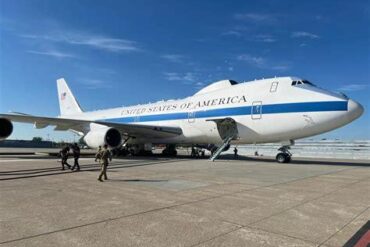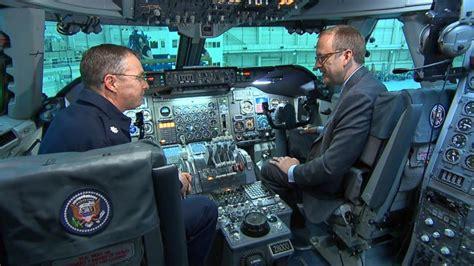
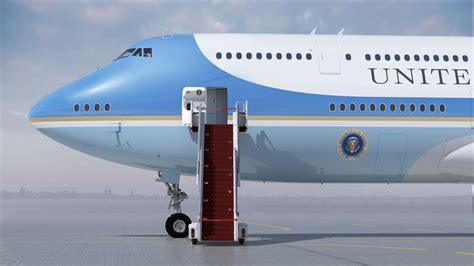
Air travel at the highest level of global power is not about comfort, prestige, or even speed. It is about control, survivability, and absolute continuity of leadership. What the world casually refers to as “Air Force One” is, in reality, a pair of highly modified Boeing 747-200 airframes designated as the VC-25—aircraft engineered not merely to transport a president, but to guarantee command authority under the most extreme conditions imaginable.
Beneath its familiar blue-and-white livery lies one of the most sophisticated airborne systems ever constructed. With hundreds of miles of wiring, hardened electronics, and classified defense suites, this aircraft functions as a mobile White House, Pentagon relay node, and nuclear-survivable command center—all at 35,000 feet.
What makes Air Force One extraordinary is not what you can see, but what remains hidden. Every panel, cable, and signal pathway has been designed with one objective: ensure the United States government never loses its ability to lead, communicate, or respond—no matter what happens on the ground.
The Hidden Infrastructure Beneath the Cabin
The public-facing image of Air Force One often focuses on executive offices, conference rooms, and presidential comfort. But that polished interior conceals a vastly more complex reality. Beneath the cabin floor exists a dense network of systems that rival the infrastructure of a hardened military installation.
The aircraft contains approximately 238 miles (383 kilometers) of wiring, nearly double that of a standard commercial 747. This is not excess—it is intentional redundancy and segmentation, ensuring that no single failure can cripple the aircraft’s core functions.
Inside, more than 85 telephones, multiple encrypted communication terminals, and a layered computing architecture operate simultaneously across three distinct network classifications:
- Unclassified systems for routine communication and media coordination
- Secure systems for sensitive operational discussions
- Top-secret networks for intelligence and military command
Each network is physically and digitally isolated, preventing cross-contamination or compromise. This architecture mirrors—and in some ways exceeds—the complexity found inside secure ground facilities such as the White House Situation Room.
The result is not just connectivity, but controlled connectivity. The president and senior officials can move seamlessly between communication levels without risking data exposure. Meetings, intelligence briefings, and crisis coordination occur in real time, as if Washington itself were airborne.
This is where Air Force One begins to transcend its identity as an aircraft. It becomes a sovereign node of governance, detached from geography yet fully operational.
The Telecommunications Core: Global Command Without Interruption
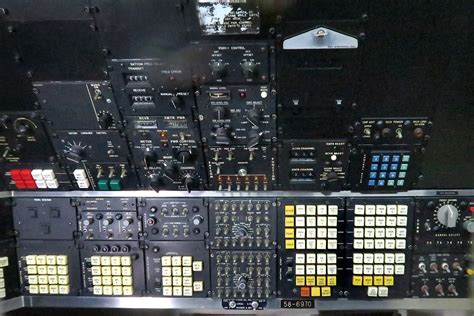
At the heart of this flying command center lies a highly specialized telecommunications hub located on the upper deck. This section operates less like an aircraft cabin and more like a miniaturized military communications headquarters, staffed by trained personnel responsible for maintaining uninterrupted global links.
Unlike commercial aviation systems, which rely primarily on ground-based communication and satellite relays, Air Force One employs a layered communications architecture designed for resilience and flexibility.
Satellite communications (SATCOM) provide global reach, ensuring connectivity regardless of location. Meanwhile, UHF and VHF radio systems maintain line-of-sight communication with military assets, including fighter escorts, naval vessels, and ground command units.
Encrypted voice and data links ensure that every transmission—whether diplomatic, military, or intelligence-related—is protected against interception and cyber intrusion.
What sets this system apart is its redundancy and autonomy. If one communication channel is disrupted, others immediately compensate. If satellites are compromised, alternative pathways activate. The system is designed not just to function—but to survive disruption and continue operating seamlessly.
This capability allows the president to:
- Issue real-time military directives
- Coordinate with global allies and defense networks
- Receive live intelligence updates
- Address the nation or the world instantly
In effect, the aircraft ensures that distance becomes irrelevant. Whether over the Atlantic, the Pacific, or contested airspace, the United States retains its command authority.
Defensive Systems: The Invisible Shield in the Sky
While its communications systems define its strategic role, Air Force One’s survivability depends on a highly classified and layered defensive suite. This is where the aircraft shifts from command center to hardened airborne fortress.
Among the few publicly acknowledged systems is the AN/ALQ-204 Matador, an advanced infrared jammer designed to defeat heat-seeking missiles. By distorting or masking the aircraft’s thermal signature, it prevents incoming missiles from locking onto their target.
But this is only one layer.
The aircraft is also equipped with:
- Chaff, which disperses metallic fibers to confuse radar-guided threats
- Flares, which act as decoys for infrared-guided missiles
- Electronic warfare systems, believed to disrupt enemy targeting and tracking
These systems are integrated into a coordinated defensive network. Threat detection sensors identify incoming dangers, triggering automated or pilot-controlled countermeasures within seconds.
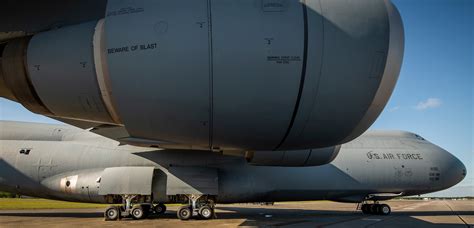
Unlike commercial aircraft, which rely on avoidance and airspace control, Air Force One is built to actively defend itself. Its defensive capabilities are closer to those of frontline military aircraft than any civilian transport.
What remains classified is likely even more significant. Analysts widely believe the aircraft incorporates advanced electronic countermeasures, cyber defense systems, and possibly classified technologies not disclosed to the public.
This secrecy is deliberate. The less adversaries know, the harder it becomes to develop counter-strategies.
Hardened for Nuclear Scenarios: Surviving the Unthinkable
One of the most defining aspects of Air Force One is its ability to operate in the aftermath of a nuclear event. This requirement dates back to Cold War doctrine, where continuity of government became a central strategic priority.
The aircraft is hardened against electromagnetic pulse (EMP) effects—bursts of energy capable of disabling unprotected electronics across vast distances. In a nuclear scenario, most civilian infrastructure would fail instantly. Air Force One would not.
Its avionics, communication systems, and onboard electronics are shielded to ensure continued operation even after a nuclear detonation.
Beyond EMP protection, the aircraft incorporates extensive redundancy. Critical systems are duplicated, sometimes triplicated, ensuring that failure in one component does not compromise the mission.
Structural reinforcements further enhance survivability, allowing the aircraft to withstand shockwaves and extreme environmental stress.
This level of resilience transforms the aircraft into something far more than a transport platform. It becomes a guarantee of leadership continuity, even under the most catastrophic conditions.
Endurance Without Limits: The Power of Staying Airborne
In crisis scenarios, time is not measured in minutes—it is measured in how long command authority can be sustained. Air Force One answers this challenge with one of its most remarkable capabilities: aerial refueling.
Through mid-air refueling, the aircraft can remain airborne indefinitely, limited only by crew endurance and mission requirements. While rarely used in routine operations, this capability becomes critical during national emergencies.
The importance of this feature was demonstrated during the aftermath of the September 11 attacks, when the aircraft remained airborne as leadership coordinated a national response.
Inside, the aircraft is designed for long-duration missions. Two full-service galleys can prepare up to 100 meals at once, while crew rest areas ensure operational continuity over extended periods.
A fully equipped medical suite, complete with emergency equipment and pharmaceuticals, allows the aircraft to function as a self-contained support environment.
This level of endurance ensures that Air Force One is not dependent on ground infrastructure. It can operate independently for extended periods, maintaining command authority regardless of conditions below.
A System of Systems: Integrated Power, Communication, and Defense
What makes Air Force One truly unique is not any single feature, but the way all its systems interconnect into a unified operational ecosystem.
Electrical infrastructure supports communication systems. Communication systems integrate with defense networks. Defense systems rely on detection and computing architectures. Every subsystem feeds into another, creating a seamless and resilient operational loop.
This integration ensures that:
- Failures are absorbed without mission disruption
- Threats are detected and countered in real time
- Command authority remains uninterrupted
Unlike conventional aircraft design, which prioritizes efficiency and cost, Air Force One prioritizes absolute reliability under worst-case scenarios.
It is, in essence, a system of systems, engineered to function under conditions where most technology would fail.
The Future: Next-Generation Presidential Airpower
As advanced as the current VC-25 fleet is, it is approaching the limits of its operational lifespan. Its successor, based on the Boeing 747-8 platform, is expected to introduce a new generation of capabilities under the VC-25B program.
This next iteration will likely feature:
- Enhanced cybersecurity architecture
- More advanced satellite communication systems
- Improved defensive technologies
- Greater fuel efficiency and extended range
Interestingly, the new platform is expected to eliminate aerial refueling capability, reflecting both the extended range of modern engines and the evolving nature of mission requirements.
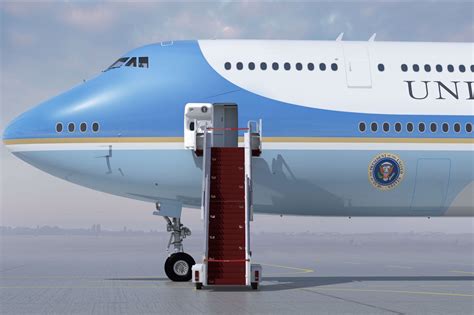
This shift underscores a broader transformation. Air Force One is not just evolving as an aircraft—it is evolving as a strategic command platform adapted to modern threats, including cyber warfare and space-based vulnerabilities.
The Power of Secrecy: What Remains Unknown
Despite decades of public fascination and limited disclosures, the most advanced capabilities of Air Force One remain classified. This is not merely tradition—it is strategic necessity.
Revealing too much would allow adversaries to:
- Develop countermeasures
- Identify potential vulnerabilities
- Replicate or adapt similar technologies
Secrecy ensures that Air Force One maintains its operational edge.
What is known already places it in a category of its own. No other aircraft combines communications dominance, defensive resilience, nuclear survivability, and indefinite endurance at this scale.
Yet the most critical systems—the ones that truly define its advantage—are precisely those that remain hidden.
Conclusion: More Than an Aircraft, A Guarantee of Leadership
Air Force One is often viewed through a symbolic lens—a representation of power and prestige. In reality, it is something far more consequential.
It is a flying command fortress, engineered to ensure that leadership endures under any circumstances. Every wire, system, and protocol serves a singular purpose: preserve the continuity of governance.
From its hardened electronics and layered defenses to its global communication reach and unmatched endurance, Air Force One represents the pinnacle of aerospace engineering aligned with national security strategy.
What defines it most is not its visibility, but its invisibility—the systems that operate silently, the defenses that remain unseen, and the capabilities that are never fully revealed.
Because in the world of strategic airpower, the greatest strength is not just what you can do.
It is what no one else can fully understand.