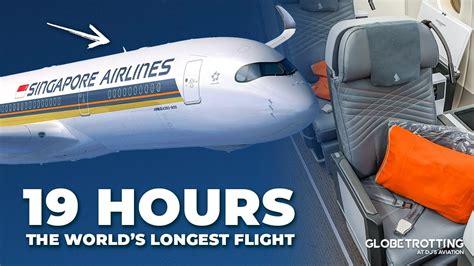
Singapore Airlines continues to operate one of the most demanding passenger flights in commercial aviation: the nonstop service between Singapore Changi Airport and the New York area. At close to 19 hours in the air, the route remains a remarkable demonstration of how far modern widebody aircraft can travel without stopping. More importantly, however, its continued operation is not simply a story about having an aircraft with enough range. The route works because Singapore Airlines has built an entire operating model around the unusual economics of ultra-long-haul flying.
The service is closely associated with the Airbus A350-900ULR, an aircraft developed to carry passengers over distances that would have been difficult to serve efficiently with earlier generations of widebody jets. Singapore Airlines became the launch customer for the type and used it to restore nonstop Singapore-New York flying in 2018 after previously abandoning the route with the less efficient Airbus A340-500. The airline’s experience provides an unusually clear lesson in what it takes to make an almost 19-hour passenger flight commercially sustainable.
The aircraft itself is only part of the answer. Singapore Airlines operates the A350-900ULR with a relatively small, premium-focused cabin, while Singapore Changi provides a powerful hub capable of feeding passengers into the service from across Southeast Asia and beyond. At the same time, the Singapore-New York market contains substantial business and premium leisure demand. Those factors help explain why the world’s longest commercial flight has survived while other airlines have generally avoided copying it. Yet the next generation of ultra-long-haul aircraft is already arriving, and Qantas Project Sunrise could eventually take the record to an even longer route.
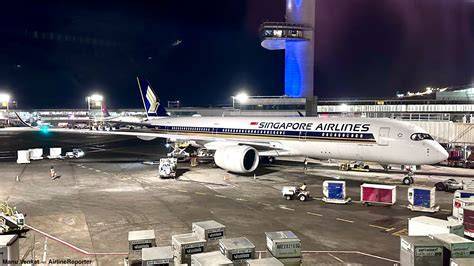
Singapore Airlines A350-900ULR Made the Longest Flight Possible
The most important aircraft in this story is the Airbus A350-900ULR. Singapore Airlines was the launch customer for the ultra-long-range version, which can achieve a range of up to approximately 11,160 miles, or 17,960 kilometers, under suitable operating conditions. That capability gives the aircraft enough endurance for missions lasting more than 20 hours in favorable circumstances, although actual scheduled flight times depend heavily on winds, routing, payload and other operational conditions.
The Singapore-New York sector covers roughly 10,300 miles, or around 16,700 kilometers. Depending on atmospheric conditions and the particular routing used, the scheduled journey can approach 18 hours and 45 minutes. This places the flight in a category where the aircraft must carry enough fuel not only to reach its destination, but also to accommodate reserves, diversions and changing conditions encountered during a flight that occupies most of a day.
The A350-900ULR is particularly suitable because it combines long range with the efficiency of a modern twin-engine widebody. Its composite structure reduces structural weight, while its aerodynamic design and efficient engines help limit fuel consumption. Those advantages matter enormously when fuel itself becomes one of the largest components of the aircraft’s takeoff weight.
An aircraft designed for a mission of this length cannot simply be judged by its maximum published range. Airlines must consider how much payload remains available after the fuel requirement is established. A theoretical range figure means little if an aircraft cannot carry enough passengers, baggage and cargo to make the flight commercially useful. Singapore Airlines therefore needed a combination of range, fuel efficiency, payload capability and premium revenue, rather than range alone.
Singapore Airlines Had Already Learned the Hard Way
Singapore Airlines’ current ultra-long-haul operation is actually the second chapter of its Singapore-New York nonstop experiment. The airline began operating the route with the Airbus A340-500 in 2004, but eventually suspended the service in 2013. The four-engine aircraft could perform the mission, but the economics became increasingly difficult as fuel costs, operating expenses and aircraft efficiency became more important to long-haul profitability.
The return of nonstop Singapore-New York service in 2018 was therefore based on a fundamentally different aircraft and business model. When the A350-900ULR entered service, Singapore Airlines launched the world’s longest commercial flight between Singapore and Newark Liberty International Airport. The airline later operated nonstop services to New York John F. Kennedy International Airport as well, giving the carrier two important nonstop links between Singapore and the New York metropolitan area.
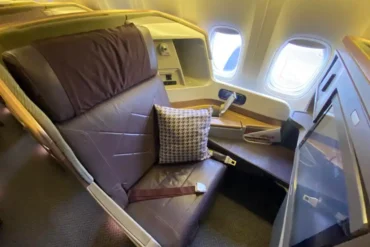
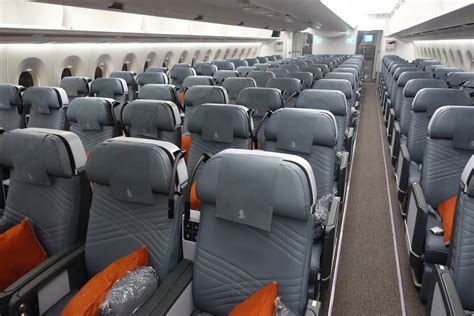
The original A350-900ULR configuration contained only 161 seats, with 67 in business class and 94 in premium economy. There was no conventional economy cabin. That decision might appear surprising on an aircraft flying such a long distance, because removing economy seats reduces the number of passengers carried. Yet the strategy directly addressed the economics of ultra-long-haul flying.
Every passenger requires fuel, cabin resources, baggage capacity and other weight. On a normal long-haul flight, an airline can compensate for relatively low fares by filling hundreds of seats. On a nearly 19-hour sector, however, the economics are different. Singapore Airlines instead concentrated on passengers willing to pay substantially more for a nonstop journey that eliminates a connection and can save several hours of total travel time.
Why Singapore Airlines Does Not Simply Fill the A350 With More Seats
The unusual cabin configuration is one of the most important reasons the route can work. A conventional high-density A350 could carry far more passengers, but the additional seats would also change the weight, service requirements and revenue profile of the aircraft. Singapore Airlines chose a premium-heavy configuration because the route connects two major global business centers where travelers can place a significant value on nonstop service.
The strategy also fits the structure of Singapore Airlines’ wider network. Singapore Changi Airport is a major international hub, allowing passengers from numerous Asian cities to connect onto the New York flight. A traveler does not necessarily have to begin the journey in Singapore to generate revenue for the ultra-long-haul service. The airline can collect passengers from across its network and concentrate them onto the nonstop transpacific sector.
This hub effect is crucial. A flight of nearly 19 hours needs reliable demand in both directions, and a single city pair may not always provide enough passengers at attractive fares. Singapore Airlines can draw from a much larger geographic market because Changi functions as a connecting point for Southeast Asia, South Asia and other international markets.
The premium cabin strategy also creates an important buffer against the cost of carrying so much fuel. Fuel efficiency alone does not make an ultra-long-haul route profitable. The aircraft must generate enough revenue from the available payload to justify the enormous amount of fuel required before departure.
Why Other Airlines Have Not Copied Singapore Airlines
The success of Singapore Airlines does not mean every airline can simply purchase an ultra-long-range aircraft and launch a 19-hour route. The biggest challenge is that the aircraft itself is highly specialized. An airline paying for additional fuel capacity and a low-density cabin must find enough routes where those characteristics produce meaningful commercial value.
On shorter routes, the additional capability provides little benefit. A long-range aircraft may spend most of its time carrying unnecessary fuel capacity or fewer passengers than a standard configuration could accommodate. The operator therefore needs a network in which the specialized aircraft can be deployed consistently on missions that justify its design.
Operational complexity is another issue. A flight lasting almost 19 hours requires careful planning around fuel reserves, weather, diversion airports, crew duty limits, payload and cargo. Strong headwinds can increase fuel consumption and potentially affect how much payload can be carried. Every additional passenger or piece of baggage has to be considered alongside the fuel required to complete the mission safely.
Cargo is especially important. A conventional long-haul flight can generate valuable belly cargo revenue, but an ultra-long-haul aircraft carrying enormous quantities of fuel has less flexibility in how much additional weight it can accept. That creates another reason for airlines to evaluate these routes differently from ordinary transcontinental or intercontinental services.
There is also the human factor. Passengers spending almost an entire day aboard an aircraft have different expectations from travelers on an eight- or ten-hour flight. Cabin design, food service, sleep opportunities, lighting and seat comfort become much more important. Singapore Airlines has built its product around that reality rather than treating the flight as simply a longer version of a conventional long-haul service.
Qantas Project Sunrise Could Change the Record
The most significant potential successor to Singapore Airlines’ ultra-long-haul record is Qantas Project Sunrise. The Australian carrier has ordered specially configured Airbus A350-1000ULR aircraft for nonstop flights from Sydney to destinations including London and New York. These missions are particularly challenging because Australia’s major population centers are geographically distant from Europe and the eastern United States.
The Qantas aircraft will use an additional 20,000-liter fuel tank and will be designed for flights lasting as long as 22 hours. That represents another major step in commercial aviation’s push toward nonstop journeys that once seemed impractical for passenger aircraft.
The A350-1000 is also larger than Singapore Airlines’ A350-900ULR. Qantas plans to configure its Project Sunrise aircraft with approximately 238 seats across four cabins, maintaining economy class while devoting a substantial proportion of the cabin to premium accommodation. The aircraft will therefore follow a different commercial philosophy from Singapore Airlines, but the underlying principle is remarkably similar.
Rather than maximizing seat count, Qantas is creating a deliberately low-density aircraft designed around the special requirements of ultra-long-haul flying. The cabin will include a dedicated Wellbeing Zone, while the airline has worked with the University of Sydney’s Charles Perkins Centre on areas such as lighting, meal timing and passenger wellbeing.
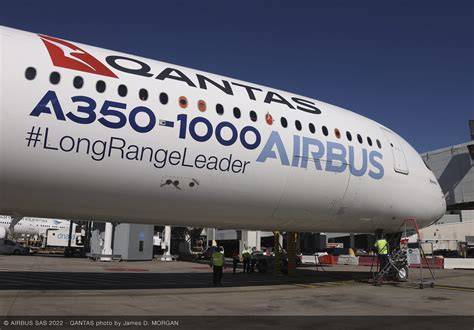
Project Sunrise Is More Than an Aircraft With Extra Fuel
The development of Project Sunrise demonstrates how much engineering is required to make ultra-long-haul passenger service practical. Qantas is not simply adding fuel to an existing A350-1000 and sending it across the world. The aircraft incorporates specialized systems, additional crew-rest provisions and a cabin designed around journeys that can last almost an entire day.
The first Project Sunrise A350-1000ULR completed its maiden test flight in June 2026, beginning the testing and certification process for the specialized aircraft. The initial test flight lasted three hours and 43 minutes, but the aircraft’s development program is ultimately aimed at commercial missions lasting up to 22 hours.
Qantas expects the first aircraft to be delivered in April 2027, with daily Sydney-London nonstop services planned to begin in October 2027. Sydney-New York is expected to follow London as another Project Sunrise destination, although its precise launch timing is separate from the initial London schedule.
If those plans proceed as scheduled, the longest nonstop commercial flight record could eventually move away from Singapore Airlines. But that would not necessarily mean the A350-900ULR has become obsolete or that Singapore Airlines’ strategy has failed. Instead, Qantas would be applying the same broad technological philosophy to an even more demanding route.
What Could Eventually Replace Singapore Airlines’ Longest Flight
The most plausible replacement for Singapore Airlines’ current record is therefore not a completely different aircraft concept. It is the Airbus A350-1000ULR used for Qantas Project Sunrise. The aircraft combines enormous fuel capacity, efficient twin-engine technology, a relatively low-density cabin and specialized systems for passenger and crew wellbeing.
That distinction matters because Singapore Airlines has already demonstrated that ultra-long-haul flying is fundamentally an integrated business model. The aircraft must have enough range, but the airline also needs a route with sufficient premium demand, a strong hub, appropriate aircraft utilization and passengers willing to pay for the time saved by eliminating a connection.
Qantas is taking that concept farther because Australia’s geography creates an unusually strong case for nonstop travel. Sydney to London and Sydney to New York are journeys where avoiding an intermediate stop can remove a major interruption from an already lengthy trip. If passengers and airlines find the economics sustainable, the Project Sunrise model could become the next major benchmark for ultra-long-haul operations.
Singapore Airlines, meanwhile, retains an important advantage: experience. The airline has already operated nonstop services of this length for years, learning how to manage fuel, payload, crew scheduling, premium demand and passenger expectations. That accumulated operational knowledge is difficult to reproduce overnight.
The future of the world’s longest commercial flight is therefore likely to be an evolution rather than a revolution. Singapore Airlines proved that nearly 19-hour passenger flights can work when aircraft technology and commercial strategy are designed together. Qantas Project Sunrise is now pushing the same formula toward 22-hour missions. If the Australian carrier’s new aircraft enters service as planned, the record may change hands, but the central lesson from Singapore Airlines will remain: the world’s longest flights are not won by range alone. They require an aircraft, cabin, route and business model that are all engineered for the extraordinary demands of staying airborne for almost an entire day.