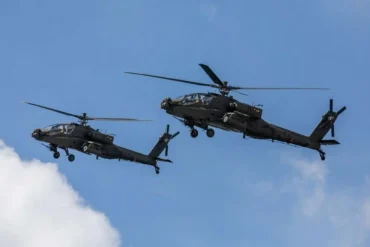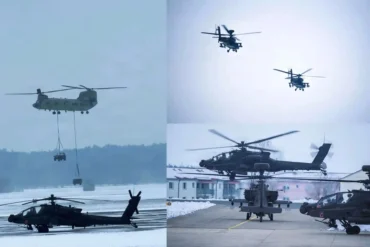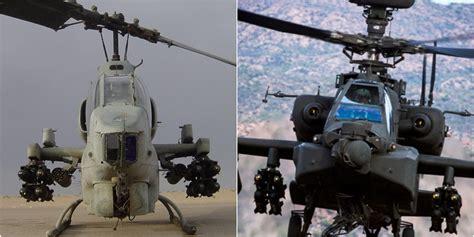
The AH-1 Cobra and AH-64 Apache occupy the same broad category of military attack helicopters, but they were created for very different battlefields. Both use tandem cockpits, stub wings, powerful cannons, rockets, and anti-armor missiles, yet their designs reflect different priorities. The Cobra emphasizes compactness, agility, and expeditionary operations, while the Apache places greater emphasis on sensors, survivability, networking, and long-range precision attack.
At first glance, the two helicopters can seem remarkably similar. Their narrow fuselages and tandem seating immediately identify them as purpose-built gunships rather than conventional transport helicopters. Both can provide close air support, attack armored vehicles, escort other aircraft, and deliver precision weapons against ground targets. The resemblance, however, largely ends at the mission category.
The origins of the two aircraft explain much of this difference. The Cobra emerged during the Vietnam War, when the U.S. Army needed a dedicated gunship capable of supporting troops in contact. Bell developed the AH-1 by drawing heavily on the mechanical architecture of the UH-1 Huey, producing a considerably narrower and faster aircraft optimized around weapons rather than troop transport. The Cobra entered operational service in 1967, becoming one of the defining attack helicopters of the Vietnam era.
AH-1 Cobra: A Lightweight Gunship Built for Close Support
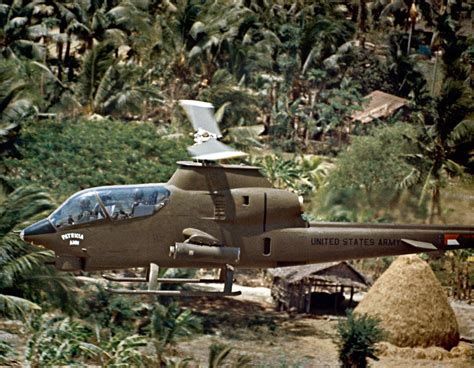
The original Cobra was essentially an answer to a very practical battlefield problem: how could helicopter forces put substantial firepower over troops without turning a large utility helicopter into an unwieldy gunship? Its tandem cockpit reduced frontal area, while its relatively compact structure improved speed and maneuverability.
The aircraft quickly demonstrated its value in close air support and armed escort missions. Its weapons could be brought rapidly against targets threatening ground units, making the Cobra particularly useful when friendly forces needed immediate aerial firepower. The introduction of the BGM-71 TOW anti-tank missile in the early 1970s expanded that role considerably, allowing Cobras to engage armored vehicles from greater distances.
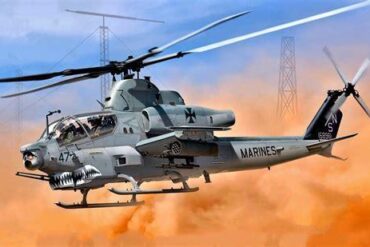
The Cobra’s evolution continued long after Vietnam. The modern AH-1Z Viper is substantially more capable than the original AH-1G. It features modern avionics, improved sensors, a four-bladed rotor system, upgraded engines, and compatibility with sophisticated precision weapons. Yet its fundamental philosophy remains recognizable: provide a comparatively compact attack helicopter that can operate effectively within an expeditionary force.
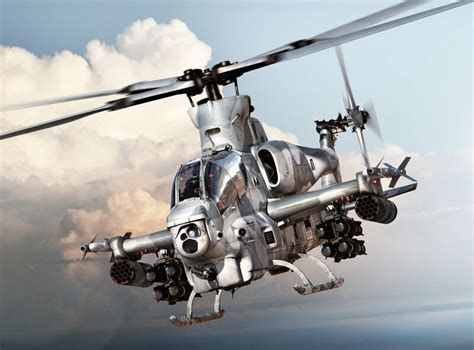
That characteristic is especially important to the U.S. Marine Corps, which operates the AH-1Z. Marine aviation has different requirements from Army aviation, particularly because aircraft may have to deploy aboard amphibious assault ships and operate as part of expeditionary formations. Size, logistics, flexibility, and compatibility with shipboard operations therefore matter enormously.
AH-64 Apache: Designed for a More Complex Battlefield
The AH-64 Apache emerged from a different strategic environment. During the Cold War, U.S. planners increasingly anticipated a major confrontation with Soviet armored formations. Attack helicopters were expected to play a crucial role in stopping large numbers of tanks, but Soviet air-defense systems were becoming increasingly capable.
That created a fundamental problem. A helicopter that had to fly directly into heavily defended areas to find and attack targets would face unacceptable risks. The answer was to increase the aircraft’s ability to detect, identify, target, and attack enemies from greater distances.
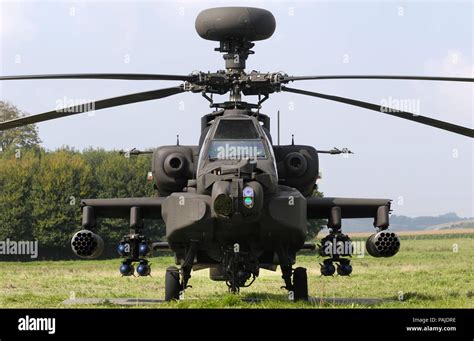
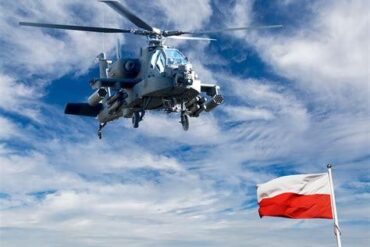
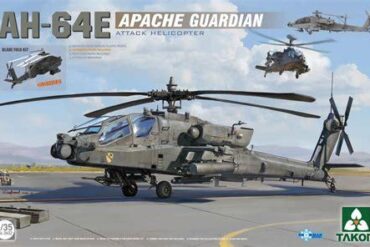
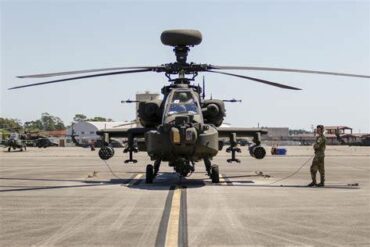
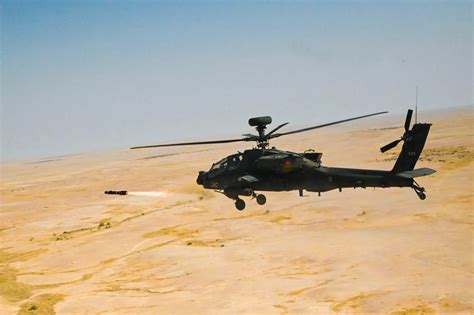
The Apache therefore became a substantially larger and heavier aircraft than the Cobra. The AH-64E Apache Guardian, the current major U.S. Army variant, combines powerful engines with advanced sensors, digital avionics, data links, and sophisticated weapons. Its architecture allows crews to build a much broader picture of the battlefield before committing the aircraft to an attack.
One of the Apache’s most recognizable technologies is the AN/APG-78 Longbow fire-control radar, mounted above the rotor on appropriately equipped aircraft. The radar allows the Apache to search for and classify targets while exposing relatively little of the helicopter itself. Combined with AGM-114 Hellfire missiles, this creates a powerful stand-off attack capability.
Cobra vs. Apache: Size and Weight Matter
One of the most obvious differences is physical scale. A fully equipped Apache weighs roughly 10.4 tons, placing it firmly in the heavy attack-helicopter category. The Cobra is considerably lighter and more compact.
That additional Apache mass is not accidental. It accommodates larger engines, extensive avionics, substantial fuel capacity, armor, sensors, weapons, and systems designed to improve survivability. The result is an aircraft capable of carrying a formidable combat load while operating across a large battlespace.
The Cobra sacrifices some of that capacity in exchange for a smaller physical footprint. This can be advantageous when operating from ships, forward locations, or environments where expeditionary flexibility is important. The difference is therefore not simply that one helicopter is “better” or more powerful. Their dimensions reflect the missions their operators expect them to perform.
Different Approaches to Weapons and Sensors
Both helicopters carry a chin-mounted cannon, but their weapon systems reflect their broader design philosophies. The AH-1Z uses the M197 20mm three-barrel cannon, while the AH-64 uses the M230 30mm chain gun. The Apache’s larger cannon provides substantial destructive power against suitable ground targets.
Both aircraft can also carry rocket pods and anti-armor missiles. The Apache’s integration of Hellfire missiles with advanced targeting systems gives it a particularly strong stand-off attack capability. The AH-1Z can employ modern precision weapons as well, including AGM-114 Hellfire missiles and other weapons integrated into Marine Corps operations.
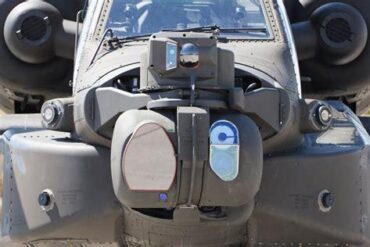
The sensor difference is especially significant. An attack helicopter is only as useful as its ability to locate and engage targets, and modern warfare increasingly depends on information as much as raw firepower. Apache crews can exploit radar, electro-optical systems, thermal imaging, digital communications, and networked battlefield information to engage targets without relying solely on visual contact.
Why the Cobra Did Not Simply Disappear
The development of the Apache did not make the Cobra obsolete. Instead, both aircraft continued along separate evolutionary paths because their operators faced different requirements.
The AH-64 Apache developed into a heavily equipped battlefield attack platform capable of integrating sophisticated sensors, precision weapons, and networked information. Its design makes it particularly suited to operations where identifying and striking targets across a broad battlespace is central to the mission.
The AH-1Z Viper, meanwhile, retains the Cobra family’s emphasis on a relatively compact attack helicopter suitable for Marine expeditionary operations. It can provide close support, conduct armed reconnaissance, attack armored targets, and accompany other Marine aviation assets while operating within the constraints of amphibious warfare.
Ultimately, the difference between the Cobra and Apache is not simply a matter of age, speed, weapon count, or appearance. They represent two different answers to the same fundamental military problem: how to put helicopter-borne firepower where ground forces need it. The Cobra is the compact, expeditionary gunship evolved around immediate battlefield support, while the Apache is the heavier, sensor-rich platform designed to find and destroy threats across a much larger and more complex battlespace.