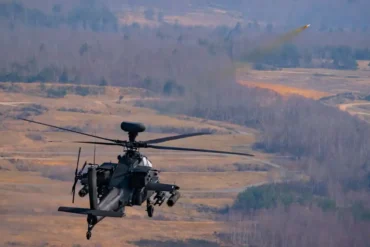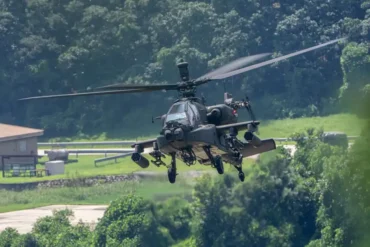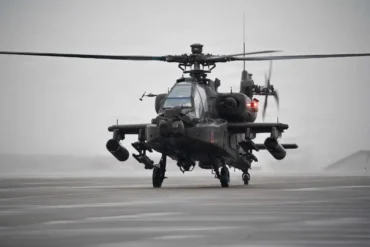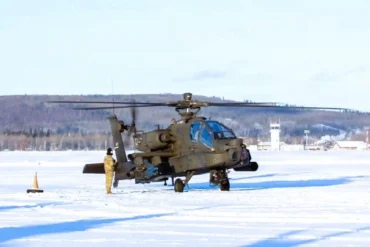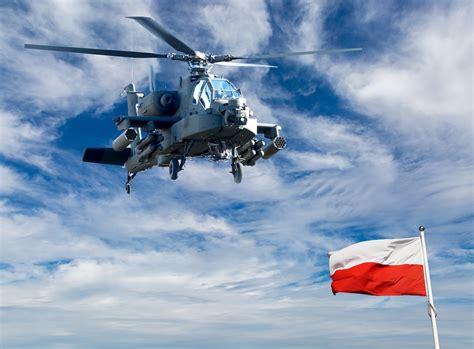
Poland is preparing to become the largest operator of AH-64 Apache attack helicopters outside the United States, following its historic decision to purchase 96 Boeing AH-64E Apache Guardians. Signed on August 13, 2024, the roughly $10 billion agreement represents the largest foreign purchase in the history of the Apache program. Deliveries are scheduled to begin in 2028, creating a powerful new helicopter force on NATO’s eastern flank.
The scale of the acquisition is striking even within the global Apache community. Boeing and its partners already support more than 1,300 Apaches operated by 19 countries, but Poland’s eventual fleet will be larger than that of any other foreign operator. The British Army currently operates 50 Apaches, meaning Poland’s planned fleet will almost double Britain’s total. For Warsaw, however, the purchase is about more than numbers. It forms part of a much broader effort to reshape Poland’s armed forces around the lessons emerging from the war in Ukraine.
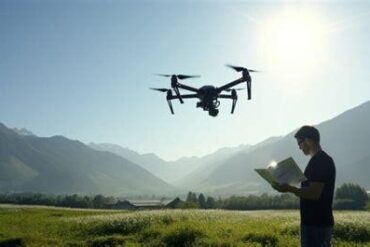
The decision also comes at an unusual moment for attack helicopters. Cheap drones have transformed modern battlefields, providing armies with inexpensive surveillance, targeting, and strike capabilities while exposing conventional aircraft to increasingly sophisticated air defenses. The experience of Ukraine has prompted intense debate over whether large, crewed gunships remain practical. Poland’s answer appears to be that the Apache is not being replaced by drones, but increasingly integrated with them.
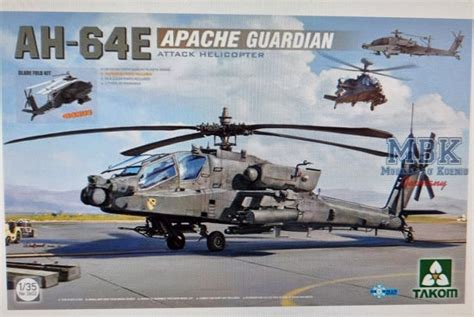
Poland’s AH-64E Apache Deal Creates A Massive New Helicopter Force
The AH-64E Apache Guardian is the most advanced Apache variant currently entering large-scale service. Poland’s purchase includes not only the helicopters themselves, but also associated weapons, spare parts, simulators, training, maintenance support, and other equipment required to establish an operational fleet. That makes the agreement considerably more substantial than a simple airframe purchase.
For Warsaw, building a fleet of this size will require an enormous support structure. Attack helicopters consume significant quantities of fuel, ammunition, spare components, and maintenance hours, while their sophisticated sensors and weapons demand highly trained technicians. Poland therefore has to develop the personnel and infrastructure necessary to keep dozens of highly complex aircraft available for operations.
The country has already started preparing for that challenge. General Electric has agreed to facilitate engine maintenance and overhaul operations in Dęblin, creating an important domestic capability for Apache powerplants. The expertise developed through this effort could also benefit Poland’s other military helicopters, including the Sikorsky UH-60 Black Hawk. Boeing and Poland have additionally signed offset agreements involving a regional service hub and a composite laboratory.
That industrial component could ultimately become almost as important as the helicopters themselves. A mature Polish maintenance and upgrade network would reduce the need to send European Apaches elsewhere for major work while strengthening Poland’s position inside NATO’s broader defense-industrial system.
The AH-64E Brings Heavy Firepower To Poland
At its core, the Apache remains a heavily armed two-seat attack helicopter designed to destroy armored vehicles and provide close air support to ground forces. The AH-64E is powered by two General Electric engines and can travel roughly 300 miles, or 482 kilometers, on a mission while carrying a maximum loaded weight of approximately 23,000 pounds.
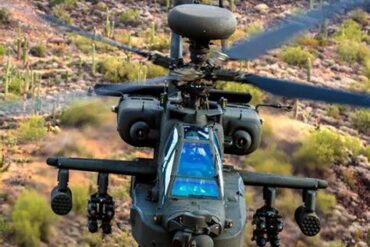
Its weapons suite provides a concentration of firepower that small drones cannot replicate individually. An Apache can carry as many as 16 laser-guided Hellfire missiles, 70mm rockets, and a powerful 30mm chain gun. The aircraft can therefore engage armored vehicles, fortified positions, personnel, and other battlefield targets during the same sortie.
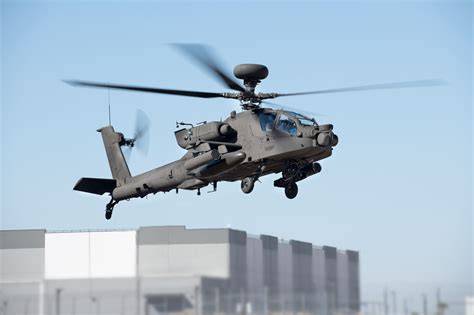
Yet the Apache’s greatest advantage is not simply the amount of ammunition it carries. Its combat value comes from combining weapons, sensors, communications, mobility, and a two-person crew into one integrated platform.
The AH-64E’s advanced avionics and targeting systems allow its crew to locate and engage targets with considerably greater precision than earlier attack helicopter generations. Its communications architecture also enables the aircraft to participate in a much wider battlefield network rather than functioning as an isolated gunship.
That distinction becomes especially important in a battlefield saturated with drones and electronic sensors. The modern Apache is increasingly envisioned as a networked combat node, receiving information from other platforms and passing targeting information across the force.
Why Poland Needs More Than Traditional Attack Helicopter Tactics
The biggest question surrounding Poland’s acquisition is not whether an Apache can destroy a tank. It can. The harder question is whether an expensive helicopter can safely reach the battlefield when modern air-defense systems and drones are searching for it.
Russian forces have deployed mobile air-defense systems such as the Pantsir-S1 and Tor-M2, while the proliferation of inexpensive unmanned aircraft has made concealment increasingly difficult. A helicopter operating without adequate intelligence or suppression of enemy air defenses could expose itself to substantial risk.
Poland therefore has strong incentives to avoid using its Apaches according to the tactics of previous generations. Rather than sending helicopters directly toward defended targets, Warsaw can use unmanned systems to extend the Apache’s awareness and keep the crew farther away from immediate danger.
This concept is known as Manned-Unmanned Teaming, or MUM-T. The Apache can operate alongside unmanned aircraft that scout ahead, identify potential threats, monitor enemy positions, and provide information to the helicopter crew. Instead of requiring the Apache to expose itself to discover an air-defense system, a drone can potentially perform the initial reconnaissance.
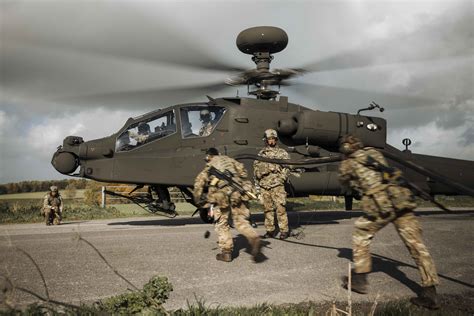
Drones Could Make Poland’s Apaches More Survivable
Imagine an Apache operating behind a ridge or tree line while an unmanned aircraft searches the terrain ahead. The drone identifies a mobile air-defense vehicle and transmits its location. The helicopter crew can then use the information to determine how and when to engage without unnecessarily exposing the aircraft.
The underlying principle is simple: let the inexpensive unmanned platform accept more of the reconnaissance risk while preserving the expensive crewed aircraft for missions requiring its greater firepower and endurance.
This does not make the Apache invulnerable. Modern air defenses remain a serious threat, and successful MUM-T operations depend on reliable communications, accurate intelligence, electronic warfare protection, and well-trained crews. Nevertheless, networking the helicopter with drones changes the tactical equation.
The Apache also brings capabilities that individual small drones cannot easily reproduce. A small unmanned aircraft may identify an armored vehicle or deliver a relatively limited munition, but the helicopter can remain on station, carry a substantial weapons load, rapidly reposition, and attack multiple targets. Its crew can also adapt to changing battlefield conditions in ways that remain difficult to reproduce with large numbers of small autonomous platforms.
The resulting force is therefore not necessarily helicopters versus drones. Poland’s emerging concept is closer to helicopters and drones working together.
Poland Is Learning From Ukraine’s Drone-Heavy Battlefield
The war in Ukraine has provided perhaps the most important real-world laboratory for examining how traditional military aviation can survive in a battlefield filled with inexpensive unmanned systems. Ukrainian helicopter units have adapted their operations, including missions involving nighttime operations, thermal sensors, and defensive engagements against drones.
The experience has also influenced Poland’s wider military restructuring. Warsaw has been studying battlefield lessons from Ukraine through initiatives intended to reshape how its armed forces operate. Under the Model 44 concept described in the reference material, Poland is moving toward greater use of unmanned systems and counter-drone capabilities within mechanized formations.
That development is significant because it places the Apache acquisition inside a much larger transformation. Poland is not simply buying 96 helicopters and expecting them to operate exactly as attack helicopters did decades ago. Instead, the country is building a force in which crewed aircraft, unmanned aircraft, ground forces, air defenses, and digital networks can support one another.
The approach could also give Poland greater flexibility in deciding how much risk to accept during different missions. An unmanned aircraft can investigate an area where sending a crewed helicopter immediately would be unnecessarily dangerous, while an Apache can remain available to deliver the heavier strike when conditions are favorable.
Poland Is Leasing AH-64Ds Before The New Fleet Arrives
There is one major problem with the 2028 delivery schedule: Poland needs trained personnel before its new helicopters arrive.
To bridge that gap, Warsaw and Washington agreed in February 2025 on a $300 million arrangement to lease eight AH-64D Apaches from the US Army. The aircraft are intended to help Polish pilots, mechanics, and ground personnel develop experience before the much larger AH-64E fleet begins arriving.
This training phase is critical. Operating an Apache squadron is not simply a matter of converting pilots onto a new aircraft. Poland must develop instructors, maintenance specialists, weapons crews, planners, logisticians, and command structures capable of supporting a fleet that will eventually contain 96 aircraft.
The leased AH-64Ds therefore provide more than temporary combat capability. They offer Poland a way to build institutional knowledge before the country’s new-generation fleet arrives.
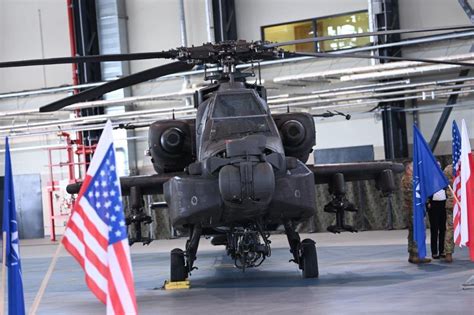
Poland Will Overtake Britain’s Apache Fleet
When all 96 new AH-64Es are delivered, Poland will have a larger Apache fleet than any other country outside the United States. Britain’s 50 Apache helicopters will consequently become significantly smaller than Poland’s planned force.
The change has implications beyond national inventory statistics. Poland sits directly on NATO’s eastern flank and has rapidly expanded its conventional military capabilities in response to the deteriorating European security environment. A large attack-helicopter force provides another layer of mobile firepower that can support mechanized formations and respond to armored threats.
The geographical position of Poland also makes rapid reaction particularly important. Attack helicopters can operate from dispersed locations and reposition more quickly than many ground-based weapons systems, giving commanders another option for supporting forces engaged along a large front.
The fleet’s usefulness will ultimately depend on how effectively Poland integrates it with ground units, drones, intelligence assets, air defenses, and NATO command networks. The number 96 is impressive, but the supporting architecture will determine how much combat power those aircraft can actually generate.
The Apache’s Future Will Depend On How It Adapts
Poland’s Apache purchase arrives during a period when the future of large attack-helicopter fleets is being reconsidered, including within the US Army. The rapid expansion of drones has demonstrated that relatively inexpensive unmanned systems can conduct reconnaissance and strike missions at a fraction of the cost of a large crewed aircraft.
That does not automatically make the Apache obsolete. Instead, it forces operators to reconsider how the helicopter should be employed.
The most important evolution may be the transition from the Apache acting primarily as an independent hunter-killer to becoming part of a larger manned-unmanned combat team. In that model, drones provide reconnaissance, targeting, deception, and potentially expendable strike capacity, while the Apache contributes speed, endurance, sensors, weapons, and human decision-making.
For Poland, that combination could define how its new fleet is used during the 2030s and beyond. The country is investing heavily not only in the aircraft, but also in domestic maintenance, training, industrial infrastructure, and unmanned warfare.
The 96 AH-64E Apaches will therefore represent much more than a new helicopter fleet. They will become a major test of whether a sophisticated crewed attack helicopter can remain relevant by embracing the very technology that appears to threaten its traditional role. If Poland successfully combines its Apaches with drones, modern air-defense tactics, and NATO’s broader battlefield network, its enormous investment could become an important example of how attack helicopters evolve rather than simply disappear in the drone age.