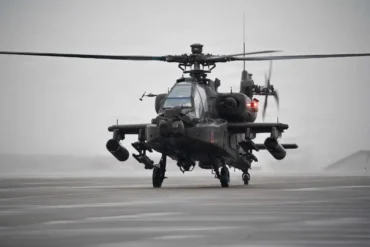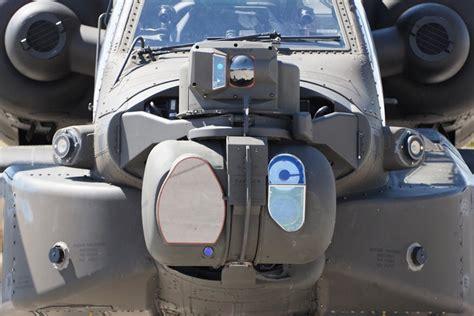
The M-TADS/PNVS is not just a sensor — it’s an integrated system that redefines what Apache helicopters can see, track, and strike. Designed for 24/7 all-weather mission capability, the system merges high-resolution day TV sensors, third-generation forward-looking infrared (FLIR), laser designators, rangefinders, and internal boresight alignment technologies to provide unmatched accuracy and reliability.
The targeting component, M-TADS, allows aircrews to detect, recognize, and engage targets at standoff distances, offering commanders a decisive tactical advantage. Meanwhile, the PNVS component ensures safe and agile low-altitude flight by providing real-time infrared imagery through the pilot’s helmet-mounted display.
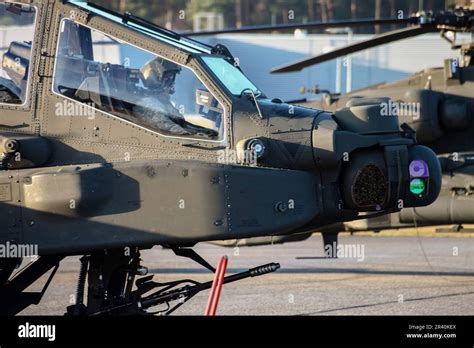
According to Lockheed Martin, the M-TADS/PNVS gives Apache pilots “long-range precision engagement and pilotage capabilities for all weather conditions, day or night.” This flexibility is crucial for the helicopter’s close air support, armed reconnaissance, and deep attack roles.
Operational Impact and Strategic Relevance
As international tensions escalate and the battlefield continues to evolve, the Army’s need for precise, resilient, and modular sensor technologies has never been greater. The Apache, originally developed in the Cold War era, remains a cornerstone of American airpower thanks to iterative modernization programs like this.
M-TADS/PNVS doesn’t just improve kill probability — it minimizes collateral damage and maximizes crew survivability. With superior imaging and tracking capabilities, pilots can acquire targets faster, distinguish between friend and foe more reliably, and neutralize threats from beyond visual range.
Moreover, Lockheed’s upgrades align with broader Department of Defense initiatives aimed at multi-domain operations, ensuring the Apache’s relevance in joint-force integrated scenarios involving air, land, and cyber assets.
Economic Implications and Defense Industrial Base
This $1.7 billion contract also has far-reaching implications for the defense industrial base, particularly in Central Florida, where Lockheed’s Orlando facilities serve as a nerve center for optical and electronic systems development. The influx of funding will likely result in job creation, supply chain expansion, and increased demand for specialty components such as electro-optical sensors, thermal imagers, and aerospace-grade materials.

Beyond direct employment, subcontractors across the U.S. — particularly small and mid-size firms that provide niche components — will benefit from long-term project stability. This contract exemplifies how defense spending continues to be a critical economic engine in technologically advanced sectors.
Global Interest and Potential International Sales
Though the official contract scope currently pertains to U.S. Army requirements, analysts suggest that the award’s size hints at provisions for Foreign Military Sales (FMS). Multiple allied nations — including the United Kingdom, Saudi Arabia, Egypt, the Netherlands, and India — operate AH-64 variants and have demonstrated interest in sensor suite upgrades.
Given the complex global security landscape and the Apache’s reputation as the premier attack helicopter, enhanced M-TADS/PNVS systems could become an exportable force multiplier. Lockheed’s track record of successfully integrating these systems into foreign fleets boosts the likelihood of further international deals over the next three years.
Engineering Excellence: Inside the M-TADS/PNVS Architecture
The system comprises two line-replaceable units (LRUs):
- The Targeting Sensor Assembly (TSA): Hosts the FLIR, day TV, laser designator, and rangefinder for target engagement.
- The Pilotage Sensor Assembly (PSA): Equipped with a wide-field FLIR for navigation, especially during night or degraded visual environments.
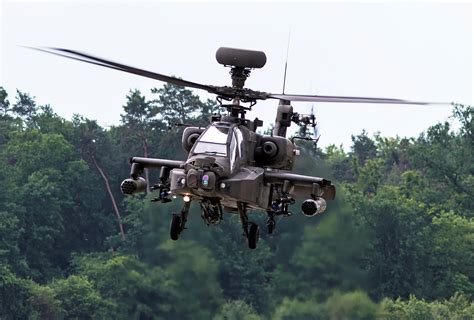
These LRUs are linked via an electro-optical turret mounted on the nose of the AH-64. A fiber-optic rotary joint ensures full-motion capability, while built-in-test (BIT) features enhance maintainability.
Additionally, Lockheed Martin has implemented continuous software updates, allowing mission-specific enhancements such as geo-location, video downlinking to ground troops, and automated threat prioritization.
Tactical Advantages in Today’s Combat Zones
M-TADS/PNVS has been battle-tested in Iraq, Afghanistan, and Syria, consistently proving its worth. The ability to rapidly acquire and designate targets — even when concealed behind obstacles or under heavy cloud cover — gives pilots a lethal edge.
In dense urban terrain or mountain warfare, the system’s precise sensor fusion allows for reduced friendly fire incidents and more effective joint-force coordination. Intelligence, surveillance, and reconnaissance (ISR) roles are enhanced through real-time data sharing, turning the Apache into a networked battlefield platform rather than a standalone weapon.
Timeline and Program Outlook Through 2027
With the project slated for completion by December 1, 2027, the next three years will be critical. Lockheed Martin is expected to prioritize system production, software integration, flight testing, and eventual deployment to frontline units.
Given the modular nature of the M-TADS/PNVS, there is a strong possibility of spiral upgrades that incorporate emerging AI-assisted analytics, enhanced threat libraries, and cross-platform compatibility with unmanned systems. The future Apache may serve as a command node for drone swarms, with M-TADS/PNVS functioning as both a targeting suite and a data relay hub.
Final Thoughts: A Contract that Reinforces American Air Superiority
This $1.7 billion contract is more than a defense procurement milestone. It is a powerful affirmation of the U.S. military’s commitment to maintaining airborne technological superiority, especially as near-peer adversaries continue to field increasingly sophisticated anti-access/area denial (A2/AD) systems.
Lockheed Martin’s M-TADS/PNVS empowers Apache pilots with unparalleled situational awareness, strike precision, and battlefield survivability. As warfare becomes faster and more complex, these attributes will determine who controls the skies — and ultimately, who prevails on the ground.