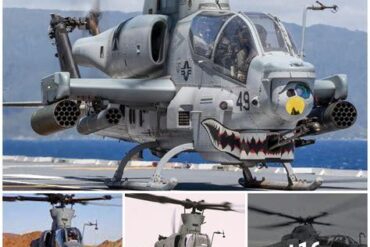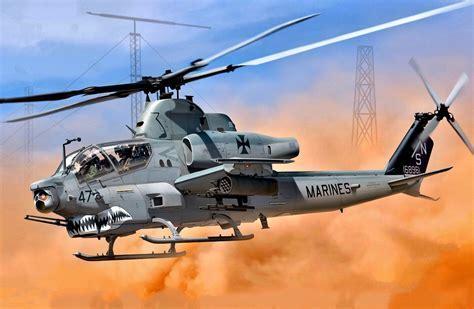
The Bell AH-1 Cobra was a revolutionary aircraft that redefined close air support in the modern age of warfare. As the first dedicated attack helicopter fielded by the United States military, its lean silhouette, purpose-built armament, and enduring service record established it as a legendary force multiplier from the jungles of Vietnam to the arid plains of the Middle East. Developed by Bell Helicopter as a direct response to the vulnerability of troop transports during the Vietnam War, the AH-1 Cobra stood apart with its narrow fuselage, tandem seating, and specialized firepower.
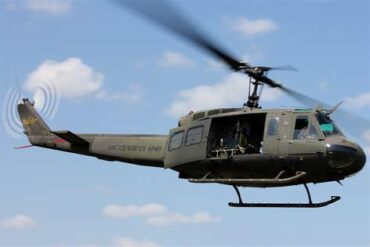
Designed as an interim solution, the AH-1 leveraged the powerplant and rotor system of the widely deployed UH-1 Iroquois, yet offered vastly superior offensive capability and survivability. From its first flight on September 7, 1965, to its retirement from U.S. Army service in 2001, the Cobra demonstrated relentless versatility. It proved essential in escort, reconnaissance, fire suppression, and “hunter-killer” tactics alongside OH-6A scouts.
Origins in a Theater of Necessity
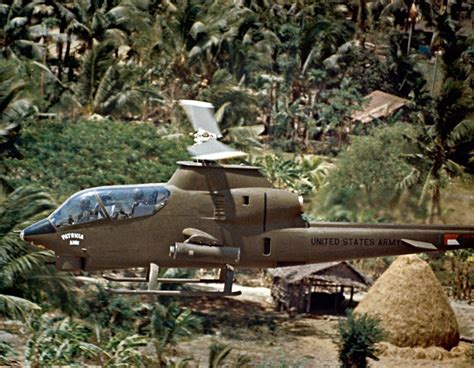
The genesis of the AH-1 Cobra stemmed from the hard lessons of early 1960s air mobility. The UH-1, though effective in transporting troops, was dangerously exposed. Field-modified armed Hueys—such as the UH-1A with side-mounted machine guns—lacked the power and precision required for survivability in high-threat environments. It became clear that a purpose-built gunship was necessary to shield troop movements and conduct offensive missions.
While bureaucratic delays hampered the development of a formal attack helicopter through the Advanced Aerial Fire Support System (AAFSS), Bell independently advanced a more pragmatic solution. In 1962, it unveiled the “Iroquois Warrior” mockup, which evolved into the Model 207 Sioux Scout by 1963. Although praised for its innovation, the Sioux Scout was deemed too small for combat application.
With the AAFSS’s own AH-56 Cheyenne mired in complexity and ultimately cancelled in 1972, Bell pushed ahead. In January 1965, it invested $1 million to develop a lightweight gunship derivative of the UH-1. The result, the Model 209, would fly less than a year later. Its sleek fuselage, stub wings, and chin-mounted turret represented a radical new philosophy in rotary combat aviation.
From Prototype to Warhorse: AH-1G Cobra in Vietnam
The U.S. Army swiftly recognized the potential of the Model 209, awarding Bell a production contract in April 1966. By June 1967, the first AH-1G Cobras had entered operational service in Vietnam. Their baptism under fire was immediate. On September 4, 1967, one of the first Cobras sank a Viet Cong sampan, initiating a combat legacy that would stretch across decades and continents.
With over 1,116 Cobras eventually built for the Army, they formed the backbone of aerial fire support during the conflict. The Cobra’s narrow fuselage reduced its visual and radar signature, while its armored tandem cockpit allowed for greater survivability. Pilots and gunners benefited from redundancy and field visibility, vital in Vietnam’s dense operational environment.
Design Philosophy and Tactical Employment
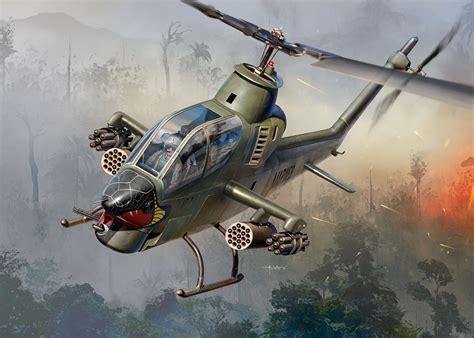
The Cobra’s structural design placed an emphasis on speed, precision, and lethality. The cockpit placed the pilot in the rear seat, and the gunner in front, both protected by armor plating. Fixed skids, a wide-chord rotor, and a repositioned tail rotor enhanced maneuverability and operational readiness.
Its stub wings housed multiple hardpoints for a range of weapons systems including:
- 2× 7.62 mm miniguns or grenade launchers in the chin turret
- 2.75-inch rocket pods
- XM35 20 mm cannon or M18 Minigun pod on outboard pylons
This weaponry allowed for not only close air support, but also anti-armor missions, especially in hunter-killer roles when paired with scout helicopters. Tactically, Cobras avoided hovering, instead favoring mobility and sweeping attacks to reduce their exposure to ground fire.
Upgrades, Variants, and Marine Corps Adoption
Following its success in Vietnam, the Cobra was subject to a series of upgrades under the Improved Cobra Armament Program. The AH-1Q introduced TOW missile capability, paving the way for the AH-1S series, and ultimately, the AH-1F, which incorporated radar and infrared jammers to enhance survivability.
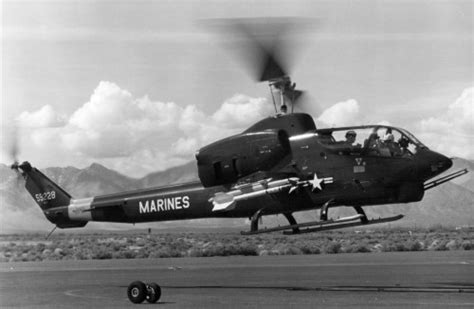
Meanwhile, the U.S. Marine Corps, recognizing the need for greater power and redundancy in naval environments, ordered twin-engine variants: the AH-1J SeaCobra in 1968 and the later AH-1T. These would form the basis for the SuperCobra line, culminating in the still-active AH-1Z Viper.
Global Operators and Battlefield Impact
United States Army and Beyond
The AH-1G served extensively until the Army’s full transition to the AH-64 Apache, retiring the Cobra in March 1999 from active duty and in September 2001 from reserve forces. Throughout its service, it saw combat in Grenada (1983), Panama (1989), the Gulf War (1991), Somalia, Haiti, and various peacekeeping missions.
Israel
The Israeli Air Force acquired six AH-1Gs from the U.S. Army, naming them Tzefa (Viper). On May 9, 1979, they fired Orev missiles in an attack on Tyre. Cobras played a major role in the 1982 Lebanon War, with a single mission seeing two helicopters destroy three Syrian tanks and a truck. Israel retired its fleet in 2013, transferring the remaining 16 to Jordan.
Japan
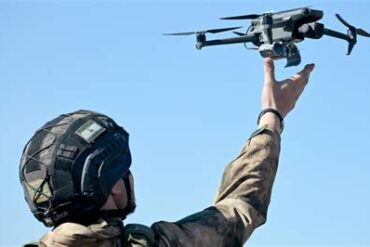
Under license, Japan manufactured 89 AH-1S Cobras between 1984 and 2000, with capabilities equivalent to the AH-1F. In December 2022, the Japan Ground Self-Defense Force initiated retirement of 47 AH-1S units in favor of unmanned aerial vehicles (UAVs).
Jordan
Jordan received 24 AH-1Fs in the late 1980s, nine more in 2001, and an additional 16 from Israel in 2014. The aircraft were deployed for border security and anti-smuggling missions.
Turkey and Pakistan
Turkey upgraded 32 ex-U.S. Army Cobras to AH-1F standards and acquired ten AH-1Ws, deploying them in counter-insurgency roles against Kurdish militants. Pakistan operated around 35 Cobras by 2013, using them in Somalia (1994) and Sierra Leone. Despite attempts, Pakistan was unable to secure more Cobras or Apaches and explored alternatives like the T129 ATAK, Z-10, and Mi-35.
Philippines
In 2019, the Philippines received two AH-1S helicopters from Jordan, primarily for training and counter-insurgency. Both were officially retired on December 28, 2024.
Civilian Conversions: Firewatch and Firesnakes
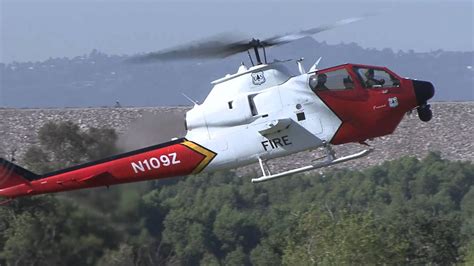
The Cobra’s design proved adaptable beyond combat. In 2003, the U.S. Forest Service acquired 25 AH-1Fs, converting them into Bell 209 Firewatch Cobras for wildfire surveillance. These aircraft featured advanced sensors and infrared systems for early fire detection and tracking. Though retired in October 2021, they demonstrated how a military platform could serve public safety.
In Florida, the Division of Forestry operated three AH-1Ps under the moniker Firesnakes, extending the Cobra’s utility into environmental protection.
Variants and Legacy
The Cobra lineage is extensive:
- Single-engine variants: AH-1G, AH-1Q, AH-1S, AH-1P, AH-1E, AH-1F
- Experimental: Bell 209, YAH-1R, QAH-1S, Model 249, Bell 309 KingCobra
- Twin-engine successors: AH-1J, AH-1T, AH-1W, and the advanced AH-1Z Viper
Former and current operators have included Bahrain, Japan, Jordan, Kenya, Pakistan, South Korea, U.S. Forest Service, and many others.
Specifications: AH-1G Cobra
- Crew: 2 (pilot and gunner)
- Length: 53 ft
- Width: 10 ft 4 in
- Height: 13 ft 6 in
- Empty weight: 5,810 lb
- Max takeoff weight: 9,500 lb
- Powerplant: 1 × T53-L-13 turboshaft (1,100 hp)
- Max speed: 149 knots (171 mph)
- Range: 310 nautical miles
- Ceiling: 11,400 ft
- Climb rate: 1,230 ft/min
- Armament: Miniguns, grenade launchers, 2.75-in rockets, 20 mm cannon
Conclusion: A Cobra’s Enduring Bite
The Bell AH-1 Cobra was not just a helicopter; it was a pioneering embodiment of the attack helicopter concept. Its elegant brutality, speed, and resilience under fire laid the foundation for all rotor-wing gunships that followed. As the Cobra’s silhouette fades from modern battlefields, replaced by more sophisticated platforms, its impact remains permanently etched into the doctrines of air-ground warfare across the globe.