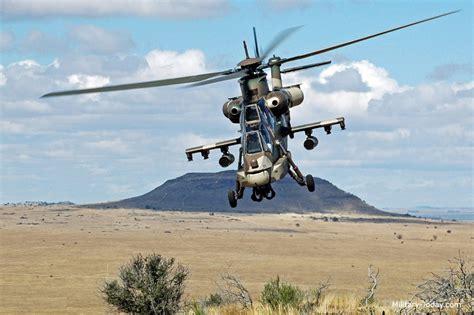
The Denel Rooivalk, whose name translates to “Red Falcon” in Afrikaans, is one of the most ambitious and technically sophisticated aerospace projects ever undertaken by South Africa. Born out of necessity during the late Cold War era, the Rooivalk represents a fusion of ingenuity, resilience, and military utility tailored to the unique demands of the African battlefield. With its origins rooted in apartheid-era defense constraints and a subsequent vision for indigenous aerospace capability, the Rooivalk’s development and evolution tell a compelling story of engineering under pressure, political complexity, and strategic foresight.
Origins Amid Embargo: Engineering in Isolation
The Rooivalk’s story begins in 1984, during the South African Border War, when the country was increasingly isolated under a comprehensive United Nations arms embargo. The embargo restricted South Africa’s access to foreign military technology, compelling local engineers and defense planners to look inward. The state-owned Atlas Aircraft Corporation (which later became Denel Aviation) initiated development by repurposing technologies already in service, namely those found in the Atlas Oryx, a locally upgraded variant of the French Aérospatiale SA 330 Puma.
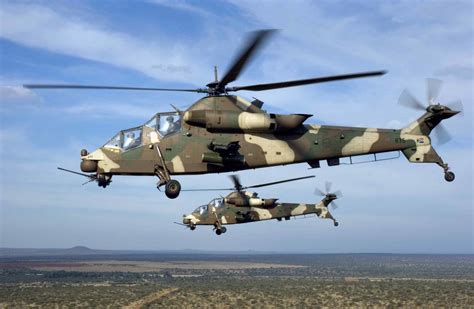
To expedite development and reduce costs, designers utilized the Oryx’s twin Turbomeca Makila engines and rotor system, creating a high power-to-weight platform optimized for anti-armor and escort missions. The program took its first tangible step forward with the XH-1 Alpha, a technology demonstrator based on the Alouette III, which flew in February 1985. Though rudimentary, it proved the concept viable, paving the way for full-scale development of the Rooivalk.
Prototype Flight and Political Turbulence
The first true Rooivalk prototype lifted off on 11 February 1990, just as South Africa was undergoing seismic political shifts. The end of the Border War in 1988, coupled with the beginning of apartheid’s unraveling, led to significant budgetary constraints. The original plan to produce 36 helicopters was slashed to 12 units, causing prolonged delays and leaving the Rooivalk’s onboard systems increasingly obsolete by the late 1990s.
Adding to these hurdles was the lack of certainty in international support—particularly from France, which had supplied several key technologies. Furthermore, aggressive lobbying by the United States in favor of the AH-64 Apache effectively stymied early export ambitions, placing the Rooivalk in a precarious position between strategic necessity and fiscal impracticality.
Technical Characteristics: Purpose-Built Firepower
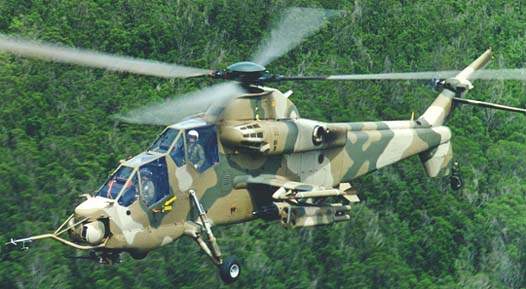
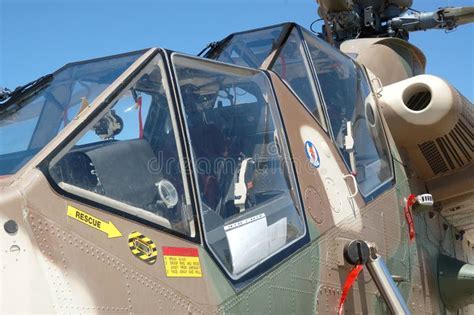
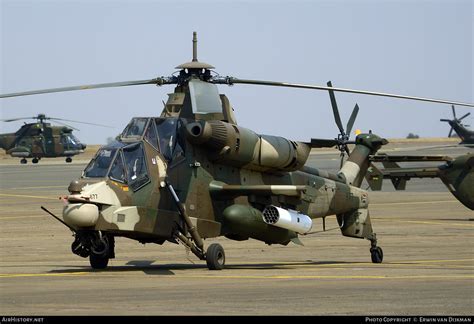
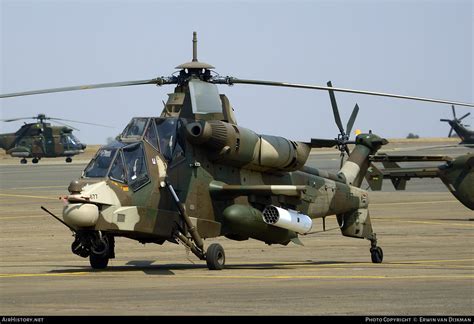
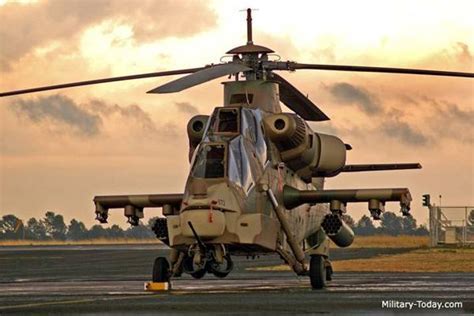
The Rooivalk is a tandem-seat attack helicopter purpose-built for durability, lethality, and advanced situational awareness. Designed with South Africa’s rugged terrain and asymmetric threats in mind, it features a gyro-stabilized day/night targeting system, TopOwl helmet-mounted display, and infrared suppression to reduce heat signature.
Its armament is both versatile and formidable:
- 20 mm chin-mounted cannon with a 700-round capacity
- Denel Mokopa anti-tank guided missiles (ATGMs) capable of penetrating heavy armor
- FZ 90 70 mm unguided rockets for area suppression
- Mistral air-to-air missiles, providing self-defense against airborne threats
The helicopter’s fixed landing gear allows for quick field repairs, while its wire cutters, electronic countermeasures suite, and armored cockpit underscore its survivability. With a cruise speed of 278 km/h, range of 740 km, and service ceiling of 6,100 meters, the Rooivalk can operate effectively in both high-altitude and tropical environments.
Modernization and the Mk 1.1 Evolution
In 2016, under a Memorandum of Understanding with Airbus Helicopters, Denel embarked on the Rooivalk Mk 1.1 upgrade. This mid-life enhancement added missile-approach warning systems, upgraded avionics, and improved payload capacity. These changes brought the Rooivalk more in line with modern attack helicopters in terms of sensor fidelity, pilot survivability, and target acquisition.
Notably, this upgrade also improved inter-operability with other aircraft types and better integration with network-centric warfare systems. Survivability enhancements included infrared missile jamming and improved flares/decoys deployment. As Denel sought to expand the Rooivalk’s capabilities, the Mk 1.1 became a stepping stone toward a larger ambition: the Mk 2.
Mk 2 Rooivalk: Resurrecting a Dormant Giant
Although shelved for years, the Rooivalk Mk 2 gained renewed interest starting in 2014, with government-led feasibility studies and emerging international partnerships. By 2016, the South African government confirmed discussions around re-opening production lines, targeting up to 70 helicopters for both domestic and export use.
Countries including Egypt, Brazil, India, Nigeria, and Poland expressed interest, reflecting a growing appetite for non-Western, high-performance alternatives in the global arms market. In 2023, Denel Aeronautics entered a joint initiative with Aselsan, a Turkish defense electronics firm, to overhaul the Rooivalk’s avionics suite. This marked a pivotal move toward transforming the Mk 2 into a digitally dominant, export-ready platform.
Operational Deployment and Combat Record
Although the Rooivalk’s development timeline spanned decades, its entry into active service began in earnest in the early 2000s. By 2005, six Rooivalks had been evaluated under Project Impepho, but full operational capability was delayed due to Denel’s personnel shortages and chronic underfunding.
On 1 April 2011, the South African Air Force (SAAF) officially inducted the first Rooivalk Mk 1s into 16 Squadron, stationed at AFB Bloemspruit. The final Block 1F unit was delivered in March 2013.
Perhaps the most significant moment in the Rooivalk’s operational history occurred in November 2013, when three helicopters were deployed to the United Nations’ MONUSCO Force Intervention Brigade in the Democratic Republic of Congo. On 4 November 2013, they engaged M23 rebel positions near Goma, marking the first time since World War II that UN aviation assets had directly engaged in offensive combat. The Rooivalks provided close air support, firing 70 mm FZ 90 rockets, and were credited with helping to dismantle M23’s operational command.
Industrial Impact and Legacy in Aerospace
Beyond its battlefield performance, the Rooivalk program played a catalytic role in shaping South Africa’s aerospace sector. The requirement for indigenous expertise led to the creation of firms like Aerosud, which later participated in international aerospace projects including the Saab Gripen and AgustaWestland AW109.
This industrial base not only enabled South Africa to sustain the Rooivalk but also facilitated collaborations with Airbus, laying the groundwork for future joint ventures. Despite the challenges, the Rooivalk remains a testament to South African resilience and innovation in military aviation.
Export Challenges and Market Realities
Efforts to market the Rooivalk internationally have faced persistent hurdles. The dominance of the Boeing AH-64 Apache, extensive political lobbying, and Denel’s internal financial woes have all contributed to stalled negotiations. Despite serious inquiries from multiple nations, no export sales have been finalized as of 2025.
One significant limiting factor remains the Rooivalk’s small production base. With only 12 active aircraft and limited spare parts, potential buyers face logistical challenges unless full-scale production resumes. However, Denel’s strategic pivot toward partnership-driven production models, particularly with Turkey’s Aselsan, offers a pathway to reviving the Rooivalk for export.
Conclusion: A Helicopter Worth a Second Look
The Denel Rooivalk is more than just an attack helicopter—it is a symbol of South Africa’s capacity to innovate under duress and a potential force multiplier for future coalition warfare environments. With its unique blend of rugged engineering, modern firepower, and combat-proven reliability, the Rooivalk stands ready for a second act, should the political and industrial support align.
Its role in UN peacekeeping missions, continued upgrades, and budding global interest hint that this African warbird may yet rise again—fiercer, smarter, and more relevant than ever in the new multipolar defense era.