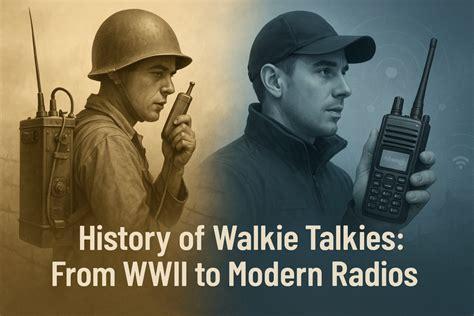
World War II transformed military communications from vulnerable battlefield links into increasingly mobile wireless networks. The development of hand-held and backpack radios gave soldiers a way to communicate while moving, reducing dependence on telephone wires and human messengers. Although these radios were bulky by modern standards, their underlying principles helped establish an important technological path toward the wireless devices used today.
During World War I, armies relied heavily on runners and wired telephone systems. Both had serious weaknesses: runners were slow and exposed, while wires could easily be severed by artillery, vehicles, or advancing troops. Wireless radio offered a solution, allowing commanders to transmit information without maintaining a physical connection between distant positions.
One of the most important World War II examples was the SCR-300 backpack radio, developed by the Galvin Manufacturing Corporation, the company that later became Motorola. Introduced into combat during the Sicily Campaign in 1943, the SCR-300 became an important communications tool for U.S. forces. It was commonly carried on a soldier’s back while another soldier or commander operated its handset.
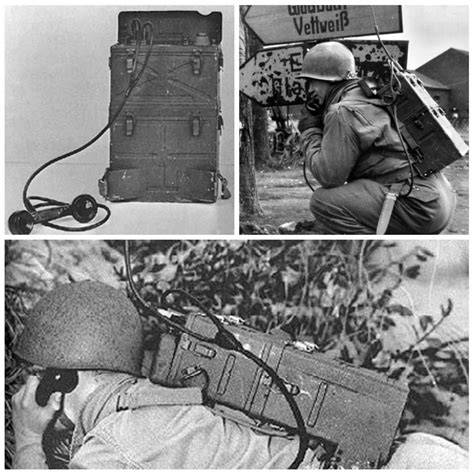
The SCR-300 and the Birth of the Walkie-Talkie
The SCR-300 weighed roughly 32 to 38 pounds, depending on its battery configuration, and provided a practical communication range of more than three miles under favorable conditions. Its size may seem enormous compared with a smartphone, but mobility was the breakthrough. Soldiers no longer needed to remain beside a wired telephone or wait for a messenger to arrive.
The radio operated in the FM frequency range around 40 to 48 MHz, using multiple channels to provide more reliable battlefield communications. The use of frequency modulation was particularly significant because it offered improved resistance to certain forms of interference compared with earlier amplitude-modulated systems. The technology demonstrated that wireless communication could become both mobile and dependable enough for demanding military operations.
From Military Radios to Cellular Networks
The technological legacy of these radios extended well beyond the battlefield. After the war, engineers progressively replaced bulky vacuum tubes with transistors, while improvements in batteries, circuitry, frequency management, and antennas made radios smaller, lighter, and more efficient. These advances were essential because practical personal wireless communication depended not simply on transmitting radio waves, but on making the equipment portable enough for ordinary users.
Commercial mobile telephone systems appeared surprisingly soon after the war. In 1946, a mobile telephone service began operating in the United States, although its equipment was extremely large and was installed in vehicles. The system had limited capacity and coverage, yet it demonstrated that wireless voice communication could move beyond military applications and into civilian telecommunications.
The eventual arrival of cellular networks required many additional breakthroughs, including compact electronics, semiconductor technology, digital communications, automated frequency management, and networks of strategically positioned cell sites. Nevertheless, the basic concept remained familiar: a portable device could transmit and receive information through radio waves without being physically connected to another communication system.
The Wireless Legacy of World War II
Today’s smartphones operate at frequencies and with technologies far more sophisticated than those available to WWII soldiers. They combine cellular networks, Wi-Fi, Bluetooth, satellite positioning, encryption, and high-speed digital data transmission inside devices weighing only a fraction of a pound. Yet the historical connection is clear. The SCR-300 and other WWII radios demonstrated the military value of reliable portable wireless communication, while postwar engineers continued refining the same broad concept.
From a heavy backpack radio carried across the battlefield to a smartphone communicating through thousands of network nodes, the scale has changed dramatically. The fundamental ambition, however, remains remarkably similar: put reliable communication into the hands of people wherever they need it. World War II did not create the modern cellphone by itself, but its portable radio technology helped establish an important foundation for the wireless world that followed.