The Boeing 777X represents the latest major evolution of Boeing’s long-running 777 family, combining a larger composite wing, new-generation engines, and updated aerodynamics with a fuselage architecture that remains closely related to the previous generation. Among the many improvements promised by the aircraft, range is one of the most closely watched because the 777-300ER established itself as one of the most capable and widely used long-haul widebodies ever produced. The question, therefore, is not simply whether the 777X is newer, but exactly how much additional distance it can cover.
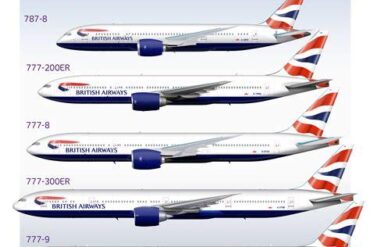
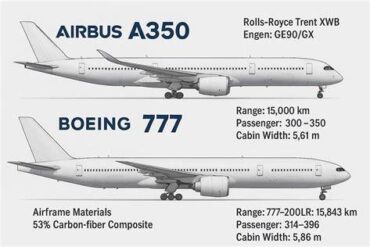
The answer is more complicated than a straightforward generational upgrade. Boeing’s published figures show that the 777-8 has a maximum range of 8,745 nautical miles (16,190 km), while the larger 777-9 is rated at 7,285 nautical miles (13,500 km). The 777-300ER, meanwhile, has a published range of approximately 7,370 nautical miles (13,649 km). That means the smaller 777-8 offers a substantial range advantage over the aircraft it most directly follows, while the larger 777-9 actually has a slightly shorter published range than the 777-300ER.
This unusual result is largely explained by the relationship between aircraft size, weight, fuel capacity, and mission requirements. The 777X family was designed around a common large composite wing, meaning the two passenger variants have essentially the same fuel-carrying wing structure. The 777-9 is considerably larger and heavier than the 777-8, so more of its available performance is consumed simply carrying the additional structure and passenger capacity. The result is an aircraft with enormous capacity but less maximum range than its smaller sibling.
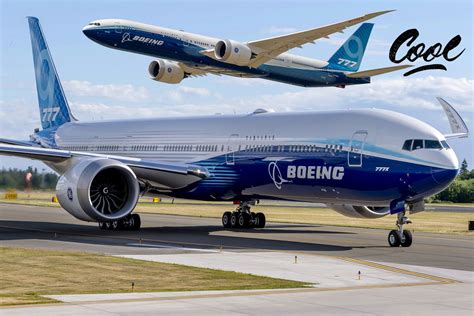
Boeing 777X Range: The 777-8 Has the Biggest Advantage
The Boeing 777-8 is the long-range member of the passenger 777X family. With a published range of 8,745 nautical miles, it can theoretically fly 1,375 nautical miles (2,541 km) farther than the 777-300ER. That is an increase of roughly 19% in maximum published range, giving the aircraft considerably more flexibility for missions that push the limits of conventional long-haul operations.
The significance of that number becomes clearer when looking at the aircraft’s intended role. The 777-8 is designed to carry a large passenger complement while also offering the range needed for some of the world’s longest nonstop routes. Boeing lists a typical two-class capacity of approximately 395 passengers, compared with about 392 for the 777-300ER under the specifications used for this comparison. In other words, the 777-8 is not achieving its greater range simply by carrying dramatically fewer passengers.
Its advantage comes from a combination of aerodynamic efficiency, structural improvements, engine performance, and a significantly more advanced wing. The aircraft can therefore offer airlines a combination that was difficult to achieve with the previous generation: high passenger capacity without sacrificing the ability to operate extremely long sectors.
The 777-8’s range also gives airlines greater flexibility in real-world scheduling. Maximum range figures are not guarantees that an aircraft will routinely fly that distance. Actual performance depends on payload, winds, temperature, airport elevation, routing restrictions, reserves, cabin configuration, and other operational factors. Nevertheless, having a larger theoretical range envelope can give an airline more options when planning routes and selecting aircraft for missions where payload and distance must be carefully balanced.
Why the Boeing 777-9 Has Less Range Than the 777-300ER
The Boeing 777-9 presents a much more interesting comparison. Despite being the newer aircraft, its published range of 7,285 nautical miles is about 85 nautical miles (157 km) shorter than the 777-300ER. At first glance, this may appear to undermine the argument that the 777X is a major improvement over the aircraft it replaces. In practice, however, the 777-9 was designed around a different priority.
The 777-9 is substantially larger than the 777-300ER and is intended to carry more passengers. Boeing lists a typical two-class capacity of approximately 426 passengers, compared with 392 for the 777-300ER. That represents an increase of around 34 seats in the reference configuration. The aircraft therefore focuses heavily on capacity and economics while retaining a very long range.
The difference illustrates an important principle in commercial aviation: range cannot be evaluated independently of payload. A larger aircraft does not automatically fly farther. Every additional seat, structural component, piece of equipment, and kilogram of payload contributes to the aircraft’s total weight. If fuel capacity remains broadly constrained by the wing and structural design, increasing aircraft size can actually reduce the maximum distance that can be flown.
That is exactly what happens with the two 777X passenger variants. The 777-9 has the same basic wingspan as the 777-8, but it has a longer fuselage and greater structural and operating weight. The aircraft consequently uses more of its available performance simply carrying itself and its larger payload.
The 777-300ER Remains a Remarkable Long-Range Aircraft
The fact that the 777-9 does not dramatically exceed the 777-300ER in range should not obscure how capable the older aircraft is. The 777-300ER was already optimized for long-haul operations, and its success was built around an unusually effective balance between passenger capacity, fuel efficiency, and range.
The 777-300ER has a published range of around 7,370 nautical miles, placing it only slightly ahead of the 777-9 in the reference specifications. It also became one of the most successful large twin-engine aircraft ever developed, serving major airlines on long-distance routes across the Atlantic, Pacific, and between major hubs in Europe, Asia, the Middle East, Africa, and North America.
Another important reference point is the 777-200LR, which was designed specifically for extreme range. Boeing gives that aircraft a technical range of approximately 8,555 nautical miles, although it achieved far less commercial popularity than the 777-300ER. The reason is revealing: maximum range alone does not determine whether an aircraft succeeds commercially. Airlines also care about fuel consumption, passenger capacity, acquisition cost, cargo capability, and the number of routes on which an aircraft can generate attractive economics.
The 777X reflects this same philosophy, but with substantially newer technology. Rather than simply maximizing range for every aircraft in the family, Boeing has created two passenger variants that target different combinations of capacity and distance.
The Composite Wing Is Central to the 777X Range Advantage
One of the most important differences between the 777X and the 777-300ER is the wing. The 777-300ER uses a conventional swept wing, while the 777X introduces a substantially redesigned wing constructed primarily from advanced composite materials.
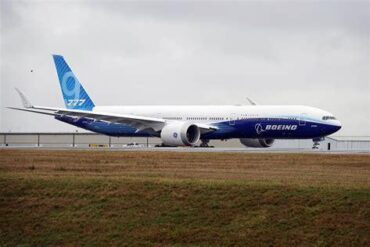
The 777X wing is also much longer in flight. Its wingspan reaches approximately 235 feet 5 inches (71.75 meters) when the folding wingtips are extended, compared with the 777-300ER’s shorter wingspan. The longer wing improves aerodynamic efficiency by increasing aspect ratio and reducing the induced drag associated with generating lift.
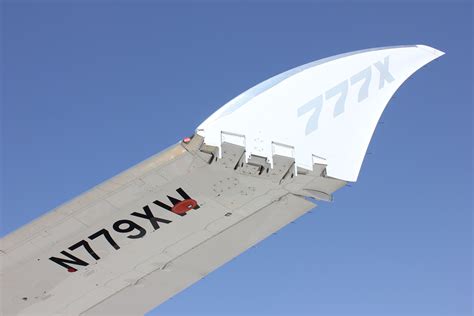
There is, however, an airport compatibility problem. A wing that large would place the 777X into a higher airport design category at many facilities, potentially limiting where the aircraft could operate. Boeing’s solution is the aircraft’s distinctive folding wingtip system. The outer portions of the wing fold upward after landing and remain folded while the aircraft is on the ground.
With the wingtips folded, the 777X retains a wingspan broadly compatible with the airport infrastructure used by earlier 777 variants. Once airborne, the tips extend and the aircraft gains the aerodynamic benefits of its much larger wing.
This feature is more than an unusual visual characteristic. It allows Boeing to pursue aerodynamic efficiency without abandoning the extensive airport network that made the 777 family attractive in the first place. The combination of a long composite wing and folding wingtips is one of the defining engineering features behind the 777X’s efficiency improvements.
GE9X Engines Add Another Layer of Efficiency
The wing is only part of the equation. The 777X is powered by the GE Aerospace GE9X, a new-generation turbofan developed specifically for the aircraft. The engine is based on technologies designed to improve fuel efficiency while producing the thrust required by a very large twin-engine aircraft.
The GE9X is enormous, with a fan diameter larger than the fuselage diameter of a Boeing 737. Its scale reflects the engine’s high bypass ratio and the effort to extract more useful thrust from every unit of fuel consumed. Compared with the GE90 engines used by many 777-300ERs, the GE9X incorporates newer materials, aerodynamic improvements, and other technologies intended to reduce fuel consumption.
GE has indicated that the GE9X can provide approximately 10% better fuel efficiency than the GE90 on the 777-300ER under the relevant comparison. Boeing, meanwhile, has marketed the 777-9 as offering approximately 20% lower fuel consumption and emissions than the aircraft it replaces, while also producing a substantially smaller noise footprint.
These improvements matter because range is ultimately constrained by how efficiently an aircraft converts its fuel into useful transportation. A more efficient engine allows a greater proportion of the aircraft’s fuel load to be used for moving passengers and cargo rather than overcoming aerodynamic and propulsion losses.
Range Depends on How an Airline Configures the Aircraft
Published specifications provide a useful baseline, but airline operations can produce very different results. A 777X configured for an ultra-long-haul mission may have fewer passenger seats than an aircraft optimized for high-density regional or hub-to-hub operations.
This is particularly important for the world’s longest flights. Airlines operating ultra-long-haul routes often dedicate additional cabin space to crew-rest facilities, allowing pilots and cabin crew to operate safely during missions that can last many hours. Removing passenger seats also reduces payload, which can improve the aircraft’s range capability.
Cabin density, cargo loading, seat pitch, premium-class space, galleys, lavatories, crew facilities, and even the weight of onboard equipment can therefore affect actual operational range. Two aircraft of the same model operated by different airlines may have meaningfully different practical capabilities even though their published technical specifications are identical.
Weather and routing introduce another variable. Strong headwinds can significantly increase fuel consumption, while favorable winds can reduce the amount of fuel needed for a particular journey. Airlines also need to carry reserves and account for diversion requirements, meaning the maximum technical range is not the same thing as the maximum distance an airline can schedule under every set of conditions.
The 777X Range Advantage Is Really About Efficiency and Flexibility
Looking at the numbers alone produces an intriguing picture. The 777-8 extends the published range by 1,375 nautical miles over the 777-300ER, while the 777-9 is approximately 85 nautical miles shorter. That does not mean the 777-9 is an inferior long-haul aircraft. Instead, it highlights the different jobs assigned to the two 777X variants.
The 777-8 is the range-focused aircraft, providing an unusually large distance capability while retaining substantial passenger capacity. The 777-9 is the high-capacity member, designed to carry more people while delivering improved fuel efficiency and economics compared with the older generation.
The larger aircraft’s slightly shorter maximum range is therefore an intentional consequence of its greater size rather than a simple failure to improve on the 777-300ER. In many airline networks, carrying more passengers and cargo efficiently can be more commercially useful than maximizing the distance of every flight.
The 777X’s biggest achievement is consequently not one isolated range figure. Its importance comes from bringing together a larger composite wing, folding wingtips, advanced aerodynamics, and GE9X engines in an aircraft family capable of covering different segments of the long-haul market. The 777-8 pushes the range envelope, while the 777-9 concentrates on capacity and efficiency.
For the 777-300ER, that creates an interesting legacy. The aircraft remains an impressive long-range machine whose published range is still competitive with the larger 777X variant. But the 777-8 demonstrates how far Boeing can extend the concept when greater range is prioritized, while the 777-9 shows how the same technological foundation can be used to create a much larger passenger aircraft without abandoning the efficiency gains expected from a new generation.
In that sense, the Boeing 777X does not replace the 777-300ER with one simple numerical improvement. Instead, it expands the family in two directions. The 777-8 delivers the dramatic range increase, while the 777-9 emphasizes capacity and operating efficiency. Together, they demonstrate why the range story of the 777X is considerably more nuanced than simply asking which aircraft can fly farther.