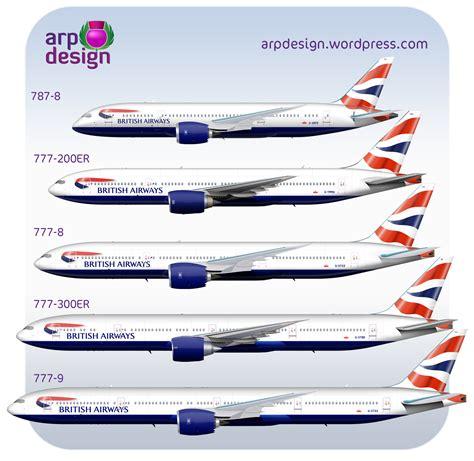
The debate over Boeing 777-300ER cabin width versus Boeing 787 Dreamliner cabin width is more than an aviation trivia question. It strikes at the heart of long-haul comfort, airline economics, and aircraft engineering philosophy. A few inches of fuselage diameter may sound trivial on paper, yet across a 14-hour transpacific flight, those inches define whether your shoulders relax or negotiate for survival.
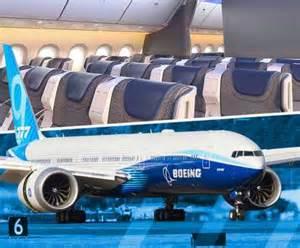
Passengers stepping into a Boeing 777-300ER often notice an immediate sense of scale. The aisle feels broad, the ceiling expansive, and the cabin proportioned like a cathedral built for jet engines. In contrast, the 787 Dreamliner, though modern and sculpted with futuristic flair, conveys a subtly narrower impression. That perception is not imagination. It is mathematics.
The 777-300ER’s internal cabin width measures 5.87 meters (19 feet 3 inches). The 787 Dreamliner, depending on variant, measures 5.49 meters (18 feet) internally. The difference is approximately 38 centimeters (15 inches). In architectural terms, that is modest. In aviation ergonomics, it is enormous.
Boeing 777-300ER Cabin Width: The Raw Numbers Explained
The 777-300ER was conceived in the 1990s as the world’s largest twin-engine jet, designed to replace aging Boeing 747s on high-density routes. Its fuselage reflects that ambition. With an external diameter of 6.20 meters, the aircraft was engineered to maximize interior cross-section while maintaining structural integrity in an aluminum body.
Inside, that translates to 5.87 meters of usable cabin width. This measurement refers to the widest interior point at armrest level. It is that dimension airlines exploit when configuring seating layouts.
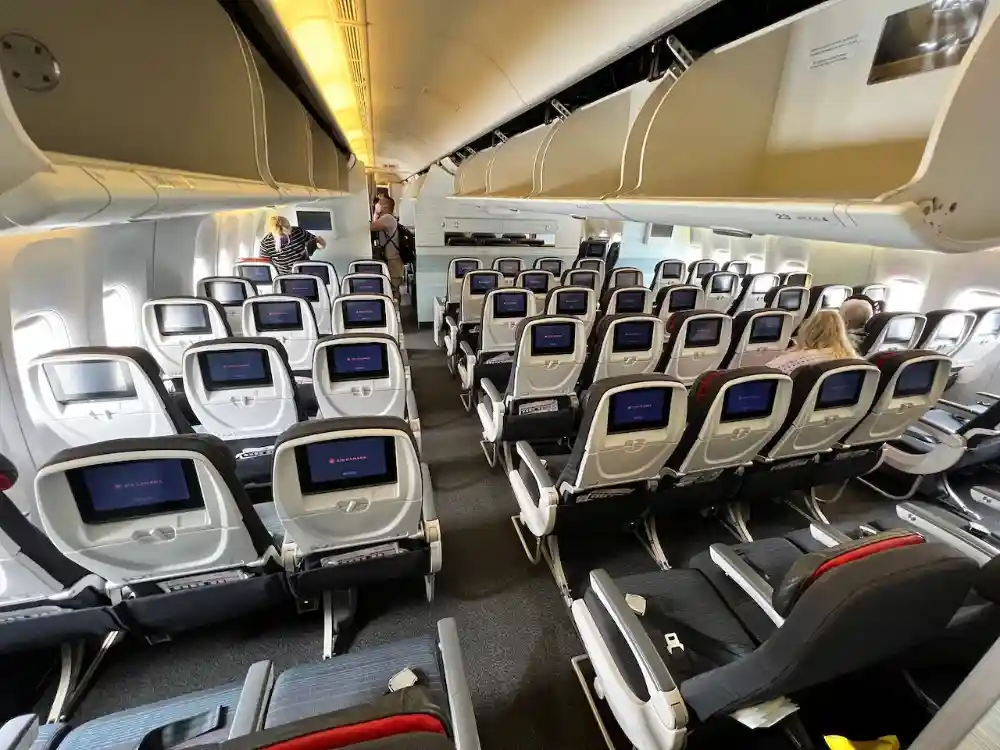
Originally, the 777 economy cabin was marketed as a 9-abreast (3-3-3) configuration. In that layout, passengers enjoyed seat widths of around 18.5 inches, making it one of the most comfortable economy experiences of its era. Over time, financial pressure altered the equation. Airlines discovered that adding a tenth seat across—moving to a 3-4-3 layout—dramatically reduced seat-mile costs.
The result? Seat widths typically shrink to approximately 17 to 17.5 inches in high-density configurations. The aircraft remains wide. The seats do not.
Boeing 787 Dreamliner Cabin Width: Efficiency With Constraints
The 787 Dreamliner entered service in 2011 with a different mission. It was not meant to outsize the 777. It was designed to redefine efficiency, range, and passenger wellness through advanced composite materials.
Its external fuselage diameter is 5.77 meters, and its internal cabin width is 5.49 meters. That 38-centimeter deficit compared to the 777 is structural, not cosmetic.
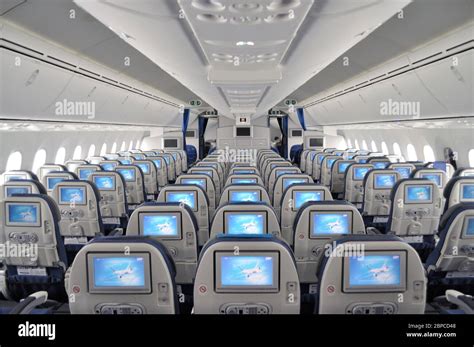
The 787’s design effectively locks airlines into a 9-abreast (3-3-3) economy configuration. Attempting 10 seats across would compromise aisle width beyond regulatory limits. As a result, passengers flying a 787 are almost guaranteed nine seats per row in standard configurations.
Seat widths typically range between 17 and 17.3 inches in 9-abreast layouts. The difference between a 10-abreast 777 and a 9-abreast 787 is therefore smaller than many expect. In fact, in many real-world scenarios, the seat width may be nearly identical.
Why 38 Centimeters Matters in the Sky
Fifteen inches of cabin width might not sound transformative. Yet aviation design magnifies small margins. The additional width in the 777 allows for:
- Wider aisles at identical seating density
- Greater armrest spacing in 9-abreast layouts
- More flexibility in premium cabin design
- Higher revenue potential through 10-abreast configurations
The 787’s narrower cross-section enforces discipline. Airlines cannot easily push beyond 9-abreast without compromising safety compliance. That structural limitation produces consistency across carriers.
Ironically, the 777’s greater width introduces variability. A traveler booking a 777-300ER could encounter either one of the roomiest economy layouts in the industry or one of the tightest.
Engineering Philosophy: Aluminum Giant vs Composite Innovator
The 777-300ER relies primarily on traditional aluminum construction. Aluminum fuselages are robust and well understood but have limitations in pressurization tolerance and fatigue resistance.
The 787 Dreamliner is built largely from carbon fiber reinforced polymer composites. These materials are lighter, resist corrosion, and tolerate higher cabin pressures. That structural capability enables the 787 to maintain a lower cabin altitude of approximately 6,000 feet, compared to the 777’s typical 8,000-foot cabin altitude.
Higher humidity is also possible in the composite fuselage. The 787 cabin often maintains humidity levels around 15–20%, whereas traditional aluminum aircraft cabins typically hover near 10%. Over a long-haul flight, that difference affects dehydration, fatigue, and overall comfort.
Thus, while the 777 wins on width, the 787 frequently wins on physiological comfort.
Airline Configurations: Comfort vs Revenue Density
Airline strategy ultimately determines how cabin width translates into passenger experience.
Japan Airlines offers a striking example. On certain 777-300ER aircraft, it maintains a 9-abreast configuration with 19-inch seats, branded as “Sky Wider.” In that setup, the 777 delivers exceptional spaciousness.
By contrast, airlines such as Emirates configure many 777-300ER aircraft with 10 seats per row, reducing seat width to roughly 17 inches. The cabin remains wide. Personal space contracts.
On the 787, configuration variation exists but within tighter bounds. Most airlines operate the aircraft in 9-abreast layout. Japan Airlines even deploys an 8-abreast (2-4-2) configuration on some 787s, offering nearly 19-inch seats in economy—an unusually generous arrangement.
The 777-300ER therefore possesses greater spatial potential, but its real-world comfort depends entirely on airline philosophy.
Operational Implications of Size
Cabin width is inseparable from aircraft mission profile. The 777-300ER is a heavyweight performer. Powered by massive GE90-115B engines, among the largest turbofans ever built, it excels on high-demand, long-haul trunk routes.
However, that scale carries operational trade-offs. The 777-300ER typically requires runways of approximately 10,600 feet at maximum takeoff weight. Its fuel burn averages around 2.9 liters per 100 kilometers per seat.
The 787 Dreamliner is optimized for efficiency and flexibility. It can operate from runways closer to 9,200 feet and consumes roughly 2.27 liters per 100 kilometers per seat. That difference enables airlines to open direct routes between smaller cities without relying on megahub infrastructure.
In other words, the 777 moves more people with more cabin width. The 787 moves fewer people farther, more efficiently, and into more diverse airports.
Perception vs Measurement: Why the 777 Feels Bigger
Cabin geometry influences perception beyond raw width. The 777’s fuselage curvature provides broader shoulder space at armrest level. The aisle-to-seat proportion often feels more generous.
The 787 counters with larger electronically dimmable windows, higher humidity, and sculpted sidewalls that create a modern aesthetic. Its cabin lighting system, designed to reduce jet lag, subtly reshapes the sensory experience.
Yet when measured at shoulder height—the point that matters most in economy seating—the 777’s additional width remains tangible.
The Airbus A350 and the Coming 777X
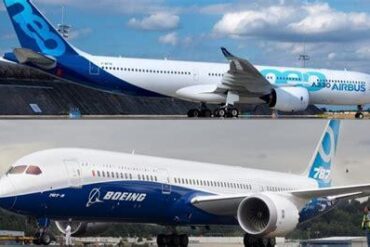
The Airbus A350-1000 enters this debate as an intermediary. With an internal cabin width of approximately 5.71 meters, it sits between the 787 and 777. Airbus markets it as an “extra wide body,” yet it still trails the 777-300ER by roughly 16 centimeters internally.
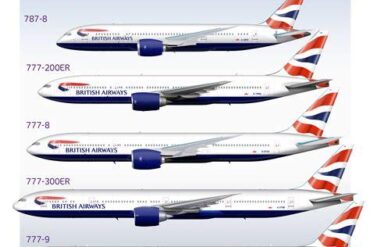
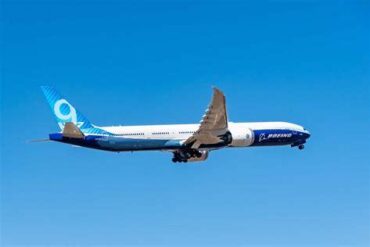
Looking forward, the Boeing 777-9, part of the 777X family, pushes the concept further. Through advanced insulation and interior optimization, Boeing has expanded internal cabin width to approximately 5.96 meters, making it the widest twin-engine passenger aircraft cabin ever designed.
The trend is clear. When airlines prioritize hub-to-hub volume, width remains king.
Is the 777-300ER Wider Than the 787 Dreamliner? The Definitive Answer
Yes. The Boeing 777-300ER has a wider cabin than the Boeing 787 Dreamliner. The difference is approximately 38 centimeters (15 inches) internally. That margin is structurally significant and measurable at shoulder height.
However, width alone does not define comfort. The 787 compensates with advanced environmental systems, lower cabin altitude, improved humidity, and fuel efficiency that reshapes global route networks.
The 777-300ER offers greater maximum spatial potential. The 787 delivers consistent configuration and enhanced passenger wellness.
Width Is Power, But Context Is Everything
On a 9-abreast 777-300ER operated by a comfort-focused airline, passengers experience one of the most spacious economy cabins available in commercial aviation. On a 10-abreast configuration, that advantage narrows dramatically.
On the 787 Dreamliner, the cabin is physically narrower, yet passengers benefit from environmental advantages that often outweigh minor seat-width differences.
Aviation is rarely about absolutes. It is about trade-offs. The 777-300ER dominates in raw cabin width. The 787 Dreamliner defines modern efficiency and physiological refinement. Each aircraft reflects a distinct answer to the same challenge: how to move people across oceans with optimal balance between space, cost, and technology.
For travelers, understanding that 38-centimeter gap transforms a vague perception into a precise fact. For airlines, those inches translate into millions in revenue or brand differentiation. And for aviation itself, they illustrate how even a few centimeters can reshape the experience of crossing the planet at 35,000 feet.