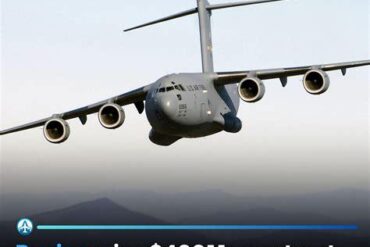
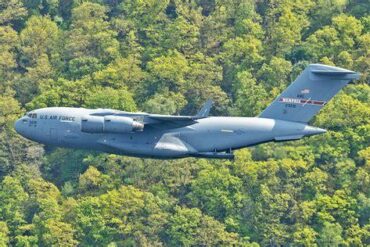
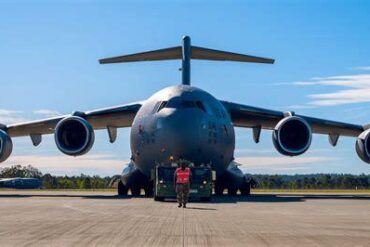
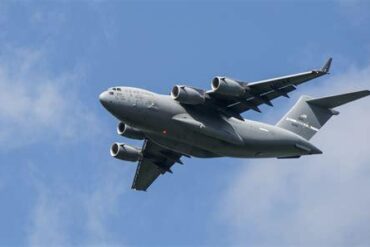
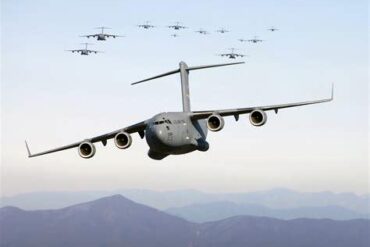
The C-17 Globemaster III could remain a cornerstone of US military airlift for another half-century, even as the United States Air Force begins developing the aircraft intended to replace it. The paradox is striking: the replacement program is already being shaped around the threats of the second half of the 21st century, yet the aircraft it is meant to succeed may continue flying well into the 2070s.
The Air Force’s Fiscal Year 2027 planning documents acknowledge both sides of the problem. The service is investing in airlift service-life extension programs while exploring next-generation airlift options, reflecting an uncomfortable reality that the current fleet must remain operational while its eventual successor is still little more than a collection of requirements, studies, and emerging technologies.
The emerging Next Generation Airlift (NGAL) program is intended to replace both the C-17A and C-5M Super Galaxy fleets. However, development is still at an early stage. An Analysis of Alternatives is expected in Fiscal 2027, while an accelerated development schedule could see the first aircraft delivered around Fiscal 2038 and Initial Operational Capability around 2041. Even if those milestones are achieved, the C-17 would not disappear quickly.

That long transition reflects how difficult it will be to replace an aircraft that occupies such a unique position in American military logistics. The C-17 is neither simply a tactical transport nor merely a strategic airlifter. It combines substantial payload capacity, long-range performance, short-field capability, rapid loading and unloading, and the ability to operate from austere locations. Replacing all of those characteristics while adding survivability and modern connectivity is a formidable engineering challenge.
NGAL Is Being Designed for a Much More Dangerous Airlift Environment
The C-17 was designed for a world in which the biggest airlift challenges centered on range, payload, reliability, and access to runways. NGAL is being conceived for an environment in which simply reaching the destination may not be enough.
The Air Force expects future adversaries, particularly China and Russia, to possess increasingly capable long-range air-defense systems, sensors, electronic warfare capabilities, and weapons able to threaten aircraft hundreds or even thousands of miles from their intended targets. Strategic airlift aircraft therefore cannot be treated as passive logistics platforms operating safely behind the front line.
That concern is particularly important in the Asia-Pacific, where distances are enormous and major bases could become priority targets during a high-end conflict. A C-17 carrying ammunition, vehicles, spare parts, fuel or personnel could be enormously valuable to US forces, but the aircraft itself could also become an attractive target.
The problem becomes even more serious once an aircraft lands. Transport aircraft spend significant amounts of time on the ground loading cargo, unloading equipment, refueling and preparing for another mission. A future adversary does not necessarily need to destroy an aircraft in flight if it can locate and strike it while parked at an airfield.
The experience of the war in Ukraine has reinforced this vulnerability. Aircraft losses have increasingly demonstrated that military aviation can be threatened on the ground, where parked aircraft can be exposed to missiles, drones and other weapons. For American planners, that raises a fundamental question: how quickly can an airlifter get in, accomplish its task and leave?
NGAL Requirements Reveal What the Air Force Wants
The Air Force’s request for information provides an early glimpse into what NGAL could eventually become. Although the design is nowhere near finalized, the service has already established several demanding baseline requirements.
NGAL must have a wingspan of less than 223 feet, approximately 68 meters. That figure is significant because it is essentially the wingspan limit represented by the C-5M Super Galaxy. Keeping the new aircraft within this boundary would help preserve compatibility with existing infrastructure and military air mobility operations.
The aircraft must also carry at least 160,000 pounds, or roughly 80 tonnes, over 2,500 nautical miles without refueling. That gives NGAL a payload requirement broadly comparable to the useful long-range capability of the C-17, although the exact performance of the eventual aircraft could be considerably different.
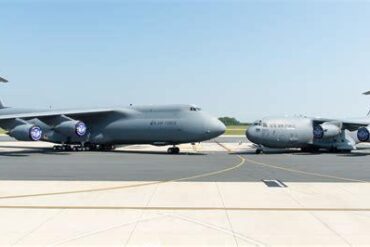
The existing fleet illustrates why these requirements matter. A C-17 has a maximum payload of about 170,900 pounds, while the enormous C-5M can carry approximately 281,000 pounds. Yet the NGAL requirement is not simply asking industry to create a larger C-5.
Instead, the emphasis appears to be on producing a highly capable strategic airlifter that can move substantial loads while operating efficiently in a contested environment.

The Air Force is also asking manufacturers about cargo volume, pallet positions, compatibility with 463L pallets, outsized cargo capability, fuel efficiency, austere runway operations and projected performance. Those requirements point toward an aircraft that must fit into today’s mobility system rather than forcing the entire system to be rebuilt around it.
The C-17 Could Serve Until 2075
Perhaps the most remarkable part of the plan is not when NGAL could arrive, but how long the C-17 could remain afterward.
The USAF currently operates 222 C-17As alongside 52 C-5Ms. Under current planning, the C-5M fleet would be replaced first, followed by the C-17. The C-17 fleet is not expected to be completely phased out until 2075.
That means some Globemaster IIIs could remain in American service for roughly seven decades after the type first entered USAF operations. The aircraft entered service in the 1990s, meaning the youngest examples could potentially approach an extraordinary service life.
This does not necessarily mean every C-17 will physically fly until 2075. Fleet retirement programs rarely work that way. Aircraft are likely to leave service progressively as new NGALs arrive, while individual airframes could be retired earlier because of structural fatigue, component availability, maintenance costs or other considerations.
Still, the overall timeline demonstrates the enormous scale of the transition.
The Air Force cannot simply wait for NGAL and then retire the C-17 overnight. Strategic airlift is a foundational capability. If too many C-17s disappear before enough replacement aircraft become available, the result could be a dangerous gap in America’s ability to move forces and equipment around the world.
$564.3 Million to Keep the Globemaster Relevant
That is why the C-17 itself remains a major investment area. For Fiscal 2027, the Air Force is requesting approximately $564.3 million for a comprehensive C-17 modernization effort.
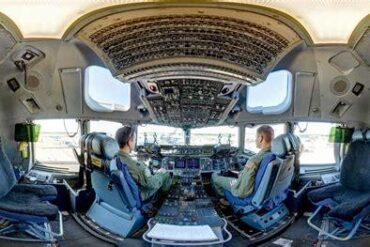
The program is intended to improve operational capability, address component obsolescence and enhance safety and reliability. Among the areas receiving attention are the aircraft’s flight deck and advanced connectivity systems.
The objective is not simply to keep old aircraft flying. Modernization can allow an aging platform to remain useful in an increasingly networked battlespace.
A C-17 operating decades into the future will need access to information that its original designers could not have anticipated. Secure communications, improved situational awareness and integration with broader military networks could become just as important as engines and airframes.
This creates an interesting dynamic. The USAF is simultaneously preparing the C-17 to survive longer and developing NGAL to eventually replace it. In effect, the service is buying time.
Why Restarting C-17 Production Is Still Being Discussed
There is another possibility that has attracted attention: restarting C-17 production.
Boeing shut down the C-17 production line in 2015, ending an era of manufacturing an aircraft that had become one of the world’s most important military transports. However, Boeing retained the facility and much of the tooling associated with the program.
In 2026, Boeing said it had been encouraged by discussions concerning a possible production restart. Congress has also requested an investigation into whether restarting the line would be technically and industrially feasible.
That investigation is important because reopening a production line after more than a decade is considerably more complicated than switching the machinery back on. The Air Force and Congress would need to examine the condition of tooling, the supplier network, skilled workforce availability and the cost of rebuilding an industrial base that has moved on to other programs.
A modernized C-17 could potentially provide additional capacity while NGAL is developed. But the Air Force previously indicated that it did not intend to restart C-17 production as an interim solution. The renewed discussion therefore reflects how strategic circumstances can change faster than acquisition programs.

Boeing May Have an Advantage in the NGAL Competition
When NGAL eventually moves from concepts to a formal acquisition program, Boeing would appear to have an obvious advantage. The company designed and built the C-17 and therefore possesses extensive experience with large military airlifters, military cargo systems and global sustainment.
Lockheed Martin is another logical contender because it produced the C-5M Super Galaxy and has decades of experience with strategic military aircraft.
However, the future could be less predictable than simply selecting another conventional transport design.
JetZero has emerged as an especially interesting possibility because of its work on a full-scale blended-wing-body demonstrator for the Air Force. A blended-wing-body aircraft could offer substantial aerodynamic and fuel-efficiency advantages compared with traditional tube-and-wing transports.
Northrop Grumman is also involved in the broader blended-wing-body effort with JetZero and could potentially play an important role as a systems or technology partner. Meanwhile, Airbus and Embraer possess extensive transport-aircraft expertise, although neither appears likely to become the prime US contractor under the current structure.
Engine suppliers could ultimately include GE Aerospace or Pratt & Whitney, depending on the final design and propulsion requirements.
Survivability Could Matter More Than Raw Payload
The most important lesson from the early NGAL requirements may be that the Air Force is not simply searching for a bigger cargo aircraft.
Traditional airlift metrics such as payload and range remain essential, but NGAL is being shaped around survivability, connectivity and operational speed.
The aircraft may need onboard sensors capable of detecting threats and sharing information with external networks. Secure long-range communications could allow aircrews to understand the wider battlespace rather than operating with limited information. Defensive systems may be required to protect the aircraft from increasingly sophisticated weapons.
Even ground operations are becoming part of the survivability equation.
Air Mobility Command leadership has emphasized the value of reducing the amount of time an aircraft spends exposed on the ground. Faster refueling, faster cargo handling and faster departure could become critical capabilities when enemy surveillance and long-range strike systems can rapidly turn an airfield into a target.
The implication is profound: cargo handling speed could become a combat capability.
The C-17’s Longevity Is Both an Asset and a Warning
The plan to keep the C-17 in service toward 2075 demonstrates just how successful the aircraft has been, but it also exposes a difficult problem facing the USAF.
The C-17 is still extremely useful, yet the threats around it are changing faster than the basic concept of strategic airlift. The aircraft can be upgraded, but there are limits to how much new technology can be integrated into an airframe designed decades earlier.
NGAL therefore has to bridge two different worlds. It must retain the enormous logistical utility of the C-17 and C-5M while incorporating technologies designed for future conflicts that are difficult to predict.
The first NGAL could potentially arrive around 2038, with Initial Operational Capability around 2041. But reaching IOC is only the beginning. Building enough aircraft to replace hundreds of existing airlifters will take decades.
That is why the C-17 remains central to the plan.
Rather than replacing the Globemaster III in one dramatic transition, the Air Force appears to be preparing for a long overlap between generations. NGAL will gradually assume more missions while upgraded C-17s continue providing the capacity that American global logistics cannot afford to lose.

A 2075 Retirement Date Shows How Long Airlift Programs Take
The projected 2075 C-17 retirement horizon may sound astonishing, but it reveals a basic truth about strategic military aviation: replacing a major airlift fleet is a multidecade undertaking.
The Air Force must maintain enough aircraft today, develop technologies for tomorrow, establish an industrial base for the future and simultaneously anticipate threats that may not fully emerge for another 20 or 30 years.
NGAL exists only in its earliest conceptual form, yet the USAF is already asking industry to think about aircraft capable of carrying enormous loads, operating efficiently over long distances, connecting to advanced sensor networks and surviving in environments filled with increasingly capable weapons.
Until that aircraft becomes reality, the C-17 Globemaster III remains indispensable. Its eventual replacement may be taking shape on paper, but the Globemaster will continue doing the very practical work of moving America’s people, equipment and supplies around the world.
And if the current plan holds, it could keep doing that for another half-century—making the C-17 one of the rare military aircraft whose operational legacy may extend deep into the 2070s.