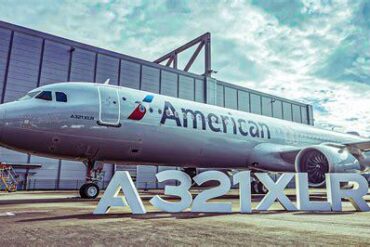
The Airbus A321XLR is rapidly changing what travelers can expect from a single-aisle aircraft. Designed to deliver up to around 4,700 nautical miles of range and roughly 11 hours of flying time, the long-range A321 variant is moving into territory once dominated by widebody aircraft. Across the Atlantic, that transformation is becoming especially visible, with several scheduled services approaching or exceeding 10 hours of block time.
Looking at active and confirmed A321XLR operations between now and mid-summer 2027 reveals 11 nonstop routes to or from the United States measuring at least 3,700 miles. Four airlines account for these services: American Airlines, United Airlines, Iberia, and Aer Lingus. Together, they show how the aircraft can support very different network strategies, from serving major European capitals to opening smaller leisure and business markets that might not justify a larger aircraft.
The most remarkable mission is American Airlines’ planned Philadelphia–Vienna service. At 4,321 miles (6,955 km), it is scheduled to become the longest A321XLR route in the world. Its maximum westbound block time of 10 hours and 15 minutes puts the aircraft firmly into long-haul territory. The route is therefore more than another addition to a transatlantic schedule: it is a major demonstration of how far airlines are willing to push the XLR in regular passenger service.

The 11 Longest Airbus A321XLR Routes to the US
Iberia previously held the distinction of operating the longest nonstop A321XLR route involving the United States. Its Madrid–San Juan service covers 3,964 miles (6,379 km) and can require more than nine hours westbound. The route remains active year-round and demonstrates the aircraft’s ability to operate lengthy sectors from Madrid to the Caribbean without requiring a widebody.
American’s new transatlantic announcements have now pushed Iberia’s route down the ranking. The carrier has four of the 11 longest services, while United also accounts for four. Iberia operates two, and Aer Lingus contributes one. The resulting network stretches from Vienna and Amsterdam to Ibiza, Marseille, Nashville and San Juan, illustrating the unusually broad range of markets the A321XLR can serve.
| Rank | Airline | Route | Start/Status | Distance | Maximum Block Time | Operation |
|---|---|---|---|---|---|---|
| 1 | American Airlines | Philadelphia–Vienna | May 6, 2027 | 4,321 mi | 10h 15m | Seasonal |
| 2 | American Airlines | New York-JFK–Nice | May 6, 2027 | 3,981 mi | 9h 50m | Seasonal |
| 3 | Iberia | Madrid–San Juan | Active | 3,964 mi | 9h 10m | Year-round |
| 4 | United Airlines | Washington Dulles–Toulouse | Apr. 26, 2027 | 3,947 mi | 9h 10m | Year-round |
| 5 | United Airlines | Newark–Marseille | June 4, 2027 | 3,915 mi | 9h 15m | Seasonal |
| 6 | Aer Lingus | Dublin–Nashville | Active | 3,896 mi | 9h 20m | Seasonal |
| 7 | United Airlines | Newark–Ibiza | May 31, 2027 | 3,882 mi | 9h 15m | Seasonal |
| 8 | United Airlines | Washington Dulles–Amsterdam | Dec. 1, 2026 | 3,878 mi | 9h 15m | Year-round |
| 9 | American Airlines | New York-JFK–Barcelona | Oct. 25, 2026 | 3,842 mi | 9h 40m | Year-round |
| 10 | Iberia | Madrid–Washington Dulles | Active | 3,828 mi | 9h 40m | Year-round |
| 11 | American Airlines | Philadelphia–Amsterdam | Feb. 25, 2027 | 3,747 mi | 9h 20m | Year-round |
Distance alone, however, does not tell the whole story. New York-JFK–Barcelona and Madrid–Washington Dulles rank ninth and tenth by mileage, yet both can have maximum westbound blocks of 9 hours and 40 minutes. Wind, routing, season and other operational factors can make the actual scheduled time considerably different from what the distance suggests.

American Airlines Pushes the A321XLR Beyond 10 Hours
American’s Philadelphia–Vienna route is the clearest example of the XLR’s expanding role. Scheduled to begin on May 6, 2027, the daily service will cover 4,321 miles and carry a maximum westbound block time of 10 hours and 15 minutes. American plans to operate the route with a 155-seat A321XLR, including 20 Flagship Suites and 12 Premium Economy seats.
The route is planned as a seasonal service but with an unusually long seasonal window. Instead of ending around the conventional conclusion of the European summer schedule, American intends to continue the service through Vienna’s famous Christmas-market period and into early January 2028. That timing creates an interesting test for the aircraft because winter westbound flights across the Atlantic can face stronger headwinds and therefore greater range pressure.
American’s confidence does not appear to be based simply on Airbus’ published specifications. Network chief Brian Znotins has explained that the airline has been drawing on operational experience from Iberia, which became the first airline to introduce the A321XLR into service. That experience has helped American develop a more realistic understanding of the aircraft’s actual range and performance.
The importance of that information becomes clear when considering a route like Philadelphia–Vienna. A brochure figure provides a theoretical maximum, but an airline needs considerably more certainty before committing a scheduled passenger service to a nearly 4,400-mile sector. Payload, weather, winds and operational reserves all matter. American’s decision suggests it believes the aircraft can perform the mission reliably rather than merely completing it under favorable conditions.
The route also demonstrates why the XLR can make markets viable that might be difficult to support with a larger aircraft. American does not need to fill a widebody with several hundred passengers every day to make Vienna work. Instead, the 155-seat configuration provides a smaller capacity level while still offering premium products capable of generating valuable revenue.
United Airlines Uses the XLR to Find New European Markets
United Airlines is taking a somewhat different approach. Its A321XLR strategy emphasizes destinations where the airline can create a distinctive nonstop offering rather than simply adding capacity to the largest established European markets.
United’s first international XLR services are scheduled to begin from Washington Dulles to Amsterdam and Dublin on December 1, 2026. The airline then plans to introduce five new European routes during 2027: Newark–Luxembourg, Washington Dulles–Toulouse, Newark–Ibiza, Newark–Valencia, and Newark–Marseille.
Several of these destinations are particularly revealing. Luxembourg, Toulouse, Ibiza and Marseille are not simply substitutes for London or Paris. United is using the A321XLR’s smaller capacity and long range to reach markets where a nonstop flight can potentially stimulate new demand rather than fight for an existing pool of passengers.

United’s A321XLRs are configured with only 150 seats, including 20 Polaris suites and 12 Premium Plus seats. That leaves 32 premium seats while keeping total capacity substantially below many conventional widebody configurations. For niche long-haul markets, that combination can be extremely attractive.
United network planning chief Patrick Quayle has described the strategy as bringing “undiscovered gems” to customers. The idea is straightforward: travelers who have already visited the biggest European capitals may be more interested in distinctive destinations, while the airline can differentiate itself by being the only US carrier offering a nonstop connection.
Why 10-Hour Narrowbody Flights Matter
The significance of these routes extends beyond their impressive numbers. The A321XLR is changing the economics of long-haul network planning by allowing airlines to operate routes with long-haul range but narrowbody capacity.
That distinction matters because demand is rarely uniform across international markets. Some city pairs have enough passengers to support a daily widebody, while others may have strong premium demand but not enough total traffic to fill a larger aircraft. The XLR creates a middle ground between traditional narrowbody aircraft and widebodies.
Aer Lingus’ Dublin–Nashville service is an early example of this philosophy, connecting a thinner US market with Europe on an aircraft capable of handling the distance. Iberia’s Madrid routes show another application, while American and United are expanding the concept into an increasingly diverse collection of European destinations.
The aircraft also gives airlines greater flexibility when launching new routes. If demand grows, the carrier can potentially increase frequency or eventually introduce a larger aircraft. If demand remains limited, the smaller A321XLR can reduce the financial exposure associated with deploying a widebody.
The A321XLR Is Expanding the Transatlantic Map
The most important result may therefore be the changing shape of the transatlantic route map. Rather than simply replacing widebodies on existing routes, the A321XLR is enabling airlines to experiment with city pairs that previously sat outside the practical range or economic profile of many single-aisle aircraft.
The 11 longest A321XLR routes to and from the United States already include major hubs, secondary European cities, leisure destinations and markets with distinctive seasonal demand. Several exceed nine hours of scheduled flying, while American’s Philadelphia–Vienna service will cross the symbolic 10-hour threshold.
As airlines accumulate more operational experience, the aircraft’s role is likely to become clearer. The early evidence suggests that its greatest value is not simply flying farther. It is giving airlines a new combination of range, capacity and flexibility.
For passengers, that could mean more nonstop choices and fewer journeys through traditional mega-hubs. For airlines, it means the ability to test long-distance markets without committing the capacity of a large widebody. And for the global route network, it means destinations that once seemed too small, too seasonal or too distant for a single-aisle aircraft can increasingly become realistic nonstop possibilities.