Modern air warfare is quietly undergoing a transformation. The old image of a single aircraft flying alone into hostile skies is giving way to something more intricate: networked systems, layered drones, and distributed combat power. In this evolving landscape, Türkiye’s aerospace sector is carving out a distinct path, blending endurance platforms with fast, expendable unmanned systems designed to overwhelm, confuse, and ultimately defeat sophisticated air defenses.
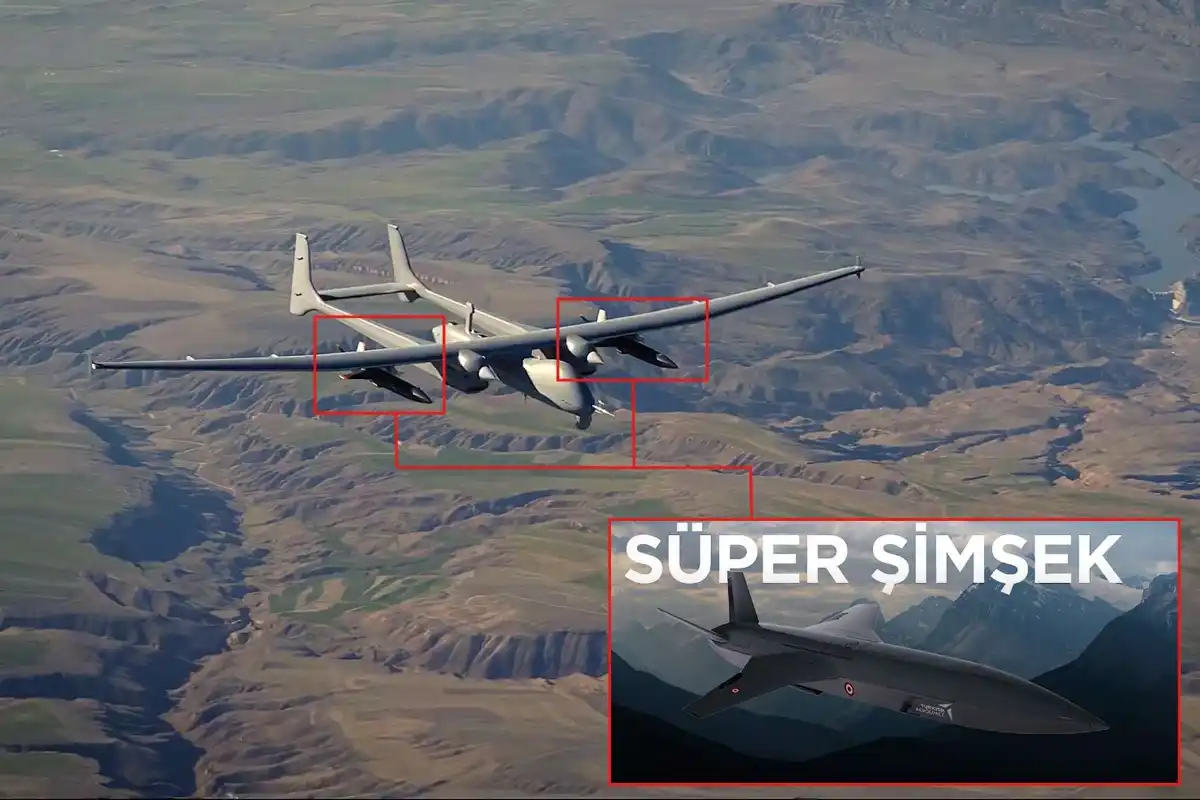
A striking demonstration of that strategy arrived on March 10, 2026, when Turkish Aerospace Industries (TAI) released footage showing its AKSUNGUR unmanned combat aerial vehicle (UCAV) flying with two jet-powered SÜPER ŞİMŞEK multi-role UAVs mounted beneath its wings. The visual alone told a powerful story: a large, long-endurance drone acting as a carrier for smaller, high-speed unmanned effectors.
Rather than simply carrying bombs or missiles, AKSUNGUR was shown carrying autonomous aerial assets capable of performing their own missions. That subtle difference signals a shift toward modular drone warfare, where large UAVs function as launch platforms for swarms of specialized systems designed for decoy operations, electronic warfare, and precision strikes.
The demonstration suggests that Türkiye is moving decisively toward a multi-layered unmanned combat architecture, where endurance, speed, autonomy, and expendability are combined into a single integrated ecosystem.
#AKSUNGUR ✈️ 🇹🇷 pic.twitter.com/XbHBVbjkCS
— Türk Havacılık Uzay Sanayii (@TUSAS_TR) March 10, 2026
AKSUNGUR: Türkiye’s High-Endurance Combat Drone Platform
At the heart of the concept sits AKSUNGUR, one of the most capable unmanned aircraft produced by the Turkish defense industry. Developed by Turkish Aerospace Industries, the aircraft represents an evolution of the ANKA drone family, but with significant structural and operational upgrades aimed at expanding its payload capacity and mission endurance.
The platform falls into the MALE category — Medium-Altitude Long-Endurance. Aircraft in this class are designed to stay airborne for extremely long durations while operating at altitudes high enough to provide broad surveillance coverage and operational flexibility. In practical terms, that means AKSUNGUR can function as a persistent presence above the battlefield.
AKSUNGUR’s physical characteristics reflect this design philosophy. The aircraft features a 24-meter wingspan and a length of 12.5 meters, giving it the aerodynamic efficiency required for extended missions. With a maximum takeoff weight of roughly 3,300 kilograms, the drone can carry more than 750 kilograms of payload, a significant figure for an unmanned system in this category.
Power comes from two TEI-PD170 dual turbo-diesel engines, each driving a three-bladed propeller. These engines are designed for reliability and fuel efficiency, enabling endurance levels that approach 50 hours in ferry configuration. The aircraft can operate at altitudes reaching 40,000 feet, placing it well above many conventional battlefield threats.
But endurance alone is not the real advantage. What makes AKSUNGUR particularly interesting is its ability to combine sensor systems, communications relays, and weapon payloads within the same platform. The drone can carry electro-optical and infrared sensors, synthetic aperture radar (SAR) capable of generating detailed ground imagery, and GMTI radar used for tracking moving targets.
Signals intelligence capabilities further expand the aircraft’s operational role. With COMINT and ELINT payloads, AKSUNGUR can monitor enemy communications and radar emissions, turning the aircraft into a flying intelligence node that feeds data back to command networks.
A Platform Designed for Networked Warfare
Modern combat aircraft increasingly operate as nodes in a network rather than standalone weapons platforms, and AKSUNGUR was built with that concept in mind. The drone integrates line-of-sight digital data links exceeding 250 kilometers, allowing operators to control missions from significant distances. Satellite communications extend that range dramatically, enabling operations beyond 5,000 kilometers from the ground control station.
In practical terms, this connectivity allows AKSUNGUR to act as both a sensor and a command relay. It can transmit intelligence to ground forces, naval units, or other aircraft while simultaneously deploying its own payloads.
Equally important is the drone’s redundant avionics architecture, designed to ensure operational resilience. The aircraft features autonomous takeoff and landing capability, automatic return-home functions, and integrated de-icing systems that allow safe flight in challenging weather conditions.
These design elements make AKSUNGUR more than a surveillance drone. It becomes a persistent combat platform capable of operating deep within complex airspace environments, which is precisely why it can now serve as a launch carrier for smaller UAVs like SÜPER ŞİMŞEK.
The Rise of the SÜPER ŞİMŞEK Multi-Role UAV
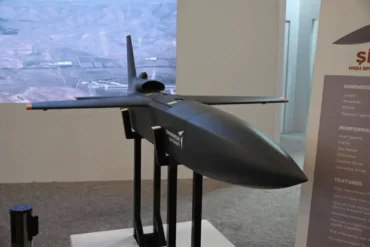
Mounted beneath AKSUNGUR’s wings in the recent test was the SÜPER ŞİMŞEK, a compact yet highly capable unmanned aerial system that represents a major evolution from earlier Turkish target drones.
The original ŞİMŞEK drone was developed as a high-speed aerial target used during air defense training exercises. Its role was to simulate hostile aircraft so that missile crews and radar operators could practice detection and engagement procedures.
The SÜPER ŞİMŞEK variant, however, has been transformed into something far more versatile.
Measuring approximately four meters in length with a wingspan of 1.75 meters, the drone remains compact enough to be launched from aircraft or ground systems. Despite its relatively small size, it carries a maximum takeoff weight of around 200 kilograms and can accommodate payloads up to 50 kilograms.
A turbojet engine provides propulsion, giving the drone speeds approaching Mach 0.85. This is exceptionally fast for a small tactical UAV and enables it to mimic the radar and flight profiles of manned combat aircraft.
The drone can operate at altitudes up to 35,000 feet and remain airborne for approximately 80 minutes. When launched from a carrier platform like AKSUNGUR, the aircraft gains an operational radius approaching 900 kilometers, dramatically expanding its strike and reconnaissance potential.
From Target Drone to Tactical Weapon
The real innovation behind SÜPER ŞİMŞEK lies in its modular mission architecture. Instead of being limited to a single purpose, the UAV can be configured with a range of interchangeable payloads.
These payload options transform the drone into a multi-role battlefield tool, capable of performing several mission types:
- Decoy operations simulating radar signatures of larger aircraft
- Electronic warfare missions including jamming and signal interference
- Direct strike attacks using a high-explosive warhead
- Reconnaissance and sensor missions for tactical intelligence
A strike configuration can carry a high-explosive payload estimated around 35 kilograms, enabling the drone to function as a one-way attack system against critical targets such as radar installations, command centers, or missile launch sites.
Equipped with radar and infrared signature enhancers, the UAV can also mimic the appearance of high-value aircraft on enemy sensors. When multiple decoy drones appear simultaneously, air defense systems may be forced to launch interceptors or activate radar systems, revealing their positions.
That moment of exposure can then be exploited by other strike assets.
Air-Launched Drone Warfare: A Tactical Shift
Combining AKSUNGUR with SÜPER ŞİMŞEK introduces a concept that defense analysts increasingly describe as “stand-in drone warfare.” Instead of risking expensive aircraft or limited cruise missiles, commanders deploy low-cost expendable drones to penetrate contested airspace.
The carrier drone remains outside the most dangerous threat zones, while smaller UAVs fly into heavily defended regions.
Imagine the operational choreography: AKSUNGUR loiters quietly at altitude, observing the battlespace. At a chosen moment, it releases several SÜPER ŞİMŞEK drones. Some of them fly directly toward enemy radar coverage, broadcasting enhanced signatures that resemble fighter jets. Others emit electronic interference, disrupting tracking systems.
Meanwhile, a separate group of drones may carry strike payloads programmed to home in on radar emissions or pre-planned targets.
This layered approach creates a tactical dilemma for defenders. Engaging the decoys wastes missiles. Ignoring them risks allowing strike drones to reach their targets.
Such asymmetric cost dynamics are exactly what modern drone warfare is designed to exploit.
Swarm Intelligence and Coordinated UAV Operations
Another critical feature of the SÜPER ŞİMŞEK system is its integration with AI-assisted swarm technology. In swarm operations, multiple drones share information and coordinate their movements automatically.
This does not mean science-fiction autonomy where machines make every decision. Instead, it refers to distributed decision-making algorithms that allow UAVs to adjust their routes, timing, and behaviors based on shared data.
For example, one drone might detect a radar signal and transmit the information to others in the formation. The group can then dynamically adjust their approach vectors or mission profiles.
In practical combat scenarios, swarm coordination can enable simultaneous attacks from multiple directions, increasing the difficulty of interception.
The result resembles a three-dimensional chess match in the sky, where dozens of small aerial pieces move according to shared tactical logic.
Integration Across Türkiye’s Unmanned Combat Ecosystem
AKSUNGUR is not the only platform capable of launching SÜPER ŞİMŞEK drones. Turkish Aerospace Industries has already demonstrated air-launch capability from the stealthy ANKA-III unmanned combat aircraft.
This interoperability suggests that Türkiye is developing a family of launch platforms, each capable of deploying the same tactical drone system. The strategy reduces logistical complexity while increasing operational flexibility.
The architecture also aligns with Türkiye’s broader manned-unmanned teaming doctrine, particularly concepts tied to the future KAAN fifth-generation fighter program.
In this vision, the KAAN fighter acts as a command node, directing a network of unmanned aircraft that includes surveillance drones, strike UAVs, and high-speed expendable systems like SÜPER ŞİMŞEK.
AKSUNGUR would function as a persistent forward carrier, extending the operational reach of the entire network.
Strategic Implications for Modern Air Warfare
The AKSUNGUR–SÜPER ŞİMŞEK pairing highlights a deeper transformation underway across global military aviation.
Traditional airpower concentrated capability in a small number of expensive platforms. Losing even one aircraft represented a major operational setback.
The emerging model spreads combat capability across large numbers of smaller systems, each individually expendable but collectively powerful.
Türkiye’s drone ecosystem demonstrates how this approach can evolve into a layered combat architecture:
- Endurance UAVs provide surveillance and command functions
- High-speed tactical drones conduct electronic warfare or strike missions
- Swarms of expendable assets overwhelm enemy defenses
Such systems complicate enemy targeting and reduce reliance on singular high-value assets.
For countries seeking cost-effective airpower solutions, integrated drone ecosystems like this offer an appealing alternative to expensive fleets of manned aircraft.
A Visible Milestone in Türkiye’s Drone Strategy
The March 2026 flight demonstration may appear simple at first glance — one large drone carrying two smaller ones. Yet the implications run deeper.
It represents the maturation of Türkiye’s indigenous UAV industry, which has rapidly expanded from basic reconnaissance drones into complex networked combat systems.
AKSUNGUR provides endurance and payload capacity. SÜPER ŞİMŞEK delivers speed, modularity, and expendability. Together they form a layered operational toolkit capable of deception, disruption, and precision attack.
In modern warfare, victory often belongs to the side that forces its opponent into impossible decisions. A sky filled with decoys, electronic interference, and autonomous strike drones does exactly that.
The sight of an AKSUNGUR UCAV climbing into the air with two SÜPER ŞİMŞEK UAVs beneath its wings captures a defining moment in that transformation — a glimpse of how future air combat may increasingly rely on networks of intelligent machines rather than individual aircraft.