The battlefield is changing faster than procurement cycles. Cheap quadcopters assembled from commercial parts, long-range one-way attack drones, and low-flying subsonic cruise missiles are reshaping how modern militaries think about air defense. Against this backdrop, Northrop Grumman has introduced a new proposal aimed squarely at the U.S. Army’s most urgent vulnerability: the ability to defeat mass drone attacks without exhausting high-cost missile inventories. The concept is called Cannon-Based Air Defense (CBAD), and it represents a decisive shift toward guided, medium-caliber gun systems integrated into layered defensive networks.
Unlike traditional gun-based air defense systems of the past, CBAD is not a standalone turret bolted onto a vehicle. It is designed as a networked terminal defense architecture, combining automatic cannons, precision-guided ammunition, layered radar sensors, electro-optical tracking systems, and digital battle management software. The objective is not simply to shoot down drones. It is to create a scalable, economically sustainable shield capable of enduring prolonged saturation attacks.
The urgency behind this concept is grounded in hard lessons from contemporary conflicts. Drone swarms and loitering munitions have demonstrated their ability to overwhelm sophisticated missile-based defenses. When dozens or even hundreds of low-cost aerial threats approach simultaneously, each missile interceptor fired represents a significant financial and logistical decision. CBAD seeks to rebalance that equation by lowering the cost per engagement while maintaining credible lethality in the terminal engagement zone—the last protective ring around troops, logistics hubs, and air bases.
The Architecture Behind Cannon-Based Air Defense
At the core of CBAD is the integration of medium-caliber automatic cannons, such as members of the proven Bushmaster chain gun family, with guided ammunition capable of in-flight maneuver. In U.S. Army service, the XM813 30mm Bushmaster, mounted on Stryker M-SHORAD vehicles, provides a rate of fire of approximately 200 rounds per minute and an effective engagement envelope typically between 2 and 3 kilometers, depending on ammunition type. Larger 35mm systems, widely fielded in European air defense configurations, extend effective ranges beyond 4 kilometers and deliver heavier fragmentation payloads.
The transformative element in CBAD is not the gun itself. It is the guided projectile. Conventional programmable airburst munitions detonate at a calculated point in space, releasing fragments along a predicted intercept path. Guided cannon rounds, by contrast, incorporate control mechanisms allowing them to correct trajectory mid-flight. In practical terms, this means a cannon shell begins to behave more like a short-range interceptor, narrowing the historical performance gap between guns and missiles.
This distinction is profound. Traditional cannons rely on volume of fire and predictive targeting. Guided ammunition introduces maneuverability, increasing single-shot probability of kill and potentially extending effective engagement distances. Fired in small salvos rather than dense streams, these rounds could intercept agile unmanned aircraft systems that change course unpredictably.
Economic Sustainability in Saturation Warfare
Modern drone warfare has exposed a stark imbalance in cost exchange ratios. A shoulder-fired missile such as the FIM-92 Stinger can engage targets at ranges of roughly 4 to 8 kilometers, but each interceptor carries substantial cost. In a scenario involving swarms of expendable drones costing a fraction of that amount, missile inventories can deplete rapidly. Replenishment during high-intensity conflict becomes both logistically demanding and financially unsustainable.
Cannon systems fundamentally alter this dynamic. A vehicle-mounted 30mm or 35mm cannon can carry a significantly deeper magazine than missile launchers. The cost per round, even with guidance technology incorporated, remains lower than most missile interceptors. For the Army, this translates into engagement endurance—the ability to sustain defensive fire over extended periods without exhausting critical stocks.
CBAD’s scalability further enhances its economic logic. The architecture could be adapted to maneuver formations operating near the front lines, as well as to fixed-site defense of air bases or strategic infrastructure. Caliber selection and rate-of-fire configurations would vary according to mission profile, but the underlying philosophy remains consistent: preserve high-end missile systems for high-end threats, and rely on guided cannons to defeat mass-produced aerial attackers.
Lessons from Europe: Skynex as a Benchmark
Northrop Grumman’s proposal enters a landscape where cannon-based air defense is already gaining traction. Germany’s Rheinmetall Skynex system represents one of the most mature examples. Skynex employs the Oerlikon Revolver Gun Mk3 in 35mm caliber, capable of firing up to 1,000 rounds per minute. Its signature AHEAD (Advanced Hit Efficiency And Destruction) ammunition releases a cloud of tungsten sub-projectiles just ahead of the target, dramatically increasing lethality against drones and rockets within an effective range of approximately 4 kilometers.
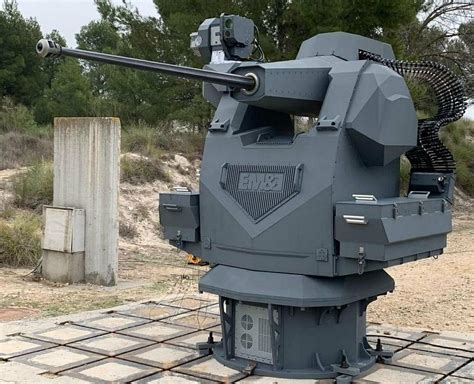
Skynex integrates the X-TAR3D radar, electro-optical sensors, and modular command-and-control nodes, forming a distributed defensive grid rather than a single-point system. It has demonstrated credible effectiveness against small unmanned aircraft, reinforcing the renewed relevance of gun-based air defense in the drone era.
The philosophical divergence between Skynex and CBAD lies primarily in ammunition design. Skynex relies on programmable airburst fragmentation optimized around predicted intercept geometry. CBAD emphasizes maneuver-capable guided rounds designed to adjust course after firing. If successfully fielded, guided munitions could expand engagement envelopes and reduce reliance on sheer projectile density.
Integration with U.S. Army Air and Missile Defense Networks
CBAD is conceived to operate within the broader framework of the Army’s Integrated Air and Missile Defense (IAMD) architecture. This ensures sensor-to-shooter connectivity across layered defenses, linking long-range radar detection systems with short-range intercept platforms. In a practical engagement scenario, a target detected by higher-echelon sensors could be handed off seamlessly to a CBAD-equipped unit positioned for terminal defense.
This digital integration is critical. Modern air defense is no longer a matter of isolated guns scanning the sky independently. It is a coordinated network where radar tracks, identification data, and fire-control solutions flow across nodes in near real time. CBAD’s architecture reflects this reality, positioning the cannon not as an outdated relic but as a fully digitized defensive asset.
Restoring Credible Terminal Defense
The strategic logic behind CBAD is rooted in the recognition that outer missile defense layers can be saturated or bypassed. Low-flying cruise missiles exploiting terrain masking, or swarms of expendable drones approaching from multiple vectors, place enormous stress on traditional interceptor-based systems. Once those outer rings are penetrated, the terminal defense layer becomes decisive.
Cannon-based systems offer immediacy. Engagement timelines are short, reaction speeds are high, and ammunition depth supports sustained firing. When enhanced by guidance technology, the cannon regains relevance not merely as an area weapon, but as a precision short-range interceptor platform.
In high-intensity conflict scenarios, this layered resilience may determine whether forward-deployed brigades maintain operational continuity or suffer debilitating disruption. Air bases, fuel depots, ammunition storage sites, and command posts remain prime targets for adversaries seeking asymmetric leverage through drone saturation.
A Structural Evolution in Ground-Based Air Defense
CBAD represents more than a hardware proposal. It signals a broader doctrinal shift in how the U.S. Army conceptualizes short-range air defense. Missile dominance defined previous decades of modernization. The rise of inexpensive unmanned systems has forced reconsideration of that paradigm.
By investing in guided medium-caliber munitions and digitally integrated cannon platforms, the Army could restore cost-effective defensive depth without sacrificing lethality. The concept aligns with observable global trends: renewed emphasis on layered systems, magazine depth, and economic sustainability in protracted engagements.
Whether fielded under the CBAD designation or incorporated into future modernization programs, the proposal underscores a reality that defense planners can no longer ignore. The sky over the modern battlefield is crowded, contested, and increasingly affordable for adversaries. Defending it demands not only advanced sensors and missiles, but also adaptable, scalable, and economically rational solutions.
Northrop Grumman’s Cannon-Based Air Defense concept positions the humble cannon—evolved, digitized, and guided—as a central player in that future.