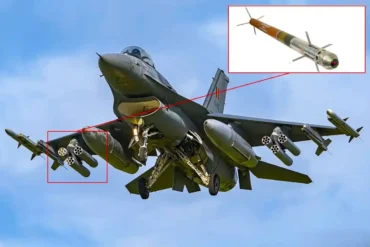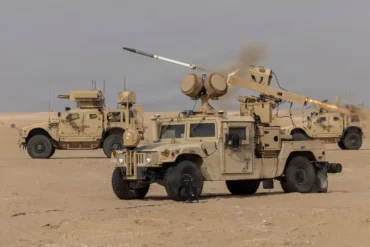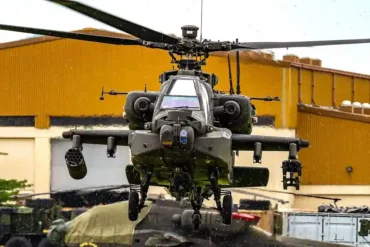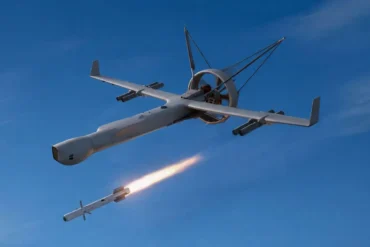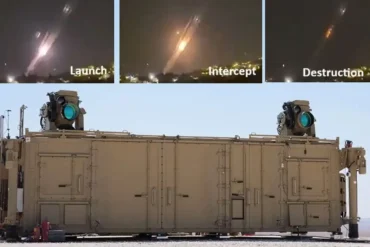
The U.S. Army has taken a decisive step in transforming counter-drone defense from concept to combat-ready capability by conducting live-fire trials of the Electronic Advanced Ground Launcher System (EAGLS) in Kuwait. Newly released imagery confirms the system successfully launched 70 mm Advanced Precision Kill Weapon System (APKWS) laser-guided rockets during Exercise Sky Shield, signaling that EAGLS is no longer an experimental solution but an operational asset aligned with the realities of modern drone warfare.
The live-fire event took place at Udairi Range on December 4, 2025, with imagery published on January 11, 2026, through the Defense Visual Information Distribution Service. The exercise unfolded under the authority of U.S. Central Command, an area where low-cost unmanned aerial systems have repeatedly stressed air defense networks. By validating EAGLS in this environment, the Army demonstrated how rapidly it is moving to field affordable, scalable hard-kill systems capable of countering persistent unmanned threats.
At its core, EAGLS reflects a shift in air defense thinking. Instead of relying exclusively on high-end interceptors designed for aircraft and ballistic missiles, the system addresses the growing imbalance created by inexpensive drones that can be launched in large numbers with minimal warning. The Kuwait live-fire confirmed that EAGLS can reliably engage aerial targets using precision-guided rockets, offering commanders an option that is both tactically effective and economically sustainable.
From Rapid Acquisition to Operational Reality
EAGLS is a mobile, radar-enabled counter-UAS launcher built around a four-round pod firing APKWS laser-guided rockets. The system integrates organic sensors that allow it to detect, track, and engage targets autonomously or as part of a wider air defense network. With an effective engagement range of up to approximately 10 kilometers, EAGLS is optimized for base defense, point protection, and the safeguarding of dispersed sites.
This design philosophy is rooted in urgency. In February 2024, MSI Defense Solutions disclosed that Naval Air Systems Command awarded the company a contract valued at $24 million, with options extending to $34 million, for up to six EAGLS systems plus engineering and maintenance support. The contract explicitly cited “emerging and persistent” unmanned threats in the CENTCOM area, underscoring how operational demand, not long-term planning cycles, drove the program forward.
The result is a system engineered for speed of deployment and adaptability. EAGLS can be mounted on different platforms, repositioned rapidly, and integrated into existing command-and-control structures. This flexibility is essential in theaters where threat vectors shift quickly and infrastructure may be limited or exposed.
Sensors and Radar as the Decisive Enabler
What distinguishes EAGLS from simpler rocket-based counter-drone concepts is its sensor architecture. Open-source reporting indicates that deployed configurations combine a stabilized weapon station with an electro-optical and infrared sensor turret and Leonardo’s RPS-40 Multi-Mission Hemispheric Radar. This radar is a software-defined, four-dimensional AESA pulse-Doppler system specifically designed for counter-UAS and very short-range air defense missions.
Leonardo describes each radar unit as providing 120 degrees of azimuth coverage, with full hemispheric coverage achieved by networking multiple radars. This modular approach allows commanders to scale protection based on mission requirements, from single-sector defense to near-complete site coverage. Equally important is the radar’s electronic counter-countermeasure capability, which enhances survivability in contested electromagnetic environments.
Tactically, EAGLS can operate with radar-led early warning before transitioning to passive EO/IR tracking during engagement. This reduces electromagnetic signature during critical phases while maintaining precise target discrimination. In practical terms, the system can detect small drones at meaningful distances, confirm hostile intent, and prosecute the target with a guided rocket that minimizes collateral damage.
Exercise Sky Shield and Layered Air Defense in Practice
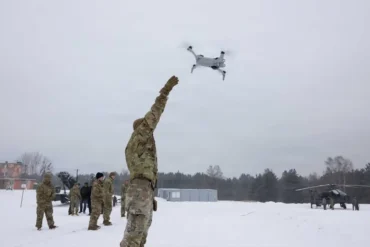
Exercise Sky Shield provided a highly relevant proving ground. Framed by CENTCOM as a Kuwait-led, high-end counter-drone exercise, Sky Shield brought together forces from the United States, Kuwait, Bahrain, and the United Kingdom. The scenario focused on detecting, tracking, and engaging unmanned aerial threats through a layered air defense architecture that included both legacy and emerging systems.
The exercise also featured live Patriot missile launches, observed by senior military and civilian leaders, including Kuwait’s defense minister and CENTCOM Deputy Commander Maj. Gen. Sean M. Salene. His remarks highlighted the exercise as a milestone for Kuwait and a tangible demonstration of collective commitment to regional security. Within this layered construct, EAGLS filled a critical gap that high-end systems like Patriot cannot economically address.
Patriot remains indispensable against aircraft, cruise missiles, and ballistic threats, but it is ill-suited for countering swarms of low-cost drones. EAGLS, armed with APKWS rockets, provides a complementary layer that preserves high-value interceptors for high-value threats while maintaining credible defense against the most common aerial attackers.
APKWS and the Economics of Drone Defense
The strategic importance of EAGLS lies as much in economics as in capability. The Advanced Precision Kill Weapon System converts standard 2.75-inch rockets into semi-active laser-guided munitions, delivering precision at a fraction of the cost of traditional surface-to-air missiles. As production scales and demand increases, APKWS has become central to restoring a favorable cost-exchange ratio in counter-UAS operations.
Congressional analysis and operational reporting have repeatedly emphasized how inexpensive drones strain readiness when intercepted with costly missiles. EAGLS directly addresses this imbalance. Each engagement represents a deliberate choice to match the interceptor to the threat, preserving resources while maintaining defensive depth. Over time, this approach reshapes doctrine, enabling sustained operations in environments saturated with unmanned systems.
Kuwait’s Role and Regional Implications
While the imagery confirms U.S. Army operation of EAGLS during Sky Shield, there is no public indication that the Kuwaiti Armed Forces have procured the system. The launcher photographed is credited as U.S. Army equipment, suggesting the deployment was intended to validate the system in-theater rather than transfer ownership. Nonetheless, Kuwait’s role as host and exercise leader is strategically significant.
Kuwait continues to invest heavily in air defense, including Patriot sustainment and modernization packages approved in 2025. By integrating exercises like Sky Shield into its defense posture, the country positions itself as a regional hub for counter-drone cooperation and learning. EAGLS firing in Kuwait provides partners with a tangible example of how layered defenses can evolve without relying exclusively on the most expensive tools available.
A Template for Future Counter-Drone Operations
The successful live-fire of EAGLS during Exercise Sky Shield marks a turning point. What began as a rapid acquisition response to an urgent problem is now a theater-validated capability with clear doctrinal relevance. By combining radar-backed detection, organic sensors, and low-cost precision rockets, EAGLS embodies a pragmatic response to the drone era.
As unmanned threats continue to proliferate across the Middle East and beyond, systems like EAGLS are likely to become standard components of base and site defense. The Kuwait live-fire demonstrates not only technical maturity but also a broader shift toward sustainable air defense architectures designed for endurance, adaptability, and economic realism.