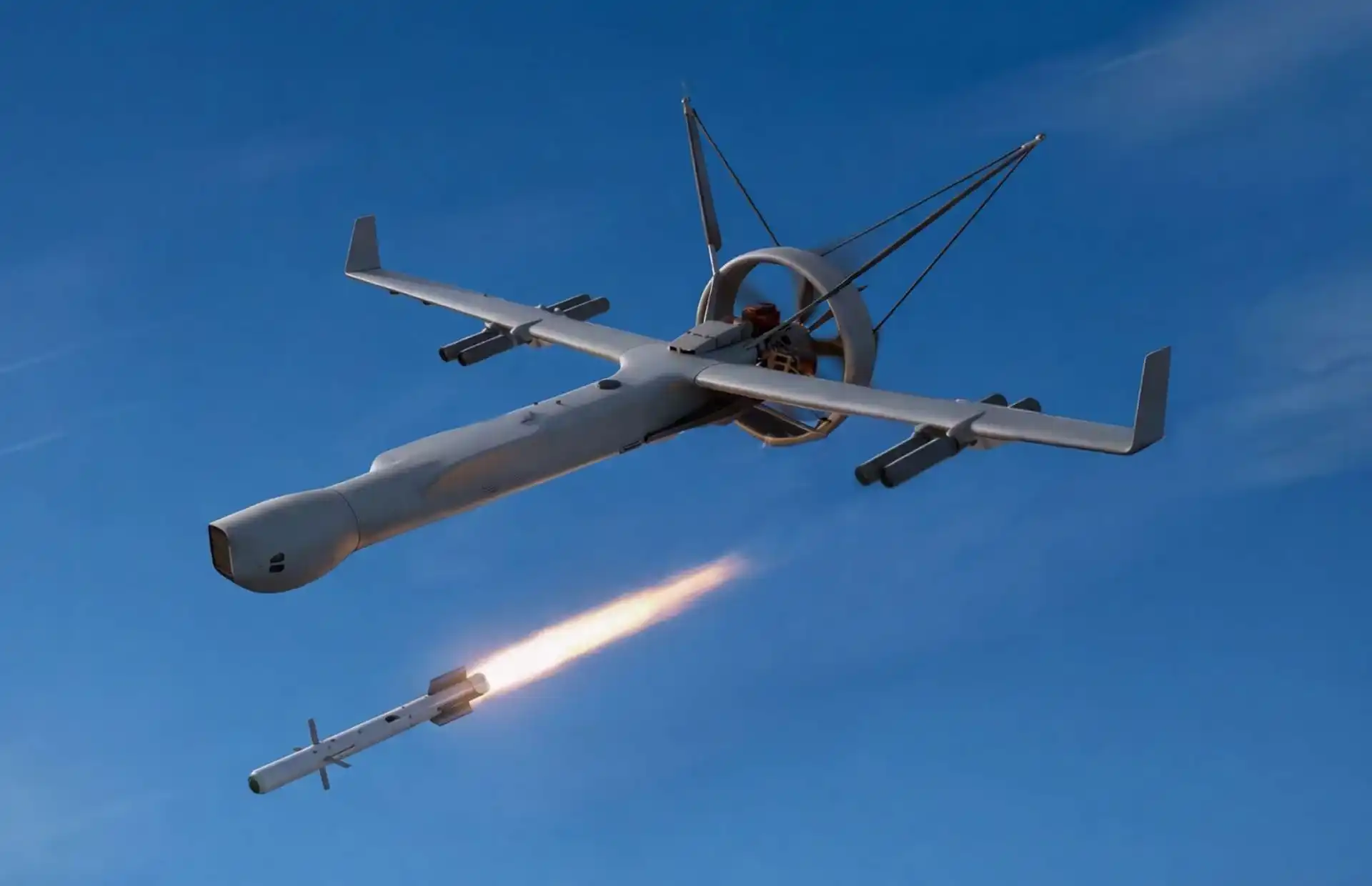
The integration of South Korean precision-guided munitions onto an American vertical-takeoff unmanned aircraft marks a subtle but consequential shift in how modern forces think about armed intelligence, surveillance, and reconnaissance. In January 2026, a new configuration of the V-BAT vertical-takeoff and landing drone, developed by U.S.-based Shield AI, emerged as a compact strike-capable platform following the announcement of live integration and flight testing of a laser-guided missile produced by LIG Nex1 of South Korea. What looks at first glance like a modest weapons upgrade is, in reality, a signal that expeditionary drones are evolving from passive observers into autonomous participants in the kill chain.
The announcement, made during UMEX 2026 in Abu Dhabi, reflects months of quiet engineering work and years of strategic alignment between the two firms. The decision to arm the V-BAT was not driven by novelty or marketing theatrics, but by a clear operational demand seen across recent conflicts: sensors are plentiful, shooters are not always nearby, and the gap between detection and engagement can be fatal to tactical relevance. By marrying a runway-independent ISR drone with a lightweight guided missile, the partnership aims to collapse that gap to minutes rather than hours.
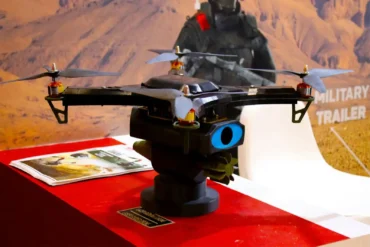
Shield AI’s V-BAT was never designed as a conventional armed drone. Its original value proposition focused on operating where runways, catapults, or recovery nets are unavailable. The aircraft’s ducted-fan design allows true vertical takeoff and landing from confined spaces, including ship decks, urban rooftops, and improvised forward positions. With endurance exceeding thirteen hours and payload capacity approaching forty pounds, the platform already had the physical margins needed to support weaponization. What it lacked, until now, was a purpose-built munition that respected the realities of small-drone integration.
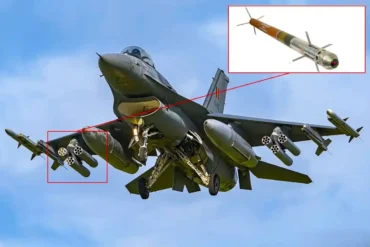
The L-MDM laser-guided missile developed by LIG Nex1 fills that niche with deliberate restraint. Rather than scaling down an existing air-to-ground weapon, the missile was designed specifically for unmanned aircraft, emphasizing low mass, simplified interfaces, and minimal aerodynamic penalties. Laser guidance enables precision against both fixed and moving targets while keeping the launch aircraft at a safe standoff distance. This choice also preserves tactical flexibility, allowing target designation to be handled either by the V-BAT’s own electro-optical payload or by external ground or airborne designators operating as part of a networked force.
The UMEX 2026 contract formalized the integration, flight testing, and systems validation of the missile-drone pairing. While the public announcement framed it as a new capability, it is more accurately understood as the first tangible outcome of a broader roadmap. In May 2025, at the MADEX naval exhibition in Busan, Shield AI and LIG Nex1 signed a memorandum of understanding covering manned-unmanned teaming, autonomous mission systems, and joint market expansion. The armed V-BAT is the opening act in that longer play, translating strategic intent into deployable hardware.
From an operational perspective, the implications are significant. ISR platforms frequently locate time-sensitive targets but must rely on fast jets, attack helicopters, or artillery to prosecute them. In contested environments, that handoff introduces delay, communications risk, and political friction. An armed V-BAT can instead execute a find–track–finish mission autonomously within a single sortie. Its operator workload remains focused on supervision rather than manual targeting, supported by Shield AI’s autonomy stack, which is designed to function even in degraded GPS and communications conditions.
This resilience is not theoretical. Shield AI has confirmed that the V-BAT has already flown operational missions in Ukraine alongside the country’s Unmanned Systems Forces, completing more than 130 sorties in an environment saturated with electronic warfare. While those missions were unarmed, they validated the drone’s ability to navigate GNSS-denied airspace, maintain mission continuity, and deliver actionable intelligence. Adding a guided missile does not suddenly make the platform invulnerable, but it does allow commanders to exploit fleeting opportunities without waiting for external strike assets.
The maritime domain is where this configuration may prove most disruptive. V-BAT has been selected by the U.S. Coast Guard for its Maritime Unmanned Aircraft System Services program and has operated from nearly every class of U.S. Navy ship, including amphibious vessels and destroyers. All seven Marine Expeditionary Units have deployed with the drone, using it for over-the-horizon surveillance and targeting support. For these users, an armed V-BAT introduces a lightweight precision-strike option that does not compete with manned aviation for deck space or logistics bandwidth.
International interest amplifies the impact. The Royal Netherlands Navy and Marine Corps have ordered eight V-BAT systems, while Japan’s Maritime Self-Defense Force selected the drone as its first dedicated maritime ISR platform. In January 2026, India confirmed an emergency procurement of V-BAT systems along with Shield AI’s Hivemind autonomy licenses for the Indian Army. Each of these operators faces dispersed threats and constrained basing options. For them, the ability to add a guided munition without changing training pipelines or support infrastructure is more than convenient; it is strategically efficient.
On the missile side, LIG Nex1’s growing export footprint strengthens the pairing’s appeal. South Korean guided weapons have earned credibility through operational deployment and international sales, including the Cheongung II air defense system adopted by several Middle Eastern customers. By offering a drone-launched missile that integrates cleanly with a widely adopted Western unmanned platform, LIG Nex1 avoids locking customers into a closed national ecosystem. Instead, it enables a modular approach where procurement of one component naturally complements the other.
The sensor-to-shooter compression achieved by this integration also aligns with broader doctrinal trends. Modern forces increasingly favor distributed operations, where small units rely on organic ISR and precision effects rather than centralized fire support. An armed V-BAT fits neatly into that model, providing persistent overwatch, rapid engagement, and minimal logistical burden. Its vertical takeoff capability allows it to operate from patrol vessels, austere forward bases, or urban environments where conventional drones would be impractical.
Critically, this development does not herald the arrival of a heavily armed drone replacing larger strike platforms. Its value lies in proportionality. The L-MDM offers controlled, precise effects suitable for limited engagements, reconnaissance-in-force, and maritime security missions. That restraint reduces escalation risk while preserving tactical initiative. In an era where overmatch often comes from speed and information rather than raw firepower, such balance matters.
As integration testing continues, attention will focus on weapons release envelopes, datalink robustness, and the choreography between sensors, autonomy, and human oversight. These details will determine how seamlessly the armed V-BAT transitions from demonstration to deployment. Yet the direction of travel is already clear. The collaboration between Shield AI and LIG Nex1 reflects a broader shift toward runway-independent, networked, and selectively armed unmanned systems that mirror how forces actually fight.
The V-BAT armed with South Korean guided missiles is not a dramatic reinvention of airpower. It is something more subtle and arguably more important: a practical answer to the messy realities of modern conflict, where access is limited, targets are fleeting, and the difference between observing and acting can define success.