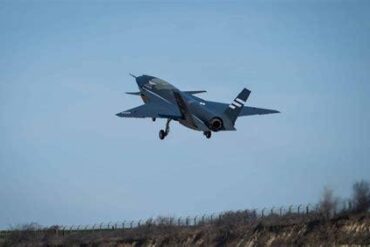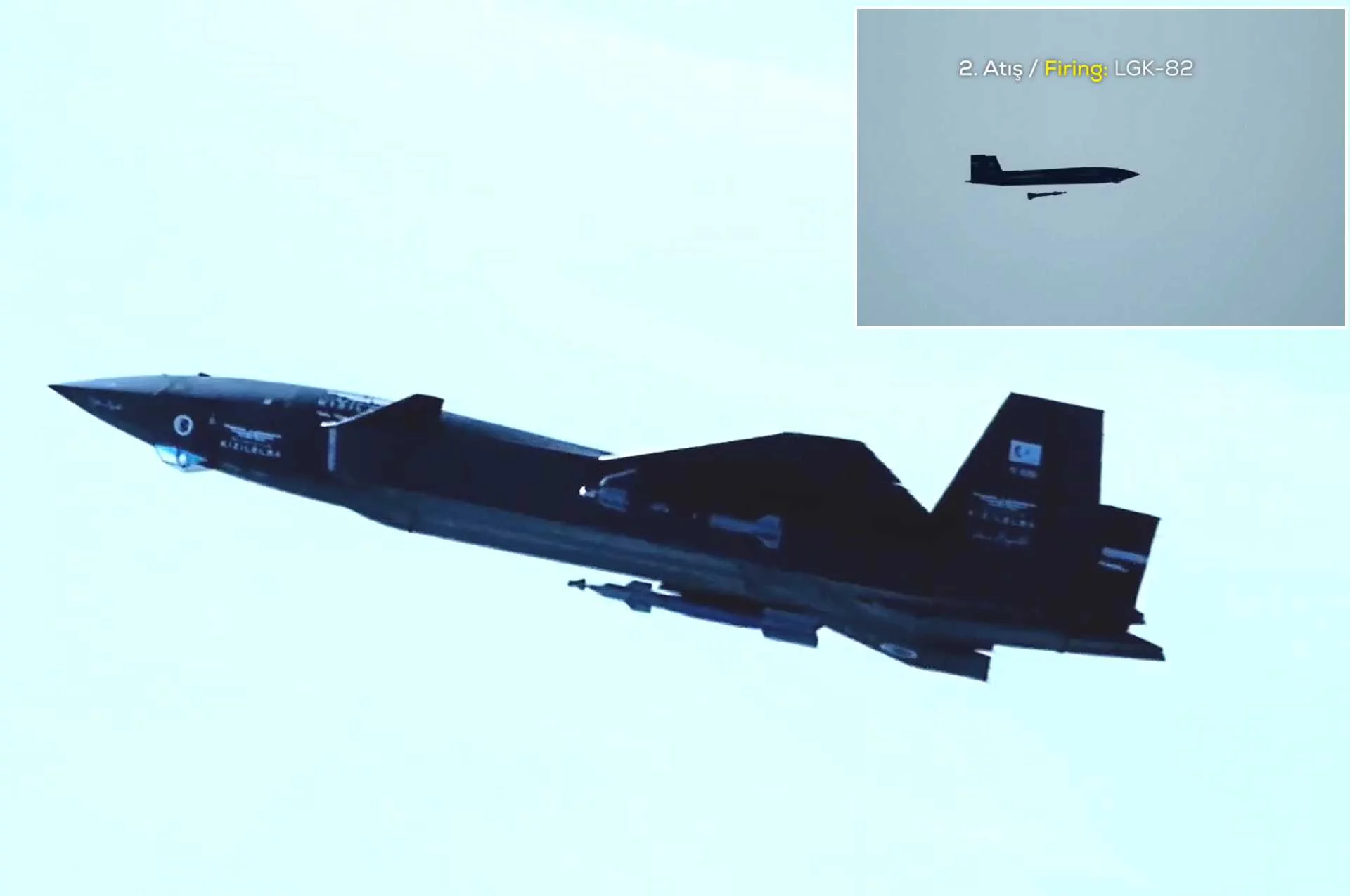
The evolution of unmanned combat aviation is accelerating rapidly, and Türkiye has positioned itself near the center of this transformation. A recent test conducted by Turkish defense manufacturer Baykar showcased the expanding capabilities of the Bayraktar KIZILELMA, a jet-powered unmanned fighter aircraft designed to operate in contested airspace and alongside manned combat jets. In the latest milestone, the platform successfully released precision-guided bombs during live-fire trials, demonstrating that the aircraft is moving closer to full operational combat capability.
The demonstration represents far more than a simple weapons test. It signals Türkiye’s broader ambition to build a fully sovereign unmanned strike ecosystem, integrating domestically produced aircraft, sensors, and smart munitions into a cohesive battlefield system. As modern warfare increasingly relies on networked sensors and autonomous platforms, the successful weaponization of the KIZILELMA places Türkiye among the small group of nations developing high-performance jet-powered UCAVs capable of precision strike missions.
Unlike earlier Turkish drones designed primarily for surveillance and light attack roles, the KIZILELMA is engineered as a next-generation unmanned fighter with higher speed, improved survivability, and compatibility with advanced weapon systems. The recent trials validate that the aircraft can deploy precision munitions while maintaining the operational flexibility required for modern air combat environments.
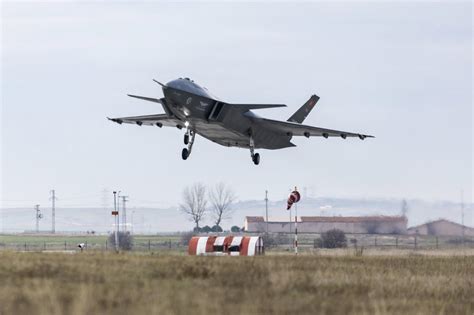
Türkiye Advances Jet-Powered UCAV Strike Capability
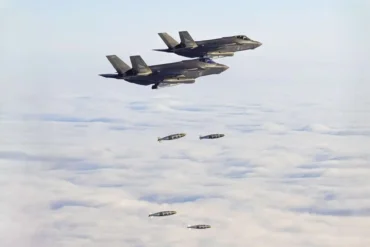
During the March 2026 trials, the Bayraktar KIZILELMA successfully released two different types of Turkish precision-guided bomb systems. These included the ASELSAN LGK-82 laser guidance kit paired with the MK-82 500-pound general-purpose bomb, as well as the ROKETSAN TEBER-82 guidance kit. Both systems convert conventional unguided bombs into highly accurate smart munitions capable of engaging battlefield targets with minimal collateral damage.
The tests confirmed that the aircraft can deploy guided weapons during flight while maintaining stable targeting and release parameters. For a jet-powered unmanned aircraft, this validation is essential. Weapon integration requires careful coordination between the aircraft’s flight control systems, onboard sensors, targeting algorithms, and mission planning software. Even minor discrepancies can affect accuracy or weapon separation safety.
The successful release of these munitions demonstrates that the KIZILELMA platform is progressing toward full combat readiness, expanding beyond experimental flight testing into operational weapons integration.
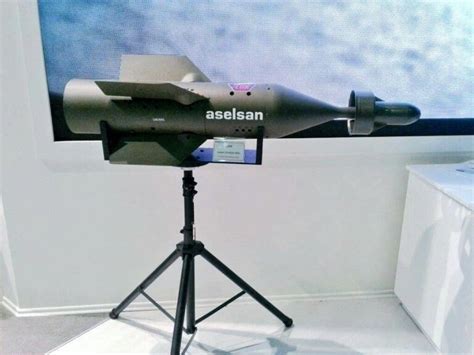
ASELSAN LGK-82 Laser Guidance System
The LGK-82 laser guidance kit, developed by Turkish defense electronics giant ASELSAN, converts the widely used MK-82 general-purpose bomb into a precision laser-guided weapon. The system operates using semi-active laser homing, a targeting method in which a laser designator illuminates the target while the bomb tracks the reflected laser energy.
This guidance technique allows the weapon to engage both stationary and moving targets with impressive precision. Armored vehicles, command posts, defensive fortifications, and logistical infrastructure can all be targeted effectively. Depending on the release altitude and aircraft speed, the weapon can strike targets several kilometers away, allowing the launching aircraft to remain outside many short-range air defense envelopes.
Such stand-off capability is crucial for unmanned combat aircraft operating in modern battlefields, where portable air defense systems and radar-guided weapons are common.
ROKETSAN TEBER-82 Dual-Guidance Smart Bomb
Complementing the LGK-82 system is the ROKETSAN TEBER-82, a versatile guidance kit designed to provide dual-mode targeting capability. The system combines GPS/INS navigation with semi-active laser guidance, giving operators flexibility in dynamic combat situations.
In GPS/INS mode, the weapon can strike pre-planned coordinates with high accuracy, making it ideal for fixed targets such as ammunition depots, radar installations, or infrastructure nodes. When laser designation is available, the weapon switches to laser guidance to achieve extremely precise targeting, often within only a few meters of the designated point.
The TEBER-82 also incorporates aerodynamic control surfaces, which extend the weapon’s glide distance after release. This extended range increases the aircraft’s survivability by allowing it to engage targets while maintaining greater separation from hostile air defenses.
Expanding the Operational Role of KIZILELMA
Integrating guided munitions dramatically expands the combat profile of the Bayraktar KIZILELMA. Earlier Turkish unmanned systems such as the Bayraktar TB2 or Bayraktar Akinci have proven effective in reconnaissance and light strike roles, but they rely on turboprop propulsion and operate at lower speeds.
KIZILELMA represents a different category entirely. As a jet-powered unmanned combat aerial vehicle, it can fly faster, carry heavier payloads, and potentially operate in more heavily defended environments. The aircraft’s design emphasizes low radar cross-section characteristics, allowing it to approach contested zones with reduced detectability.
This capability enables a wider set of missions, including:
- Suppression of enemy air defenses (SEAD)
- Battlefield interdiction
- Precision strike against high-value targets
- Maritime strike operations
The ability to carry guided bombs internally or on external hardpoints further enhances its tactical versatility.
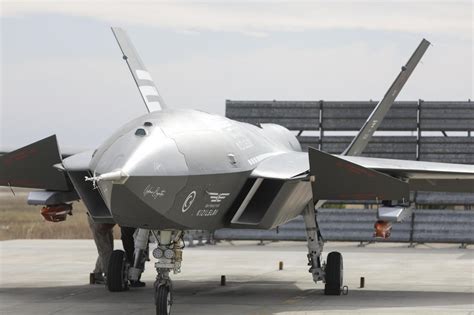
Manned-Unmanned Teaming in Turkish Air Strategy
One of the most intriguing aspects of the KIZILELMA program is its role in Türkiye’s evolving concept of manned-unmanned teaming (MUM-T). In this operational framework, unmanned aircraft operate in coordination with piloted fighters to extend sensor coverage, distribute strike capabilities, and reduce risk to human pilots.
The Turkish Air Force plans for KIZILELMA to operate alongside existing F-16 fighter aircraft and the future TF-X KAAN fifth-generation fighter currently under development. Unmanned fighters could serve as forward sensors, electronic warfare platforms, or precision strike assets within these coordinated formations.
By integrating unmanned systems into traditional air combat structures, air forces can increase operational flexibility while preserving the decision-making advantages of human pilots.
Carrier Operations and Naval Deployment Potential
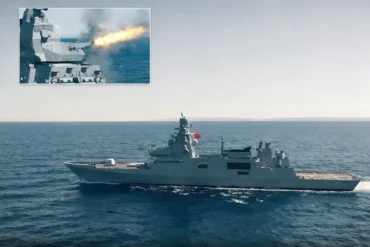
Another defining feature of the KIZILELMA program is its potential compatibility with naval aviation operations. The aircraft is being designed with the capability to operate from short runways and naval platforms, including Türkiye’s TCG Anadolu amphibious assault ship.
Carrier-capable unmanned fighters represent a significant shift in naval air power. Traditional carrier aviation relies heavily on large, crewed aircraft that require extensive training pipelines and maintenance resources. Unmanned alternatives could provide persistent surveillance, strike capability, and rapid sortie generation without exposing pilots to high-risk environments.
If successfully deployed from the Anadolu, KIZILELMA could become one of the first operational carrier-capable unmanned fighter aircraft in the world.
Strengthening Türkiye’s Domestic Defense Ecosystem
The successful live-fire trials also highlight the growing maturity of Türkiye’s domestic defense industry. The KIZILELMA program represents a tightly integrated ecosystem involving Baykar, ASELSAN, and ROKETSAN—three companies responsible for the aircraft platform, electronic systems, and precision munitions respectively.
This level of domestic integration carries significant strategic advantages. It allows Türkiye to develop and deploy advanced weapon systems without reliance on foreign export approvals or technology transfers, a critical consideration following past restrictions imposed by international defense partners.
By controlling the full development cycle—from aircraft design to guidance systems and smart munitions—Türkiye is building a self-sufficient unmanned combat architecture capable of rapid innovation and adaptation.
The Future of the Bayraktar KIZILELMA
The latest precision-strike tests represent another step toward operational deployment of the Bayraktar KIZILELMA unmanned fighter. As testing continues, engineers will focus on refining flight performance, expanding weapon compatibility, and validating autonomous operational capabilities.
If development progresses as planned, the aircraft could soon become a central component of Türkiye’s next-generation air combat doctrine. Its combination of jet speed, stealth-influenced design, carrier compatibility, and precision-guided strike capability positions it as one of the most ambitious unmanned combat aircraft projects currently underway.
The implications extend well beyond Türkiye. As more nations explore autonomous air combat platforms, systems like the KIZILELMA may redefine how air forces project power—introducing a future where unmanned fighters operate alongside human pilots in tightly coordinated combat networks.