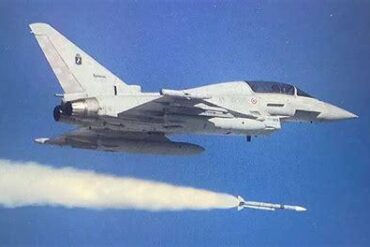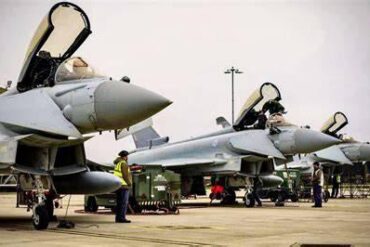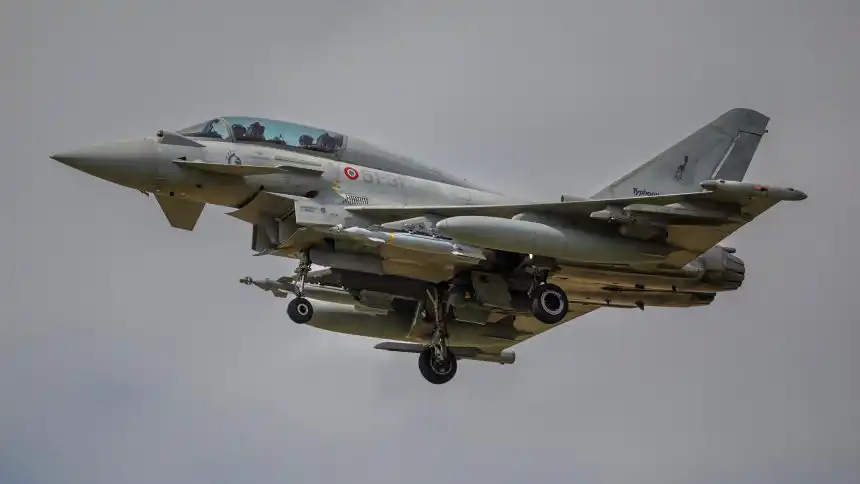
The Italian Air Force has embarked on a major munitions integration campaign, deploying a trio of Eurofighter Typhoons to RAF Marham in the United Kingdom for the first-ever live-fire testing of the Paveway IV dual-mode guided bomb. This initiative not only marks a significant enhancement in the Italian Typhoon fleet’s strike capabilities but also underscores a growing interoperability between Italy and the United Kingdom within the broader NATO defense framework.
Strategic Deployment to RAF Marham for Live Testing
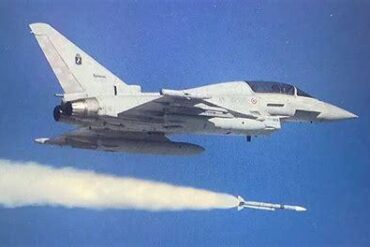
Led by Italy’s Reparto Sperimentale Volo (RSV), or Flight Test Unit, the deployment included one F-2000A (single-seat variant) and two TF-2000As (twin-seat trainers) operating under the callsign SPERA. The aircraft took part in live munitions training with Paveway IV bombs—a first for Italian Eurofighters. The weapons, distinguishable by their yellow bands denoting live status, were mounted under the Typhoon’s inner wing pylons, alongside external fuel tanks and the advanced Litening 5 targeting pod.
Open radio frequency monitoring confirmed their activity in the vicinity of Aberporth Range in Wales, a well-established weapons testing area. However, due to proximity and shared infrastructure, Holbeach Air Weapons Range—a parent site of RAF Marham—may have also hosted portions of the mission.
Emergency Response Highlights Mission Complexity
During the high-stakes trials, an unexpected in-flight emergency involving the single-seat F-2000A led to a precautionary return to RAF Marham, where it was met by emergency response teams. Notably, this aircraft did not carry bombs, though it is unclear whether this was due to mission planning, the emergency itself, or a mid-air jettison of ordnance. A second Typhoon served as a safety chase aircraft during the incident.
The Paveway IV Bomb: A Precision Strike Workhorse
The Paveway IV is a cutting-edge, 500-pound (226 kg) precision-guided munition developed by Raytheon UK. At its core, it combines a Mk 82 general-purpose warhead with a guidance kit that integrates both GPS/INS and laser targeting capabilities. This dual-mode system allows for unparalleled operational flexibility in targeting both stationary and moving threats under any weather or lighting conditions.
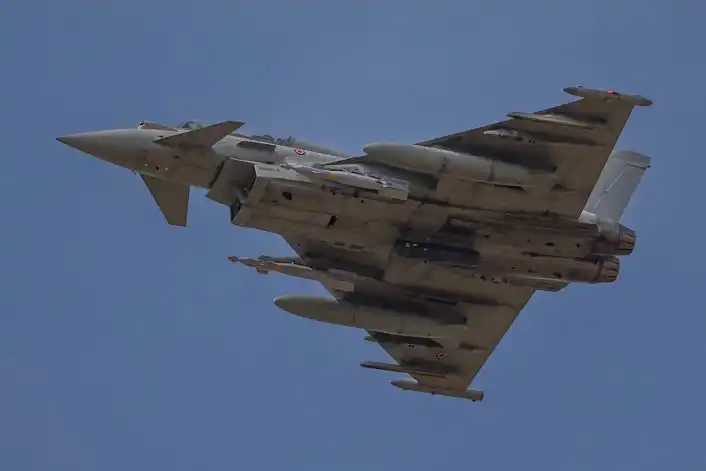
A standout feature of the Paveway IV is its programmable fuzing, offering options for airburst, impact, and delayed detonation. These configurable settings enhance its utility across various mission profiles—from anti-armor engagements to urban warfare where low collateral damage variants can be deployed. A penetrating warhead version is also in development under the SPEAR Capability 1 program, broadening the munition’s application against fortified structures.
Since its operational debut in 2008, the Paveway IV has been a staple in RAF combat operations over Afghanistan, Iraq, Syria, and Libya, and is cleared for use on platforms including the Typhoon FGR4 and the F-35B Lightning II.
Italian Typhoon Modernization: Strategic Shift Toward Advanced PGMs
Until now, the Italian Air Force Typhoons were primarily armed with the GBU-16 Paveway II and GBU-48 Enhanced Paveway II—both based on the larger Mk-83 1,000 lb warhead. The GBU-48 was jointly selected by Italy, Germany, and Spain as a stopgap solution for precision strike capability. In contrast, the United Kingdom took a divergent path with Project Centurion, which fully integrated the more compact Paveway IV into the RAF’s Typhoon arsenal.
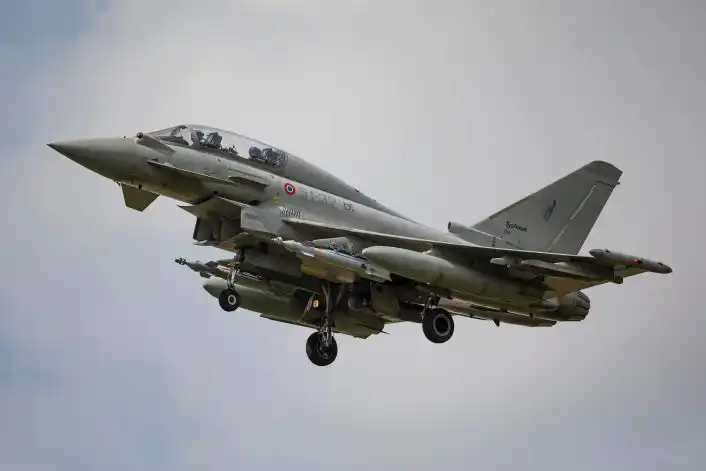
The Italian test campaign hints at a paradigm shift in munitions philosophy, with Rome now pursuing a munitions roadmap more aligned with its British counterparts. This strategic convergence reflects not just in weapons integration, but also in logistical and maintenance interoperability agreements. Under a formal Implementing Arrangement, the Italian and Royal Air Forces are collaborating on shared Typhoon support ecosystems, including software upgrades, mission data libraries, and joint spare part inventories.
Domestic Production Advantage: RWM Italia’s Role
One of the less publicized but strategically significant aspects of Italy’s move toward the Paveway IV lies in domestic industrial participation. The Mk-82 bomb bodies—the core of the Paveway IV—are manufactured by RWM Italia, a subsidiary of Rheinmetall’s Weapon and Ammunition Division. This allows Italy to sustain the bomb’s production domestically, bypassing some of the logistical bottlenecks tied to foreign supply chains and enhancing sovereign control over precision munitions.
A 2022 report by Italian Defense Minister Guido Crosetto acknowledged Italy’s intent to acquire Paveway IVs not just for the Typhoon, but also for legacy platforms like the Tornado IDS, alongside other smart bombs such as the GBU-12 and GBU-54. The potential cross-platform applicability could streamline logistics and training while amplifying strike options.
Interoperability with NATO and the UK: Strategic Value Beyond Capability
Italy’s foray into Paveway IV integration aligns well with broader NATO interoperability goals. As multinational missions increasingly demand coalition air strike coordination, uniformity in munitions, targeting data, and mission software becomes critical. Italy’s alignment with the UK, one of the most experienced operators of Paveway IV, ensures not only smoother joint air operations, but also enhanced mission effectiveness in coalition campaigns.
Additionally, as the RAF and other NATO forces shift their strike doctrine toward high-precision, low-collateral solutions, Italy’s entry into the Paveway IV community places it in a more favorable position to contribute meaningfully to coalition operations in complex theaters like North Africa and the Middle East.
What This Means for Italy’s Airpower Future
The live tests at RAF Marham represent more than a munitions upgrade—they are a strategic signal of intent. Italy’s Typhoon fleet, long seen as primarily air superiority-focused, is being transformed into a multirole strike platform with increasing relevance in both conventional warfare and expeditionary operations.
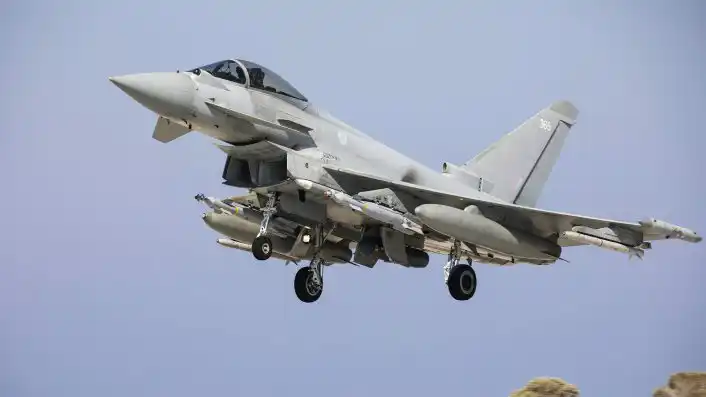
If the Paveway IV integration proceeds as expected, Italy will unlock a more agile, lower-yield, and weather-agnostic precision strike option, bridging a capability gap that has persisted since the Tornado GR4 era. Furthermore, it aligns Italy’s fighter modernization trajectory with evolving European defense standards and transatlantic interoperability priorities.
In a world where airpower precision, interoperability, and resilience are more critical than ever, the Italian Air Force’s Paveway IV campaign is a bold and necessary step forward—one that may well redefine the operational philosophy of one of Europe’s key NATO air arms for years to come.