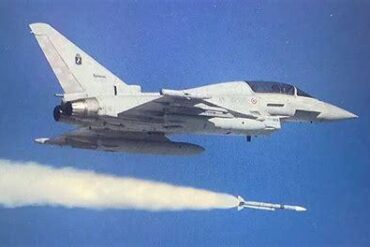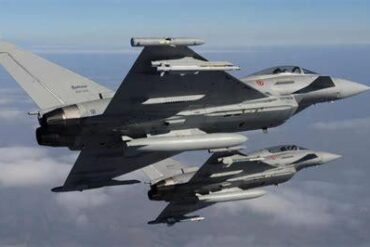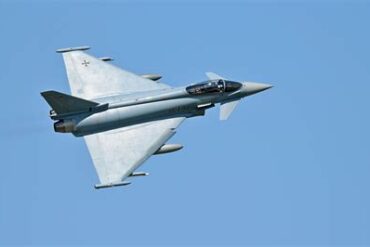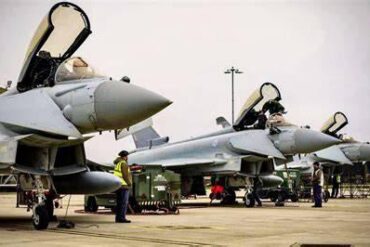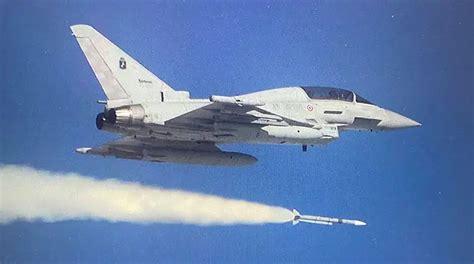
The Italian Air Force (ItAF) has taken a pivotal step forward in its air defense capabilities by deploying its F-2000 Typhoons equipped with the MBDA Meteor Beyond Visual Range Air-to-Air Missile (BVRAAM) for active operations under NATO’s Enhanced Air Policing (EAP) in Romania. This deployment not only signifies Italy’s growing integration with advanced European defense systems but also reflects the maturity of the Phase 2 Enhancement (P2E) program for the Eurofighter Typhoon.
The deployment took place at Mihail Kogălniceanu Air Base, where the Italian Task Force Air 51st Wing launched the “Black Storm II” mission, operating in collaboration with Romanian F-16s. The presence of the Meteor-equipped Typhoons marks a critical milestone, as it represents the first operational use of the missile by the Italian fleet.
Operational Debut Under NATO Enhanced Air Policing
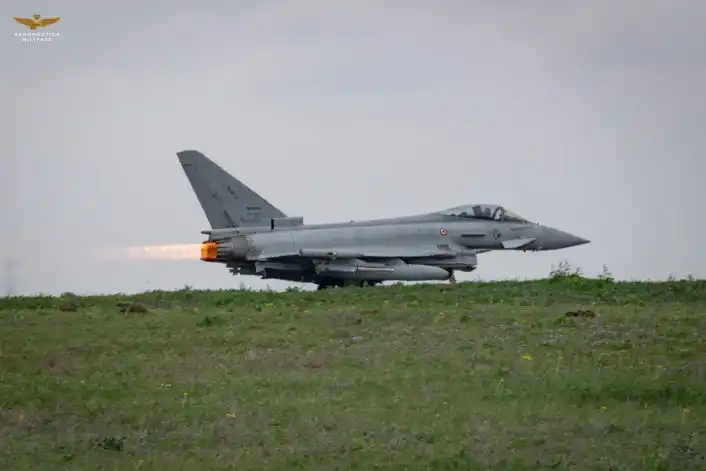
As of early April 2025, the Italian Typhoons arrived in Romania for the NATO EAP mission. The deployment came just weeks after Italy concluded the second phase of Operational Test & Evaluation (OT&E) of the Meteor missile. The mission became operational on April 10, and on April 28, an Alpha Scramble was executed in response to a potential airborne threat in Romania’s northeastern sector.
This high-readiness alert was coordinated by the NATO Combined Air Operations Center (CAOC) in Torrejón, Spain, and executed under the direction of the Control and Reporting Center (CRC) in Balotești. The Italian Typhoons, alongside their Romanian counterparts, executed a Combat Air Patrol (CAP) to intercept and monitor suspicious drone activity near the Tulcea border, returning to base after a night sortie that ended around 5 a.m.
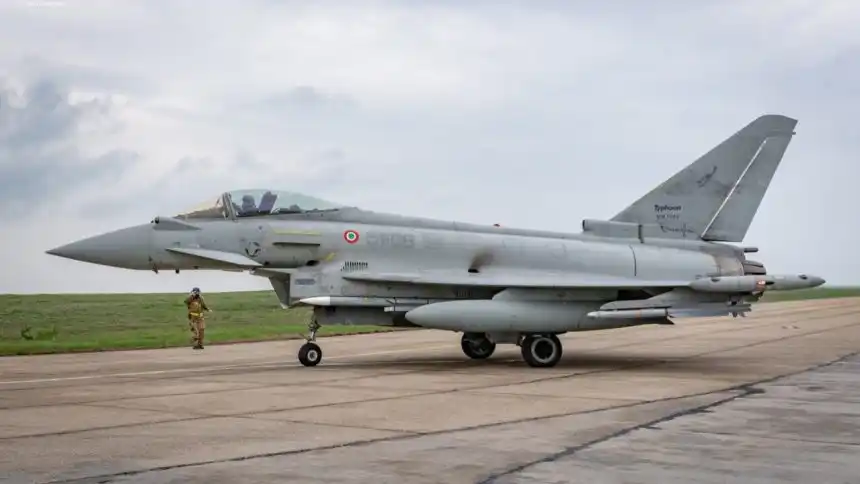
The Meteor‘s involvement in such a mission underscores the seriousness with which Italy is now integrating this system into its real-world defense operations. The scramble not only tested the interoperability between NATO allies but also highlighted Italy’s commitment to rapid, responsive air security.
The Loadout Configuration: Meteor Joins the Arsenal
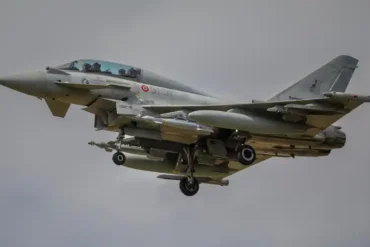
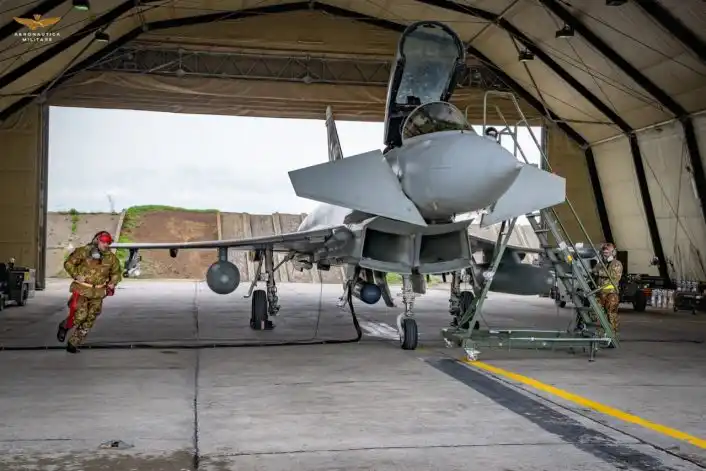
Although the ItAF has not formally declared Meteor’s operational status, recent images and the loadout configuration of the deployed Typhoons leave little room for doubt. The aircraft are equipped with:
- Two external fuel tanks for extended range
- A Litening 5 targeting pod mounted on the centerline
- Two IRIS-T short-range infrared-guided missiles on the outer pylons
- Two Meteor missiles mounted on the semi-recessed fuselage stations
This is a marked evolution from the previously standard configuration that featured AIM-120C-5 AMRAAM as the primary medium-range radar-guided missile. It is expected that both Meteor and AMRAAM will be used in a complementary role depending on mission specifics.
With this integration, Italy joins the ranks of Germany, the UK, and Spain, which have long since operationalized Meteor on their Eurofighters. The missile also arms Rafale and Gripen aircraft and is undergoing integration on platforms such as the F-35 and South Korea’s KF-21 Boramae.
Meteor BVRAAM: A Technological Leap in BVR Combat
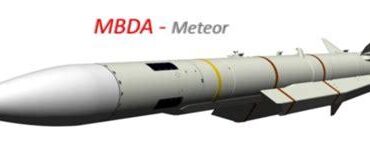
The MBDA Meteor represents a revolutionary leap in air-to-air missile technology. Unlike traditional rocket-powered missiles, Meteor is equipped with a ramjet propulsion system—a solid-fuel, variable-flow ducted rocket. This gives it an edge over conventional systems such as the AIM-120 by offering:
- Throttle control during cruise and terminal phases
- Sustained high energy throughout flight
- Extended No-Escape Zones
Meteor’s throttleable motor ensures it can maintain energy efficiency in cruise and deliver high kinetic energy upon terminal engagement. This design makes it nearly impossible to evade, especially when compared to older-generation BVRAAMs.
The missile’s data-link capability enables it to receive real-time updates from the launching aircraft, thereby increasing its Probability of Kill (Pk) against maneuvering targets. Furthermore, it employs a dual-mode fuze system—impact and proximity—and a fragmentation warhead for optimal lethality.
Integration and Evolution within the Italian Fleet
Italy’s journey toward integrating Meteor was relatively slow compared to other European nations. The reasons range from operational prioritization to resource allocation within the Eurofighter upgrade programs. However, the commitment has become visible through increasing mentions in recent military exercises and OT&E campaigns.
The integration is part of the Phase 2 Enhancement (P2E) bravo upgrades on the Typhoon, aimed at enabling the platform to carry and effectively deploy Meteor. Notably, two OT&E campaigns—one in 2023 and the latest in early 2025—tested the compatibility, firing envelope, and mission readiness of the system. Both campaigns involved live-fire drills and simulated engagements.
This progressive evolution not only validates the Eurofighter’s modular architecture but also underlines the importance of cross-national cooperation. The Meteor program, managed by MBDA, is a product of joint investment and technical collaboration among six European nations: the UK, Germany, Italy, France, Spain, and Sweden.
Strategic Implications for NATO and Italy’s Role
The operational debut of Meteor-equipped Typhoons during NATO’s EAP mission in Romania comes amid increasing aerial tensions along NATO’s eastern borders. With drone incursions and surveillance missions becoming more frequent, the demand for a rapid-response, long-range interceptor capability is growing.
By deploying Meteor-armed jets, Italy is signaling its readiness to uphold its NATO responsibilities while also showcasing the advanced deterrent capability the new missile brings. The ability to engage targets at extended ranges before they pose a direct threat to NATO airspace dramatically improves the alliance’s defensive posture.
The Meteor’s No-Escape Zone, significantly larger than that of the AIM-120, allows NATO aircraft to hold adversaries at risk over a broader area. Coupled with the Eurofighter’s supercruise capability and integrated sensor suite, the result is a high-speed, networked interceptor platform ready for future aerial warfare.
Conclusion: Italian Typhoons Enter a New Era of Lethality
The deployment of Meteor BVRAAM on Italian F-2000 Typhoons marks a turning point in the Italian Air Force’s evolution into a next-generation aerial force. With its enhanced range, sustained kinetic energy, and superior guidance, Meteor enables Italy to align with NATO’s cutting-edge air defense doctrine.
The successful integration and operational debut of this missile in Romania demonstrates that the ItAF is no longer a follower but a peer among Europe’s advanced air forces. As threats become more asymmetric and technologically sophisticated, systems like Meteor will serve as a backbone of deterrence and preemptive defense.
With the Typhoon-Meteor pairing, Italy ensures it remains not only relevant in the skies of Europe but a leading force in shaping air superiority for the next decade.