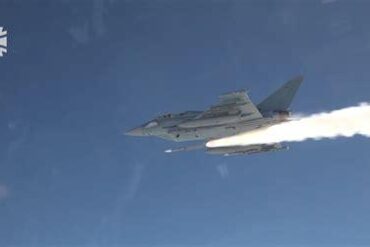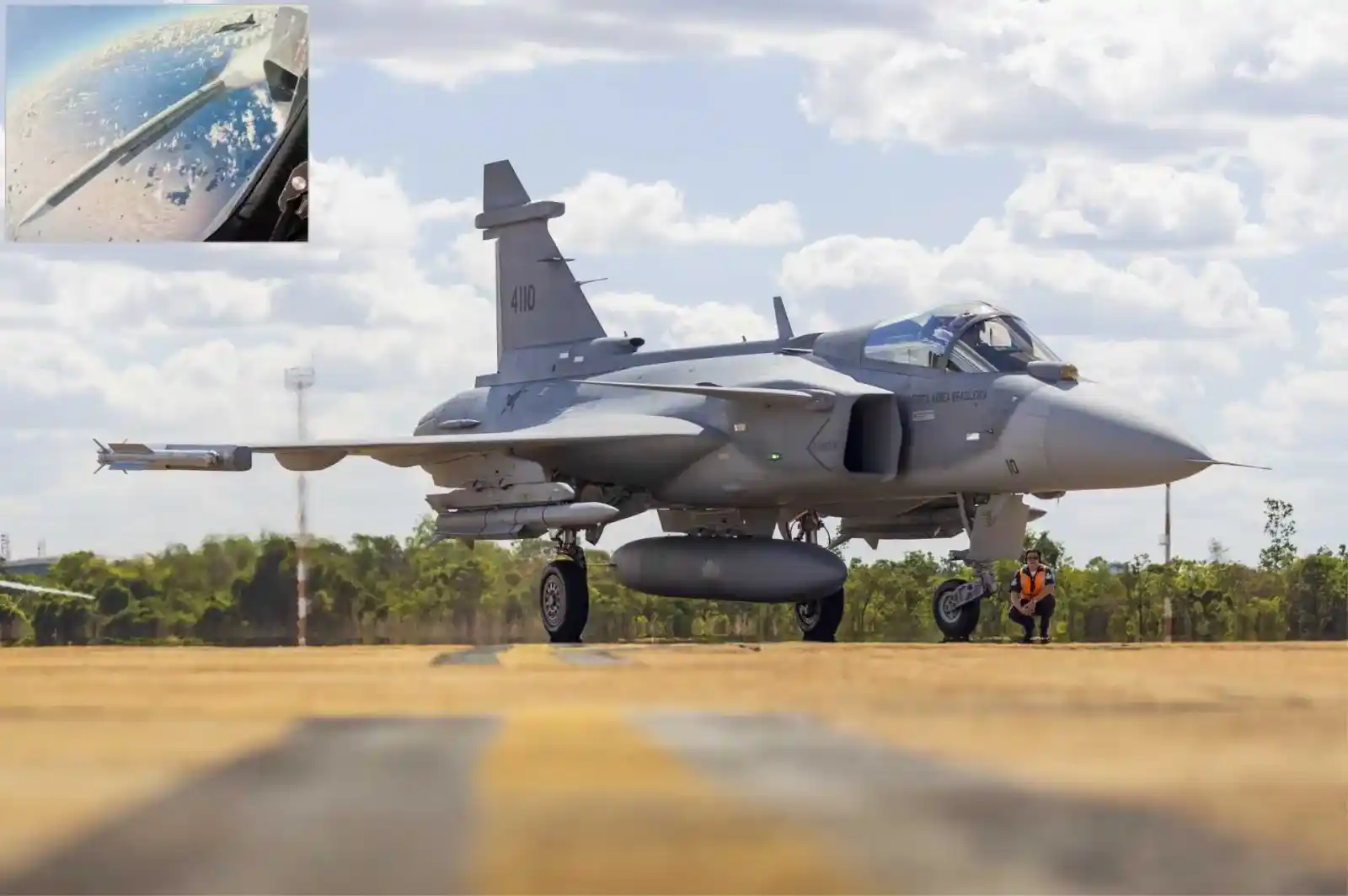
Brazil has completed a milestone years in the making with the first operational firing of the Meteor beyond-visual-range air-to-air missile from an F-39E Gripen fighter jet. Conducted on November 27, 2025, during the EXTEC BVR-X exercise near Natal Air Base, this real-world launch represents a decisive step in validating the country’s newest fighter and its most advanced long-range missile capability. The test was intentionally designed to mimic the chaos of modern air warfare, placing the Gripen and the Meteor in a scenario involving high-speed aerial targets, complex environmental factors, and stringent data-collection goals.
This launch is more than a technical achievement—it is a signal of a strategic shift. With the Meteor now validated in Brazilian hands, the Gripen F-39E is becoming the backbone of national air defense for decades ahead, replacing legacy platforms that can no longer keep pace with regional threats or global standards of aerial warfare.
The chosen test location, the coastal area near Natal, offered the ideal mix of geography, controlled traffic corridors, and consistent weather. It provided the type of clean but realistic airspace needed to observe the Meteor’s performance envelope without interference.
Inside the First Operational Launch Scenario
The launch was executed against Mirach 100/5 aerial drones, fast and agile targets that simulate the flight profile of modern fighter aircraft at high altitude. These drones allowed test designers to measure missile precision, assess tracking data, and evaluate the missile’s performance envelope under demanding conditions.
Four F-39E Gripen fighters from the First Air Defense Group, known as Jaguar Squadron, took part in the test. In parallel, the Anápolis Logistics Group handled the meticulous technical workflow that such a launch requires—loading rounds, conducting pre-flight inspections, and carrying out comprehensive post-flight diagnostics.
The test’s firing profiles were carefully curated by Brazil’s most experienced long-range engagement specialists. Their objective was simple: extract the maximum amount of technical data from every second of flight. Each firing fed directly into Brazil’s evolving doctrine on long-range engagements, shaping future tactics and acquisition decisions.
Saab, MBDA, and Brazil’s Deepening Technology Partnership
The pathway to this launch began years earlier with intensive training that blended Saab’s Gripen expertise and MBDA’s missile knowledge with Brazil’s domestic operational planning. Saab provided foundational training for pilots, while MBDA supported mission planning, data analysis, and integration oversight through its cooperation with the Operational Applications Institute (IAO).
This partnership is part of a substantial offset package attached to Brazil’s 2019 Meteor contract. These offsets include technology transfer, data-analysis capability development, and assistance in the broader integration architecture that ensures the Meteor performs seamlessly with Brazil’s Gripen fleet.
The IAO will now sift through the telemetry and mission recordings gathered during BVR-X, determining real-world strengths, identifying possible limitations, and refining tactics, techniques, and procedures (TTPs) to ensure Brazil can exploit the Meteor’s full potential.
Multi-Aircraft, Multi-Agency Coordination Behind the Scenes
While the Meteor firing was the headline event, the broader exercise involved a sprawling network of aircraft and agencies working in concert. A-1M attack aircraft created threat-like conditions, E-99 early warning platforms monitored the airspace, and A-29 Super Tucanos enforced control over restricted zones.
Over the waters near Natal, P-3AM and P-95BM maritime patrol aircraft scanned for vessels entering the exclusion zone, using radar and electro-optical sensors to maintain safety barriers. An H-36 Caracal helicopter remained on standby for search and rescue operations, ensuring that personnel safety was never compromised.
At the heart of the telemetry chain was the Barreira do Inferno Launch Center, which provided real-time tracking of both targets and the Meteor missile, capturing crucial data on trajectory, speed, and terminal engagement.
This entire structure was supported by Brazil’s logistics and materiel network, including the Preparation Command, São Paulo Aeronautical Material Park, and Rio de Janeiro Aeronautical Armament Material Park.
Meteor Missile: The Most Advanced BVR Weapon in South America
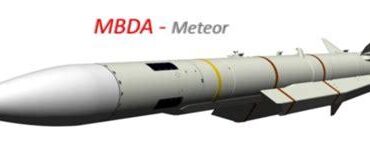
The Meteor missile brings capabilities far beyond the reach of older long-range systems. Its defining advantage is its ramjet propulsion, which maintains energy throughout flight and accelerates during the terminal phase. This creates a “no-escape zone” estimated at ~60 km—significantly larger than missiles such as the AIM-120 AMRAAM used by Chile and future Argentine F-16s, or the R-77 and R-27 carried by Venezuela’s Su-30MK2 fleet.
Public performance figures indicate:
- Range: exceeding 100 km, with many sources suggesting beyond 200 km
- Speed: approximately Mach 4
- Guidance: inertial navigation mid-course, active radar homing terminal phase
- Data Link: bidirectional, enabling real-time retargeting
Several nations operate the missile—including France, Sweden, the UK, India, and Egypt—placing Brazil among a select group of air forces wielding a high-end, modern BVR deterrent.
Validation of the F-39E Gripen Ahead of Full Operational Clearance
The Meteor launch slots into a broader series of validation events for Brazil’s Gripen program. From August to September 2025, the Air Force conducted a sweeping evaluation of the aircraft’s updated configuration, covering system performance, alert readiness, and deployment operations.
The tests included Forward Arming and Refueling Point (FARP) operations using the KC-390 Millennium, demonstrating the Gripen’s ability to operate in dispersed basing scenarios—an increasingly vital capability in modern air warfare.
Integration of the Link BR2 data link is progressing, promising real-time information-sharing between Gripens and other platforms, elevating situational awareness across the entire Brazilian air defense grid.
Under Brazil’s 2014 contract for 36 Gripens—28 F-39E and 8 F-39F—eleven aircraft have already been delivered, with more scheduled through 2026 and additional adjustments extending some deliveries to 2032. Brazil has also discussed acquisition of supplementary Gripen C/Ds to prevent temporary capability gaps.
The domestic final assembly line in Gavião Peixoto, inaugurated in 2023, is now a crucial industrial pillar, joining Brazil-built structures with Swedish components and managing full aircraft assembly through flight testing.
A Leap Beyond Legacy Platforms
The Gripen and Meteor combination is replacing aircraft such as the Mirage III, Xavante, legacy A-1, and F-5, which underwent decades of incremental upgrades but ultimately lack the range, data fusion, and sensor integration required for modern operations.
During CRUZEX 2024, the F-39E already demonstrated its capability—even when artificially limited for balanced training—against F-16s, F-15Cs, IA-63 Pampas, A-1s, and F-5s. With the Meteor now validated, Brazil enters a new tier of regional airpower.
Path to Operational Deployment in 2026
With the first Meteor firing complete and future tests planned—including the 27 mm cannon trials near Rio de Janeiro—the Brazilian Air Force is on track to certify the Gripen for full operational missions in 2026.
This achievement marks not just the debut of a missile, but the arrival of an integrated air defense ecosystem built around a modern fighter, long-range weapons, data networks, and joint-force doctrine. It establishes the Gripen F-39E as a central pillar of Brazil’s air sovereignty and a foundation for future modernization efforts stretching well into the 2040s.