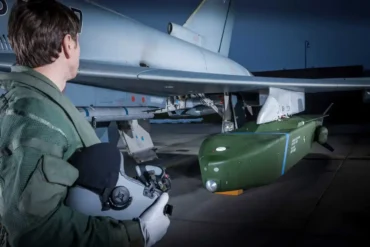
Germany has taken another deliberate step toward strengthening its air combat posture by expanding its stockpile of Meteor beyond-visual-range air-to-air missiles, a move that directly enhances the long-range lethality and deterrence value of the Eurofighter Typhoon within NATO’s evolving airpower landscape. Confirmed by MBDA in January 2026, the new contract reflects a growing European focus on depth, sustainability, and technological credibility in high-end air-to-air warfare rather than symbolic fleet numbers alone.
The decision arrives at a moment when air policing missions across Europe are increasingly intersecting with contested airspace dynamics, advanced electronic warfare environments, and near-peer adversary capabilities. For the Luftwaffe, Meteor is not merely another missile in inventory; it is a defining element of how German fighters can shape an engagement before an opponent ever reaches their own weapons release range.
Unlike legacy procurement cycles driven by one-off acquisitions, Germany’s latest order signals a sustained approach to stock resilience, ensuring that operational readiness can be maintained during prolonged periods of tension or crisis. In modern air combat, where missile expenditure rates can rise sharply in the opening hours of conflict, depth of inventory has become as strategically important as platform performance.
Meteor as a Strategic Enabler of Beyond-Visual-Range Dominance
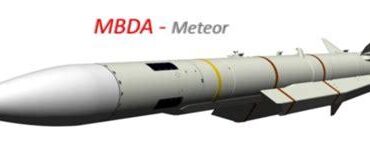
Meteor’s core advantage lies in its solid-fuel, variable-flow ducted rocket motor, produced in Germany by MBDA subsidiary Bayern Chemie. This propulsion system allows the missile to maintain thrust throughout much of its flight, rather than relying on a brief boost phase followed by energy decay. The practical outcome is a significantly expanded No Escape Zone, particularly in the terminal phase where opposing aircraft traditionally exploit a missile’s loss of speed to evade.
This sustained-energy profile reshapes pilot decision-making. Instead of committing to closer engagements that expose the launching aircraft to counterfire or surface-based air defences, Meteor allows Eurofighter crews to apply pressure earlier, forcing adversaries into defensive manoeuvres that degrade their own mission objectives. The missile’s effectiveness is therefore not measured purely in advertised maximum range but in its ability to deny options and compress an opponent’s tactical freedom.
Equally important is Meteor’s two-way datalink, which supports in-flight target updates and flexible engagement management. This capability enables German Eurofighters to launch based on cooperative sensor data, adjust targeting as situations evolve, and reduce the need for continuous radar illumination. In a battlespace saturated with jamming, decoys, and fast-moving threats, this network-enabled approach aligns closely with NATO’s broader shift toward distributed sensing and cooperative engagement.
Eurofighter Typhoon at the Center of Germany’s Air Defense Architecture
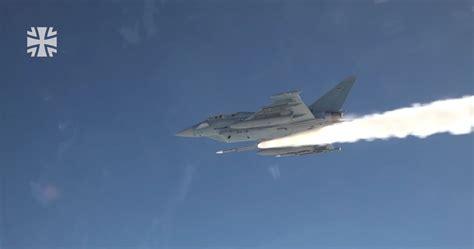
For the Luftwaffe, the Eurofighter Typhoon remains the principal carrier of Meteor and the backbone of Germany’s air sovereignty mission. Initial carriage and integration milestones were achieved earlier in the decade, with flight activities at Neuburg in 2021 laying the groundwork for operational use. These efforts culminated in December 2024, when Germany conducted its first live Meteor firing from a Eurofighter during trials at RAF Lossiemouth, a moment publicly framed as a decisive expansion of the aircraft’s long-range combat envelope.
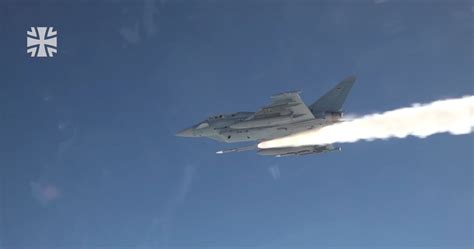
Meteor’s integration has steadily transformed the Eurofighter from a highly agile multirole fighter into a platform capable of imposing stand-off risk against advanced threats. This capability is particularly relevant for Germany, whose air defense responsibilities include rapid-reaction alerts, NATO air policing, and reinforcement of alliance deterrence along Europe’s eastern flank. In such scenarios, the ability to engage decisively without closing distance reduces both operational risk and escalation pressure.
The latest missile order further supports Germany’s emphasis on readiness over rhetoric. Rather than announcing headline-grabbing fleet expansions, Berlin has focused on ensuring that existing platforms are fully armed, sustained, and credible in a high-intensity environment. Meteor stock depth directly underpins that philosophy.
Stockpiling as Deterrence in a High-Tempo Air Environment
Modern air operations increasingly blur the line between peacetime patrols and wartime engagements. Intercepts can escalate rapidly, and missile inventories can be depleted far faster than traditional planning assumptions once predicted. Against this backdrop, Germany’s decision to replenish and expand Meteor stocks reflects a clear understanding of consumption-based deterrence: credibility depends on what can be sustained, not just what can be fielded on day one.
By maintaining robust Meteor inventories, the Luftwaffe enhances its ability to contest airspace at extended distances while minimising exposure to layered surface-to-air missile systems and electronic attack. The missile’s performance in end-game scenarios is particularly relevant against fast, high-altitude targets where reaction times are compressed and engagement windows are narrow.
This approach also sends a quiet but unambiguous signal to allies and potential adversaries alike. Germany is not relying solely on alliance guarantees or future platforms; it is investing now in the tools required to hold contested airspace with confidence.
European Industrial Cooperation and Sovereign Capability
Meteor is the product of one of Europe’s most successful cooperative weapons programmes, involving Germany, the United Kingdom, France, Italy, Spain, and Sweden. Germany’s latest order reinforces this framework, sustaining critical propulsion and systems expertise within Europe while ensuring interoperability among allied air forces.
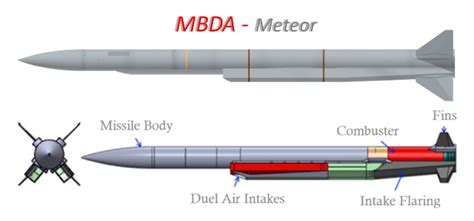
From an industrial perspective, continued procurement supports the long-term viability of specialised manufacturing capabilities that would be difficult to regenerate in a crisis. From an operational standpoint, it ensures that European air forces share a common, high-performance beyond-visual-range weapon that simplifies joint planning and combined operations.
MBDA has consistently positioned Meteor as a missile with growth potential rather than a static design. Ongoing upgrades and sustainment efforts are aimed at preserving relevance against evolving threats, including advanced countermeasures and increasingly agile adversary aircraft.
Meteor’s Expanding Role Beyond Eurofighter
While the Eurofighter remains Germany’s primary Meteor carrier, the missile’s operational footprint continues to widen. Meteor has already flown on the F-35B, and MBDA reports that ground vibration testing and fit checks have been conducted at Edwards Air Force Base in preparation for F-35A flight trials, with Italy sponsoring that integration path. The United Kingdom continues to lead the F-35B effort, underscoring Meteor’s growing relevance within fifth-generation force structures.
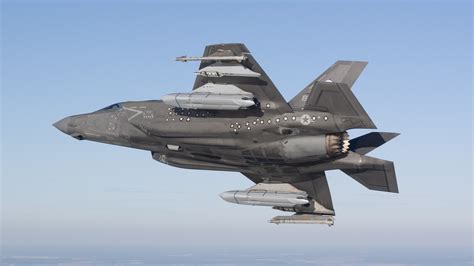
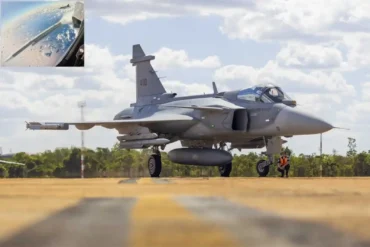
This expansion enhances the missile’s strategic value for existing users, including Germany. As more allied platforms field Meteor, the benefits of shared logistics, common tactics, and cooperative engagement increase. Saab’s successful firings from Brazil’s Gripen E in late 2025 further illustrate how Meteor has matured into a globally relevant capability rather than a niche European solution.
A Readiness Decision With Long-Term Significance
Germany’s expanded Meteor procurement, disclosed on 21 January 2026, is best understood as a readiness-driven investment rather than a routine resupply. It strengthens the Luftwaffe’s ability to deter, control, and if necessary dominate long-range air engagements while reinforcing Europe’s collective industrial and operational autonomy.
In an era where air superiority is increasingly determined by who can detect, decide, and engage first at distance, deep stocks of a network-enabled, sustained-energy missile represent a tangible form of deterrence. For Germany, Meteor is not just about range or technology; it is about preserving credible options in a strategic environment where hesitation carries its own risks.