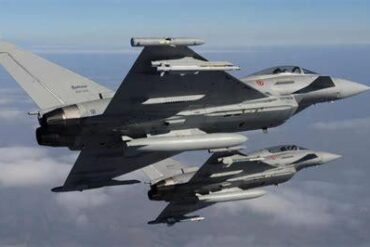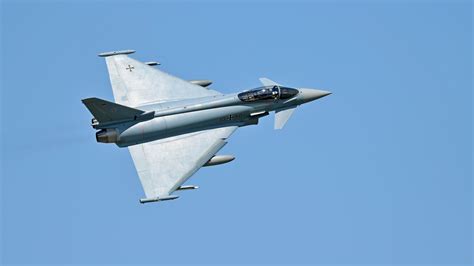
Europe’s combat aviation landscape is often discussed in the language of ambition: sixth-generation fighters, combat clouds, loyal wingman drones, and digital battle networks. Yet beneath the futuristic vocabulary sits a far more grounded reality. Air superiority today is still carried by proven, continuously evolving fighters, and the Eurofighter Typhoon remains one of the most important examples of this philosophy. Understanding how many Typhoons Europe produces each year is not just a question of factory output; it is a window into European industrial capacity, strategic autonomy, and the balance between next-generation dreams and present-day defense needs.
The short answer is deceptively simple. Europe currently produces around 15 Eurofighter Typhoons per year, with plans to push that figure toward 20 aircraft annually in the coming years. The long answer is far more interesting, because those numbers reflect political decisions, multinational cooperation, industrial bottlenecks, and shifting security priorities across the continent.
The Typhoon exists in an era dominated by stealth narratives, yet it refuses to fade. Instead, it is being reshaped into a digitally connected, heavily armed “quarterback” of European airpower, complementing stealth fighters rather than competing with them. Production volume is therefore not declining into irrelevance; it is stabilizing, and in some respects, cautiously expanding.
Annual Eurofighter Typhoon Production in Context
Measured purely by numbers, Eurofighter Typhoon production looks modest. An average output of roughly 15 aircraft per year stands in stark contrast to the over 150 F-35s produced annually by Lockheed Martin. This comparison, while tempting, misses the strategic point. The Typhoon is not a mass-produced global export product driven by a single national supply chain. It is a multinational European program, deliberately structured to balance sovereignty, employment, and military independence.
As of September 2025, 606 Eurofighter Typhoons had been delivered, from a total order book exceeding 750 aircraft. That leaves a substantial backlog, enough to sustain production well into the 2030s even without major new export wins. Unlike Cold War production lines that surged during crises and collapsed afterward, the Typhoon’s output has been deliberately paced to preserve skills, control costs, and align with long-term defense planning.
What matters is not whether Europe produces dozens of Typhoons each year, but whether it produces enough. Enough to replace aging fleets. Enough to deter near-peer threats. Enough to keep its aerospace workforce alive until sixth-generation systems arrive.
Why Production Numbers Remain Relatively Low
The Eurofighter’s production rate is not a failure of demand or capability. It is a consequence of how Europe builds combat aircraft. The Typhoon is produced by a consortium involving Germany, the United Kingdom, Italy, and Spain, with workshare carefully divided to reflect each nation’s investment and fleet size. This structure ensures political buy-in but inherently limits how fast production can scale.
Each aircraft is also extremely labor-intensive, incorporating advanced composites, precision-aligned fuselage sections, and highly integrated avionics. This is not a platform optimized for industrial surge in the American sense. It is optimized for sustained, high-quality output, where every jet meets the specific national requirements of its end user.
There is also the strategic overlay. European air forces are not replacing entire fleets overnight. They are managing transitions: Tornados giving way to Typhoons, Typhoons complementing F-35s, and both bridging toward FCAS and Tempest. In such an environment, steady production beats explosive growth.
The Multinational Production System Explained
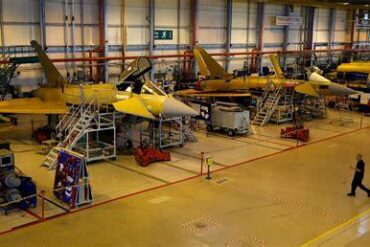
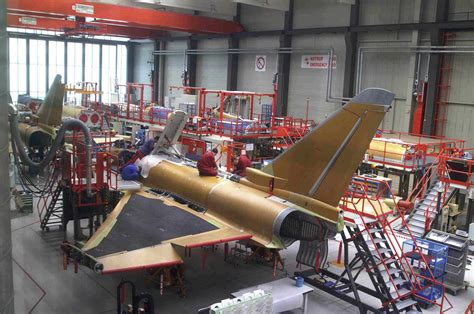
The Eurofighter Typhoon is not built in one country from start to finish. No single nation owns the aircraft outright, and that is by design. Major components are produced across Europe, then shipped to one of four final assembly lines.
Germany assembles aircraft at Manching, primarily for the Luftwaffe. Spain’s jets are finalized in Getafe. Italy uses Turin, while the United Kingdom historically assembled aircraft at Warton. Even when a final assembly line slows or pauses, the factories feeding it continue producing components for the other lines. This interdependence is one of the program’s quiet strengths.
The EJ200 engines follow a similar model. Rolls-Royce, MTU Aero Engines, Avio, and ITP each contribute a portion of the engine, ensuring that engine expertise remains distributed across Europe rather than concentrated in a single state.
This system caps production speed, but it also locks in resilience. A shock in one country does not collapse the entire program. From an industrial strategy perspective, that trade-off is intentional.
Tranche 5 and the Push Toward 20 Aircraft Per Year
The most important development affecting future production numbers is Tranche 5. This latest iteration of the Typhoon is not a cosmetic upgrade. It represents a deep transformation of the aircraft’s digital architecture, sensors, and role within future European airpower.
Germany’s order of 20 Tranche 5 aircraft in October 2025, followed by Spain’s Halcón II order for 21 jets, and Turkey’s agreement for 20 aircraft, collectively changed the production outlook. These commitments provide the volume needed to justify ramping production toward 20 Typhoons per year.
This increase is modest on paper but significant in practice. It stabilizes supply chains, extends factory lifelines, and prevents a production cliff before FCAS becomes operational. It also signals political confidence that the Typhoon will remain relevant for decades, not years.
Why Europe Still Needs the Eurofighter
The persistence of the Typhoon raises an obvious question. Why keep building a non-stealth fighter in the age of radar-evading jets? The answer lies in mission reality rather than marketing.
The Typhoon excels at Quick Reaction Alert (QRA) duties, scrambling at high speed to intercept unknown or hostile aircraft near European airspace. Its supercruise capability, climb rate, and acceleration make it ideal for this task. Stealth fighters, optimized for penetration and sensor fusion, are not always the best tool for air policing.
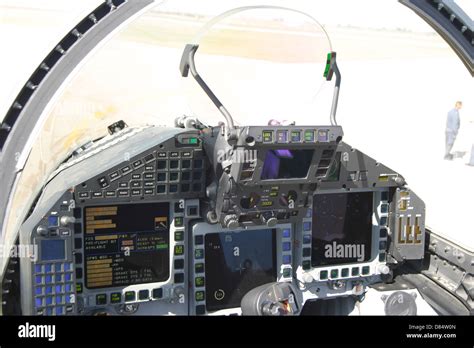
More importantly, Tranche 5 reimagines the Typhoon as a networked node. It does not need to be invisible if it can see everything, jam everything, and share everything. In this role, the Typhoon amplifies the effectiveness of stealth platforms rather than competing with them.
Production as a Strategic Signal
Producing 15 to 20 Typhoons per year sends a message that goes beyond aircraft counts. It signals that Europe intends to retain control over its air combat destiny. Total dependence on American platforms would be cheaper in the short term, but it would hollow out European design, testing, and systems integration expertise.
Aerospace skills decay quickly when not exercised. Engineers move on. Supply chains dissolve. Restarting a fighter program after a long pause is vastly more expensive than keeping one alive at a controlled tempo. Tranche 5 production is therefore less about the aircraft itself and more about keeping the ecosystem breathing.
Preventing the Fighter Gap Before FCAS
The Future Combat Air System is ambitious, complex, and politically fragile. Disputes over industrial leadership, particularly between Dassault and Airbus, have already slowed progress. Timelines once pointing to 2040 now drift toward 2045 or later.
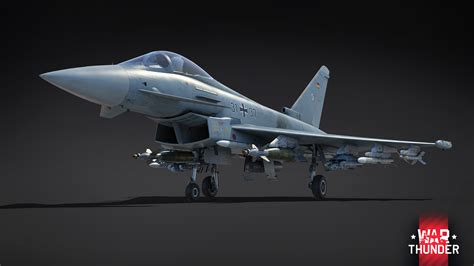
Without continued Typhoon production, Europe would face a fighter gap in the 2030s. Aging fleets would retire faster than replacements arrive. Restarting production later would be costly and slow. Tranche 5 acts as a bridge, ensuring that air forces like Germany’s and Spain’s maintain credible combat power while FCAS matures.
This bridging role also allows new technologies to be tested operationally. Manned-Unmanned Teaming, advanced electronic warfare concepts, and combat cloud integration can all be refined on a platform already in service.
How Production Numbers Reflect Security Reality
Russia’s war against Ukraine reshaped European defense planning almost overnight. Airpower, once seen as a background capability, returned to the center of deterrence thinking. Mass still matters, and so does readiness. The Typhoon offers both.
Producing 20 aircraft per year may sound conservative, but over a decade it yields a substantial fleet refresh. More importantly, it aligns with training pipelines, basing capacity, and maintenance infrastructure. Air forces can absorb these aircraft without overwhelming their systems.
In this sense, Typhoon production reflects a European style of rearmament: deliberate, coordinated, and industrially sustainable rather than explosive and reactive.
How the Typhoon Competes Without Stealth
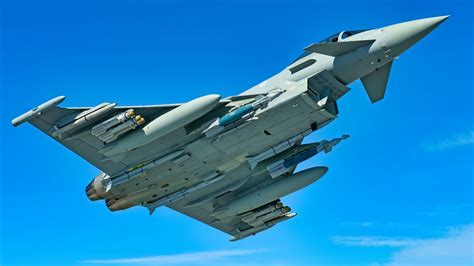
The Typhoon will never be a stealth aircraft, and it does not pretend otherwise. Instead, Tranche 5 leans into electronic dominance. The ECRS Mk2 AESA radar can search, track, and jam simultaneously, blurring the line between sensor and weapon.
Combined with the Praetorian Defensive Aids Sub-System, the Typhoon can distort enemy radar pictures, create false targets, and survive in contested environments. This capability set makes it particularly valuable in European scenarios, where dense air defenses and electronic warfare are expected.
Production volumes reflect confidence in this approach. Europe is betting that information dominance can substitute for invisibility in many missions.
Employment, Industry, and Political Gravity
Behind every production number lies a workforce. The Eurofighter program sustains around 100,000 jobs across 400 companies. These are not easily replaceable roles. Composite fabrication, radar integration, flight control software, and engine testing require years of experience.
Reducing production below sustainable levels would trigger an irreversible skills drain. Increasing it too aggressively would strain budgets and logistics. The current 15–20 aircraft per year represents a politically and economically balanced equilibrium.
This balance also explains why export success, while welcome, is not pursued at any cost. The Typhoon’s primary mission is to serve European air forces, not to flood the global market.
Looking Ahead: What the Numbers Really Mean
So how many Eurofighter Typhoons does Europe produce annually? The numerical answer is straightforward. Roughly 15 today, aiming for 20 tomorrow. The strategic meaning is anything but simple.
Those numbers represent Europe’s determination to remain a first-rank aerospace power, even as it navigates political complexity and technological transition. They reflect a belief that airpower is not defined solely by stealth or generation labels, but by how effectively platforms are integrated into a broader system.
The Eurofighter Typhoon is not fading quietly into history. It is being deliberately, methodically sustained. Production rates are tuned not for headlines, but for endurance. In an era of rapid change and uncertain futures, that restraint may prove to be one of Europe’s most underappreciated strengths.