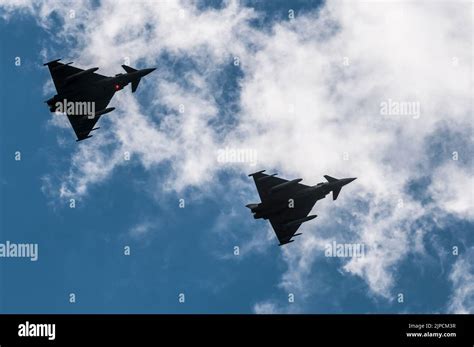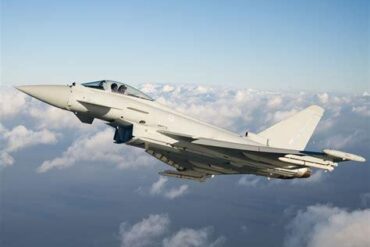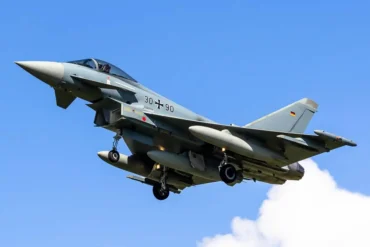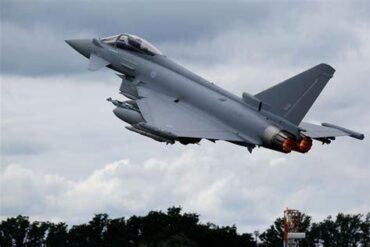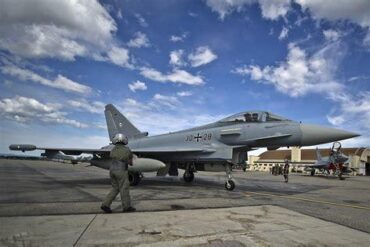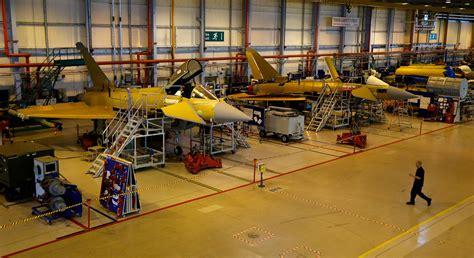
Europe is entering a new era of military aerospace production as the Eurofighter Typhoon consortium—comprising Airbus, BAE Systems, and Leonardo—announces plans to triple annual output of the Typhoon jet, a move that reflects the intensifying security demands of partner nations and strategic allies. Confirmed during the 2025 Paris Air Show by CEO Jorge Degenhardt, the plan will elevate production from 12 units annually to 20, with potential scaling to 30 aircraft per year, depending on global contract completions and export agreements.
This major shift comes in the context of what Degenhardt described as the “total madness” of the current geopolitical climate, referencing rising tensions in Eastern Europe, the Middle East, and the Indo-Pacific. With core European allies ramping up procurement and fresh international interest intensifying, the Eurofighter program—once thought to be winding down—is now positioned as Europe’s primary multirole airpower solution for the 2030s.
Strategic Recovery After Years of Decline
From a production standpoint, the Typhoon project has followed a rollercoaster trajectory. At its peak in 2010, during Tranche 2 deliveries, annual output reached around 60 aircraft. However, that pace dwindled steadily as early orders from the UK, Germany, Spain, and Italy were fulfilled. By 2023, the production rate had bottomed at roughly 14 aircraft annually. The turnaround began with Germany’s 2020 Quadriga order for 38 Tranche 4 jets, followed by sustained contracts from Spain and Italy between 2022 and 2024.
As of June 2025, confirmed deals across the consortium amount to 127 new aircraft, supporting a minimum baseline of 20 aircraft per year through the early 2030s. These include:
- Germany: 38 units (Quadriga, 2020) + 20 units (2024 extension)
- Spain: 45 aircraft across Halcón I and II phases
- Italy: 24 units in a joint order with Spain (2024)
This production rebound is strategically vital—not just for operational fleet expansion, but for retaining critical aerospace industrial infrastructure, particularly as nations transition toward sixth-generation capabilities through the Global Combat Air Programme (GCAP).
Sustaining Europe’s Airpower Edge
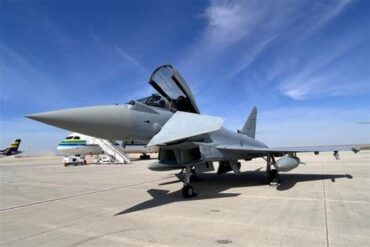
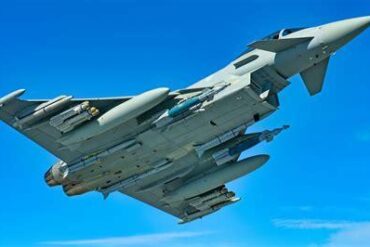
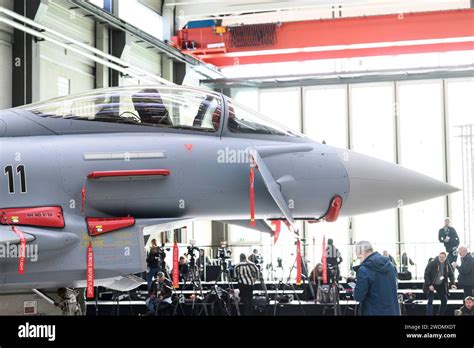
The Eurofighter Typhoon, with its canard-delta wing design, twin EJ200 turbofan engines, and swing-role capabilities, remains one of the most agile and versatile platforms in Europe’s military inventory. It serves as a key pillar for air dominance, strike missions, and multi-domain integration, capable of operating with a wide range of munitions including:
- Meteor and AMRAAM for beyond-visual-range air combat
- IRIS-T and ASRAAM for short-range interception
- Brimstone missiles, Storm Shadow cruise missiles, and Paveway laser-guided bombs for air-to-ground precision strikes
With systems such as PIRATE IRST, Captor-M radar, and Praetorian defensive aids, the Typhoon delivers exceptional situational awareness and survivability. The platform supports Link 16 datalink operations, enabling networked warfare across NATO and allied forces.
Upgrades currently underway include:
- Phase 1 Enhancement Package (P1Eb): Advanced targeting and strike capabilities
- Project Centurion: Multirole enhancements aligning RAF capabilities with F-35 interoperability
- Human-machine interface improvements: Helmet-mounted display, wide-angle HUD, voice command
Export Opportunities and Geopolitical Tensions
A crucial element behind the decision to increase output is the consortium’s growing export pipeline. Eurofighter GmbH projects 150–200 additional sales between 2023 and 2025, with PwC’s April 2024 report outlining 287 potential units, including 213 to non-consortium buyers. Export targets include:
- Saudi Arabia: Potential 60-unit follow-on order
- Qatar: Possible expansion by 12 aircraft beyond current deliveries
- Austria, Greece, Poland, and Portugal: In various stages of evaluation and bidding
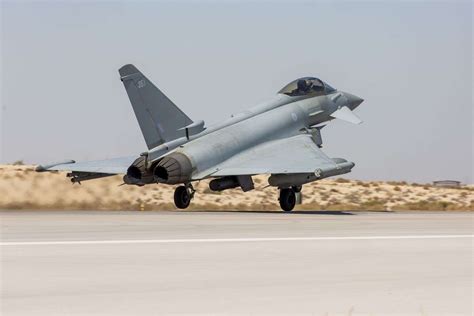
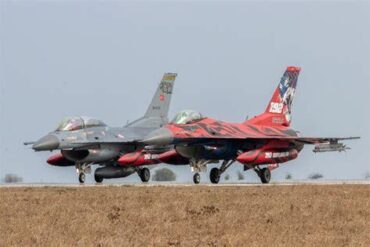
However, export expansion has not been without complications. Turkey, which submitted a request for 40 Typhoons, received initial authorization in 2024. Yet in April 2025, the German government exercised its veto power, citing political concerns over Ankara’s internal affairs and strained bilateral relations. The blockage of the Turkish sale underscores how intergovernmental politics continue to shape the jet’s international reach.
Preparing the Supply Chain for Expansion
To accommodate a ramp-up to 30 aircraft annually, the production ecosystem must undergo a synchronized transformation. The consortium operates four final assembly lines:
- Warton, United Kingdom
- Manching, Germany
- Turin, Italy
- Getafe, Spain
These sites are supported by a modular production model, allowing each nation to manufacture common components for use across all assembly centers. Coordination is now intensifying with key suppliers such as:
- EuroJet Turbo GmbH: EJ200 engine production
- Leonardo and Hensoldt: Radar and avionics systems
The goal is to ensure supply chain resilience, minimize delays, and guarantee on-time deliveries for both domestic and export customers. This also includes ramping up logistics, testing, and quality assurance capabilities.
Bridging the Gap to Sixth-Generation Fighters
Europe’s Typhoon expansion is not just a military or economic necessity—it is also a strategic hedge. The sixth-generation Global Combat Air Programme (GCAP), jointly developed by the UK, Italy, and Japan, is expected to become operational by 2035. Until then, the Eurofighter serves as both the workhorse and technological stepping stone for European air forces.
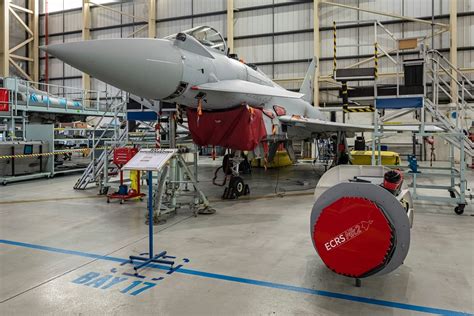
To ensure this transition, the UK Ministry of Defence in 2024 allocated £204.6 million to develop the ECRS Mk2 radar, a powerful electronic warfare and air-to-air sensor suite. Integration into Typhoon fleets is scheduled to start in 2028, ensuring that:
- Typhoons remain combat-relevant until GCAP maturity
- Radar/avionics suppliers stay active and invested
- Aerospace engineering and R&D communities retain skills
A Renewed Pillar of European Defense Strategy
As nations across NATO and Europe confront heightened security challenges, the decision to accelerate Eurofighter production confirms that the platform is far from obsolete. Instead, it is undergoing a renaissance, bolstered by financial investments, government backing, and strategic foresight.
Germany, Spain, and Italy have committed to the Typhoon not only as a frontline aircraft but also as a bridge capability linking current operations to next-generation ambitions. The production surge supports modernization, interoperability, and industrial continuity—ensuring that Europe remains a credible military power in the skies.
Whether production will eventually reach the 30-unit annual ceiling depends on the outcome of pending export bids, resolution of political roadblocks, and successful supply chain scaling. However, the foundation is now firmly set. With multiple lines humming across four nations and new orders secured until the 2030s, the Eurofighter Typhoon’s second life has taken off at full throttle.