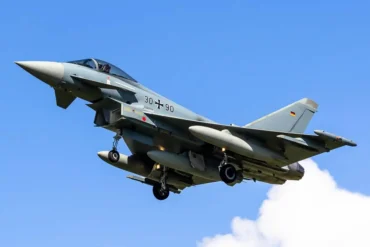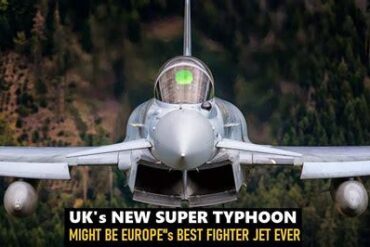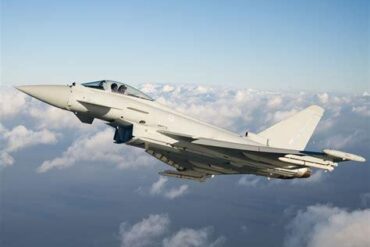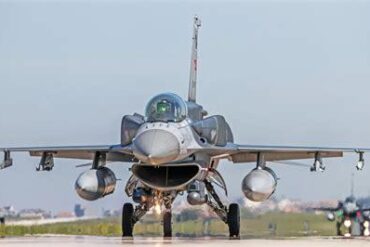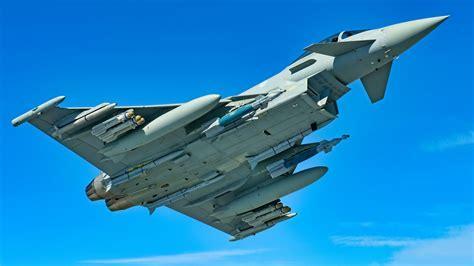
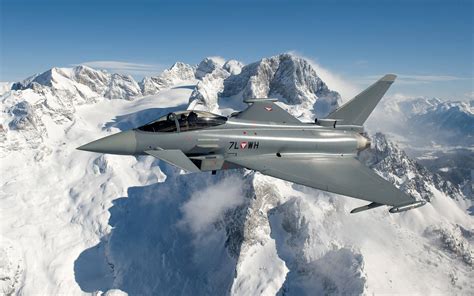
Europe’s skies are stirring once again. As the United States’ F-35 Lightning II continues to dominate headlines and defense budgets, a new contender is emerging from across the Atlantic — one that carries both nostalgia and defiance in its afterburners. The Eurofighter Typhoon, once dismissed as a proud relic of 4th-generation engineering, is undergoing a renaissance. Its ambitious Mid-Life Upgrade (MLU) program is transforming it into what many are already calling the “Super Typhoon” — a reimagined, hyperconnected European warbird ready to challenge American dominance and secure Europe’s aerial independence.
A Bold New Direction: Europe Redefines Its Air Power
The shift from the Long Term Evolution (LTE) roadmap to the MLU strategy marks a profound reorientation in how Europe envisions its aerial defense. Gone are the days of slow, cumbersome block upgrades. Instead, the new MLU approach introduces incremental retrofits designed for agility — updating computing, avionics, and electronic warfare suites at a rapid pace. This change signals more than just a technical evolution; it’s a statement of intent.
The goal is simple but revolutionary: to turn every Typhoon into a networked combat node capable of fusing battlefield data with drones, satellites, and allied aircraft in real time. Think of it as giving an already nimble predator the digital brain of a sixth-generation jet — without having to build one from scratch.
Behind this transformation stands Jorge Tamarit Degenhardy, Eurofighter’s CEO, who unveiled the MLU initiative at the 2025 Paris Air Show. His message resonated across European capitals increasingly wary of overdependence on U.S. systems. The Typhoon’s revival is now part of a continental strategy — a steppingstone to the Future Combat Air System (FCAS), Europe’s ambitious sixth-generation fighter program.
The Strategic Shift: From Dependence to Autonomy
Europe’s relationship with the F-35 has always been complicated — a blend of admiration, necessity, and faint resentment. While the stealthy American fighter offers unmatched capabilities, it also comes with limitations that sting European pride. Supply chain bottlenecks, maintenance costs, and data-sharing restrictions have all fueled a growing sentiment: Europe needs to fly on its own wings again.
Now, with the Super Typhoon, that vision is beginning to take shape. Countries like Germany, Spain, and Italy — the original consortium members — are rallying around the MLU project. Even traditional U.S. allies are reconsidering procurement decisions. Some nations have quietly slowed or paused F-35 orders to reassess their long-term strategic independence.
The Eurofighter’s appeal lies not only in performance but also in sovereignty — the ability to upgrade, adapt, and deploy without waiting for Washington’s permission slip.
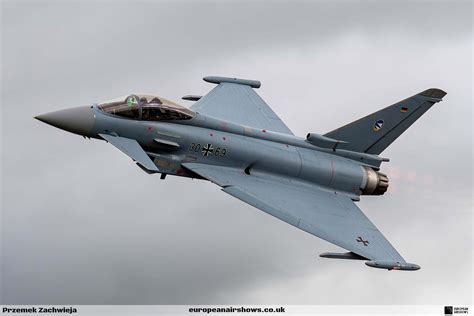
Inside the Super Typhoon: Engineering the Evolution
So, what’s under the hood of this reborn fighter? The MLU blueprint aims to overhaul nearly every critical system onboard:
- Computing & Mission Architecture: Brand-new modular processors designed to handle exponentially greater data loads.
- Avionics & Cockpit Systems: Upgraded displays and user interfaces optimized for real-time data fusion and drone coordination.
- Electronic Warfare Suite: A reimagined defensive system with advanced radar jamming and countermeasure capabilities.
- Sensor Fusion & Networking: The ability to integrate with both manned and unmanned platforms, including FCAS “loyal wingman” drones.
In short, the MLU Typhoon isn’t just keeping up with the F-35 — it’s learning to think like one.
A Platform with Proven Pedigree
The Eurofighter Typhoon’s legacy is already impressive. Developed through a partnership between the U.K., Germany, Italy, and Spain, it made its first flight in 1994 and entered service in the 2000s. Over 700 aircraft have been produced, and it remains a cornerstone of European air defense.
Its aerodynamic design — with canards, delta wings, and thrust-vectoring agility — ensures superb maneuverability. Although it lacks stealth, its sheer performance, acceleration, and radar capabilities keep it formidable. For all its vintage charm, the Typhoon was born ahead of its time; now, it’s finally catching up to the era it was built for.
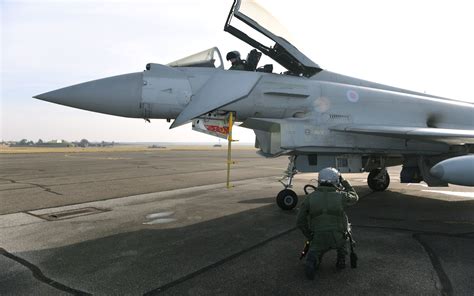
However, aging architecture presented limits. Early mission computers could not handle the massive data flow of modern sensors and networks — a problem the MLU seeks to decisively eliminate. By introducing scalable, open-architecture systems, engineers are future-proofing the Typhoon for continuous software-based enhancements well into the 2050s.
Production, Politics, and the New Air Power Math
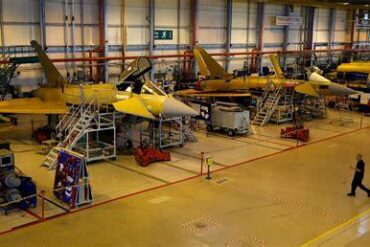
With the MLU gaining traction, Eurofighter plans to boost annual production from around 14 aircraft today to 20 by the late 2020s, and potentially up to 30 as exports grow. This expansion underscores both industrial confidence and political will.
European governments view the Typhoon not merely as a fighter, but as a strategic anchor — a hedge against U.S. unpredictability and a pillar for the continent’s defense industrial base. In an era when supply chains can be weaponized, controlling one’s own fighter production is not just prudent; it’s existential.
Countries such as Austria, Poland, Turkey, Saudi Arabia, and Portugal have shown renewed interest, while Germany and Spain are expanding their fleets. Meanwhile, the U.K., ever the contrarian, continues to hedge its bets — investing heavily in both the F-35 and the homegrown Typhoon while championing the Tempest next-generation program.
The Bridge to the Sixth Generation
The Super Typhoon’s greatest strength may lie in its interoperability with future systems. It is not meant to replace the F-35 or leapfrog to sixth-generation status overnight; rather, it’s the perfect bridge — a modernized 4.5-generation fighter capable of operating seamlessly with drones and stealth platforms.
By embracing open architecture, modular electronics, and continuous upgrades, the MLU Typhoon could remain Europe’s combat backbone well into the 2050s, serving alongside FCAS and Tempest jets once they come online.
A Symbol of Europe’s Technological Reawakening
In many ways, the Super Typhoon is more than a jet — it’s a declaration. It represents Europe’s determination to chart its own course in defense innovation, to compete on merit rather than alliance inertia.
Where the F-35 symbolizes stealth, secrecy, and software lock-ins, the Super Typhoon embodies transparency, adaptability, and freedom — the kind of attributes that once defined Europe’s greatest aviation achievements.
So yes, the F-35 remains a marvel of engineering. But as the Super Eurofighter Typhoon roars back into relevance, it’s a timely reminder that the future of air combat may not belong solely to stealth — it might just belong to smart, sovereign, and beautifully European ingenuity.