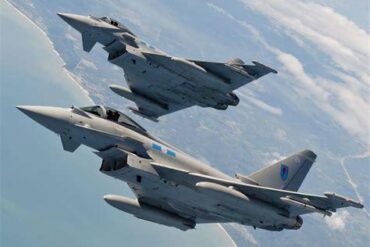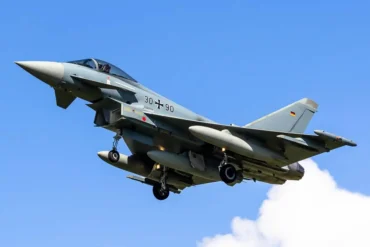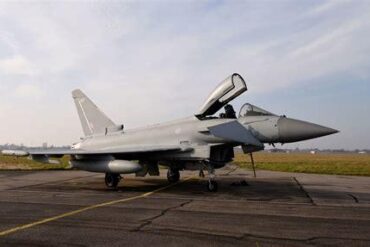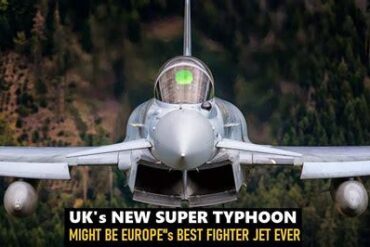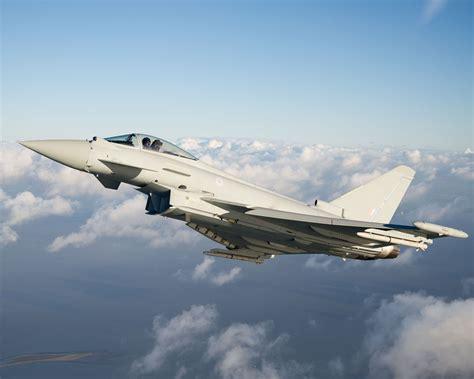
The moment an aircraft program surpasses one million flying hours, it stops being just a platform and becomes an institution. That threshold represents decades of trust, thousands of aircrew, millions of maintenance actions, and an uninterrupted chain of operational relevance that few combat aircraft ever achieve. As 2026 began, the Eurofighter Typhoon quietly crossed that rare milestone, joining an elite club occupied by only the most heavily used and most adaptable fighters in modern history.
This achievement carries particular weight because the Typhoon was never designed for a single, narrow mission or a short technological lifespan. Conceived at the tail end of the Cold War, it has lived through the collapse of the Soviet Union, the rise of expeditionary warfare, the emergence of fifth-generation stealth aircraft, and a return to high-intensity state-on-state deterrence. One million flight hours is not an accident of time; it is the cumulative result of an aircraft that keeps being needed.
Unlike milestone announcements driven by nostalgia, this one arrives while the Typhoon is still flying daily operational sorties across Europe and the Middle East. It is still intercepting unidentified aircraft on NATO’s borders, still deploying on overseas missions, and still receiving upgrades that expand what it can do in modern, networked air combat. The million-hour mark is less a victory lap than a sign that the aircraft remains deeply embedded in real-world airpower.
One Million Hours and Why This Number Carries Real Weight
When Eurofighter GmbH confirmed on January 29, 2026 that the global Typhoon fleet had exceeded one million flying hours, the figure immediately stood out for what it implies about reliability, interoperability, and operational tempo. Flight hours are not ceremonial; they represent sorties flown in all weather, under combat conditions, during exercises, and across national boundaries. Each hour reflects systems that worked, maintenance that succeeded, and crews that trusted the aircraft enough to take it airborne again.
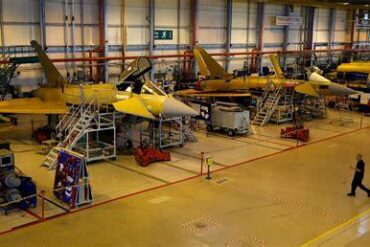
What makes this milestone especially notable is the Typhoon’s multinational structure. Unlike single-nation programs, the aircraft is built and sustained by Airbus, BAE Systems, and Leonardo, then operated by air forces with different doctrines, training pipelines, and logistical systems. Accumulating one million hours under those conditions demonstrates that the platform performs consistently despite national variations in how it is flown and maintained.
Operationally, those hours span a wide spectrum of missions. Typhoons spend countless hours on quick reaction alert duties, launching at short notice to identify or escort aircraft approaching NATO airspace. They conduct extended air-policing deployments in the Baltics, rotate through Middle Eastern bases, and increasingly fly precision strike and electronic warfare sorties. The aircraft is not preserved for special occasions; it is used constantly, and that is precisely why the hour count climbed steadily over three decades.
As Eurofighter Chief Executive Officer Jorge Tamarit-Degenhardt noted, the milestone reflects “three decades of teamwork, innovation, and commitment.” That statement is not corporate flourish. Without continuous upgrades and a stable industrial backbone, flight-hour accumulation slows as aircraft are grounded or replaced. The Typhoon has avoided that fate.
A European Fighter Built for Collective Power Projection
The Eurofighter Typhoon is one of the most ambitious collaborative defense programs Europe has ever attempted. Developed jointly by the United Kingdom, Germany, Italy, and Spain, it was designed not just to meet national requirements but to anchor European airpower as a collective capability. That design philosophy continues to shape how and where the aircraft flies today.
According to Airbus, 617 Typhoons have been delivered, with roughly 610 still in active service. Those aircraft are spread across nine air forces and 38 squadrons, creating a global operational footprint that extends far beyond Europe. In addition to the four core partner nations, the Typhoon is operated by Austria, Saudi Arabia, Oman, Kuwait, and Qatar, with Türkiye actively negotiating a potential acquisition that could further expand the fleet.
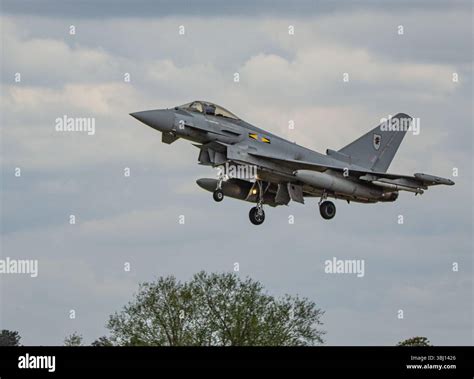
This geographic diversity matters because it exposes the aircraft to radically different operating environments. Typhoons based in northern Europe fly frequent short-notice intercepts in cold, damp conditions. In contrast, Middle Eastern operators conduct long-duration sorties in extreme heat, placing sustained stress on avionics cooling, engines, and airframes. Each environment contributes data that feeds back into upgrades and maintenance practices across the entire fleet.
From RAF Coningsby to Al Udeid Air Base, the Typhoon has proven adaptable to national needs without fragmenting into incompatible variants. Weapons integration, mission software, and sustainment processes must work across all users, and that requirement has quietly driven improvements in reliability and maintainability. The million-hour milestone is therefore as much a triumph of systems engineering as it is of air combat design.
From Air Superiority Specialist to True Swing-Role Workhorse
When the Typhoon was conceived in the late 1980s, its mission was clear and unapologetically focused: defeat advanced Soviet fighters and secure air superiority over Europe. That priority shaped everything from its high thrust-to-weight ratio to its carefree handling and ability to sustain supersonic flight without afterburner. Early in its career, the aircraft’s flight hours were dominated by air-defense sorties and air-combat training.
Over time, however, operational reality reshaped the aircraft’s employment. Modern air forces could no longer afford fleets optimized for single missions. The Typhoon’s transformation into a true swing-role combat aircraft fundamentally altered how often and how intensively it was flown.
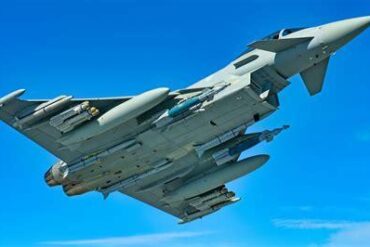
The integration of precision-guided munitions such as Paveway II and IV opened the door to strike missions. Later additions like Storm Shadow and Brimstone extended the aircraft’s reach into deep-strike and close air support roles. These capabilities did more than broaden mission sets; they increased sortie complexity, duration, and frequency.
Typhoon squadrons began launching missions that could shift seamlessly from air-to-air combat to ground attack within the same sortie. That flexibility changed force planning across multiple air forces, reducing dependence on specialized strike aircraft and ensuring the Typhoon was constantly tasked. From a flight-hour perspective, this evolution was decisive. Aircraft that can do more are flown more, and the Typhoon’s expanding role ensured it remained operationally indispensable.
Tranches, Variants, and the Quiet Engine of Longevity
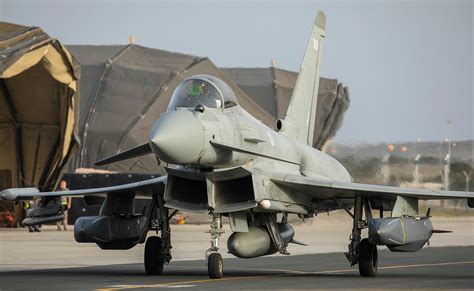
The path to one million flight hours cannot be separated from the Typhoon’s tranche-based evolution. Unlike programs that leap from one block to another, the Typhoon developed incrementally, creating a fleet with layered capabilities. This structure allowed newer aircraft to absorb higher operational demand while earlier variants continued contributing through training and air-defense missions.
Tranche 1 aircraft formed the backbone of early operations, accumulating significant hours through routine air policing and training sorties. While optimized for air-to-air combat, they provided the initial mass needed to establish the fleet’s operational presence.
The arrival of Tranche 2 and Tranche 3 marked a turning point. Enhanced power generation, improved cooling, and more capable mission computers enabled sustained multirole operations. These aircraft became the primary contributors to expeditionary deployments and high-tempo NATO exercises, accelerating the accumulation of flight hours.
More recently, aircraft often referred to as Tranche 4, including those ordered under Germany’s Quadriga and Spain’s Halcon programs, represent the next phase. Built on the Tranche 3 foundation but optimized for advanced sensors and electronic warfare, these jets are designed to exploit capabilities like the ECRS Mk2 AESA radar. They will likely shoulder the most demanding missions in the coming decade, concentrating future flight hours among the most capable airframes.
Training, Exercises, and the Invisible Majority of Flight Hours
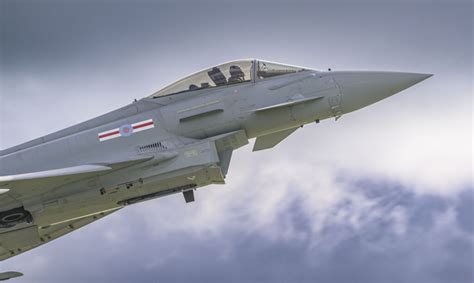
It is tempting to associate high flight-hour totals with combat operations, but the reality is more nuanced. The vast majority of the Typhoon’s million hours were accumulated through training and readiness activities, reflecting NATO’s emphasis on preparedness rather than constant combat.
Typhoon squadrons regularly participate in large-scale exercises such as Red Flag, Arctic Challenge, and the NATO Tiger Meet. These events involve dense flying schedules and complex, multi-domain scenarios that stress both aircraft and crews. Pilots fly multiple sorties per day, often at the limits of endurance, while maintainers turn aircraft around under tight timelines.
Export customers contribute in different but equally demanding ways. Operating smaller fleets, air forces in the Middle East rely on the Typhoon as a primary combat asset rather than one element of a layered force. Longer sortie profiles, persistent regional deterrence, and harsh environmental conditions drive high utilization rates. Together, these models explain how flight hours accumulate steadily even in the absence of constant combat deployments.
Standing Tall in a Fifth-Generation World
The Typhoon’s million-hour milestone arrives in an era increasingly defined by fifth-generation fighters like the F-35. Rather than rendering the Typhoon obsolete, this context has clarified its role. The aircraft excels where agility, payload, and adaptability matter, and it integrates effectively into networked operations alongside stealth platforms.
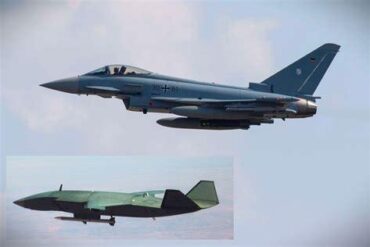
Modern Typhoons increasingly act as sensor nodes, missile carriers, and electronic warfare platforms within a broader battlespace. Upgrades such as enhanced data links and advanced radars allow them to share targeting information and extend the reach of allied forces. In this role, the aircraft’s lack of stealth is offset by its ability to carry large weapon loads and remain on station for extended periods.
The sustained accumulation of flight hours underscores that air forces continue to find real value in this balance. Rather than being sidelined, the Typhoon is being repositioned as a critical component of mixed-generation force structures.
What One Million Hours Signals About the Decades Ahead
Reaching one million flight hours is not an endpoint; it is a checkpoint. Most Typhoon operators plan to keep the aircraft in frontline service well into the 2030s, with structural upgrades and avionics modernization extending its usable life even further. The aircraft’s continued high utilization suggests that the next million hours may arrive faster than the first.
Geopolitical tension across Europe and the Middle East is driving increased air patrols, more frequent exercises, and higher readiness standards. In that environment, platforms that are already proven, widely deployed, and continuously upgraded hold enormous value. The Typhoon fits that profile precisely.
The deeper lesson of the million-hour milestone is that evolution often outperforms replacement. Well-designed fourth-generation aircraft, when paired with modern sensors and weapons, remain potent and flexible. The Eurofighter Typhoon’s journey to one million hours is a testament to design foresight, multinational cooperation, and the enduring importance of adaptability in air combat.
As airpower enters an increasingly complex era, the Typhoon’s story reminds us that longevity is not about resisting change. It is about embracing it, one flight hour at a time.